This shelf holds books that teach you how to read a market — Graham on value, Dalio on debt cycles, Lowenstein on what leverage does to clever people. For Our Posterity teaches none of that, and it is here anyway, because it is the only primary source that predates the thing it explains. A fund called Situational Awareness LP was named after a post on this blog. Anything you want to claim about what its manager believed before he ran money has to be quotable from these fourteen posts rather than remembered.
Reading notes · DR·—
For Our Posterity
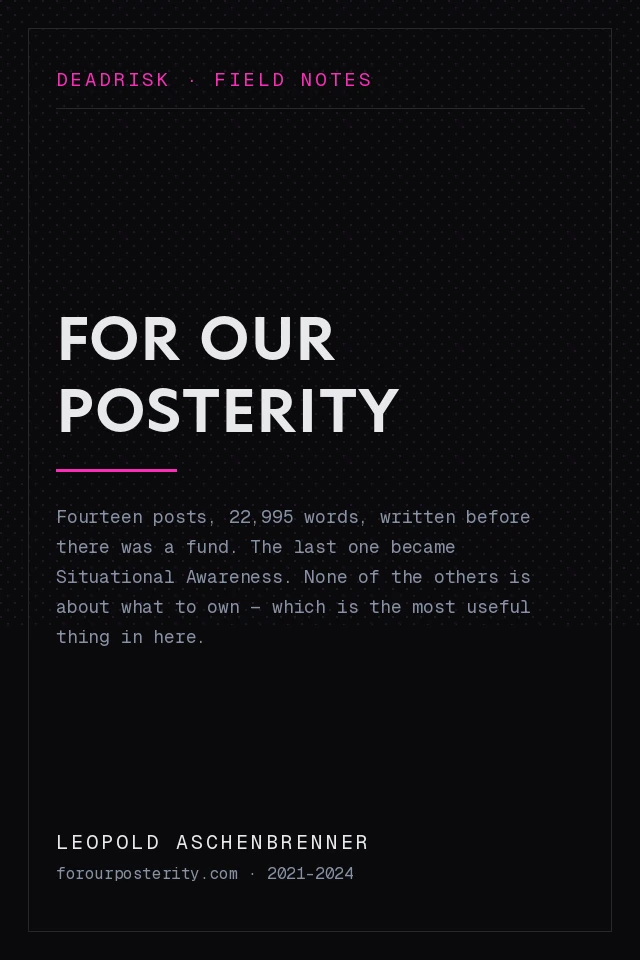
Fourteen posts, 22,995 words, written before there was a fund. The last one became Situational Awareness. None of the others is about what to own — which is the most useful thing in here.
Distilled reading notes — 23 micro-notes across 7 chapters. Buy the book.
Preface: Why a blog is in the library
The corpus is small and we hold all of it: 14 posts, 22,995 words, published between 5 July 2021 and 14 June 2024, retrieved 2026-08-01 with a per-file hash. Four of the fourteen run under 250 words and are announcements rather than essays — two podcasts, a paper, and the landing page of the essay itself. So the real prose is ten posts.
Read it as what it is: a very young person thinking in public, in a tradition (growth economics, longtermism, alignment) with its own vocabulary and its own certainties. The interest for anyone reading the AI trade is not whether he was right. It is that this is the intellectual scaffolding under a book that, at its last public filing, held $3.86bn of long equity, published free, under his own name, two years early.
Chapter 1: Growth, 2021
The blog opens on economics, not intelligence. The first two posts are a reading list and an appreciation of Chad Jones’s papers on economic growth — idea production, population, the arithmetic of how output compounds when ideas get harder to find. This is the substrate of everything he wrote later. Situational Awareness is an argument about orders of magnitude before it is an argument about machines.
“The Economics of Decoupling” (November 2021, 2,715 words) is the most conventionally analytic thing on the site: what it costs to separate two economies that have specialised in each other. It is also the only post here whose subject became a live policy question rather than a forecast waiting to be scored.
What is worth noticing is the scale of the object he is comfortable reasoning about. Not a company, not a sector — an economy, a century, a civilisation. It is the habit that gives the essay its power. Whether it also explains a long book whose top six names were 84.8% of it is a connection worth holding loosely: the writing and the portfolio are separated by three years and a job.
Chapter 2: Burkean Longtermism, 2021
The longest post of the early period (3,173 words) argues for caring about the far future by way of Edmund Burke rather than by way of expected-value arithmetic — society as a partnership between the living, the dead and the unborn, obligations inherited rather than calculated.
It is a conservative argument in a movement that mostly does not make conservative arguments, and it is where the site’s name comes from. It also contains all three of the blog’s uses of the word “stock” — every one of them inside a quotation from Burke, about the private stock of reason a man is born with. That is not a joke at his expense; it is the plainest available measure of what this blog is about.
Chapter 3: Three days in March 2023
Five posts appear on 27 and 29 March 2023. The site goes from an occasional growth-economics blog to an alignment blog in seventy-two hours. The two substantial ones are “Nobody’s on the ball on AGI alignment” (4,084 words — the longest thing here) and “Want to win the AGI race? Solve alignment” (1,665 words).
The argument of the first is a labour-supply argument: that the number of people doing serious technical safety work is small, countable, and much smaller than the public conversation implies. The argument of the second is that safety is not a tax on capability but a precondition for deploying it — the case he would later be fired from OpenAI while making.
“Europe’s Political Stupor” lands the same week, and it is a different register entirely: a young European’s frustration with a continent he reads as having opted out. Taken together the three posts are the moment the blog acquires urgency. Everything before is analysis; everything after is argument.
Chapter 4: The one sentence about buying anything
On 6 April 2023 he replies to Tyler Cowen, who had argued that people warning about AI risk should be judged by whether they put money behind the warning. The reply lists researchers who take the risk seriously and then answers the challenge:
“And before you ask, ‘did they actually bet on the market’—yes, many I know did, e.g. buy NVDA when it was many multiples below the current price.”
That is the only time a ticker appears anywhere in the archive — three years of writing, from July 2021 to June 2024. Read it carefully: it is not advice and it is not about him. It is other people, offered as evidence that they meant what they said. Anyone quoting it as a recommendation is quoting it wrongly.
It is still worth knowing, because of what the filings then show. Across all six 13Fs the fund ever filed, Nvidia appears as a long position exactly once, at 2,855 shares — about half a million dollars — and its last filing before its worst month carried puts referencing $1.57bn of the stock. Six quarter-end photographs cannot tell you what was held between them, and a 13F reports no short sales at all; what they establish is what was reportable on six dates. The record of that is on the fund’s page and read at length in the ninety days.
Chapter 5: The silence, and then the essay
After April 2023 the blog effectively stops. Two stubs — a paper announcement in December 2023, a podcast in June 2024 — and then, on 14 June 2024, a 477-word post whose job is to point at something else: Situational Awareness: The Decade Ahead, fifty thousand words, published the same day.
Between those two dates he was hired by OpenAI, worked on the Superalignment team, and was dismissed in April 2024 over an alleged leak. None of that appears on the blog. The fourteen months of silence are the most consequential period in the record and the site says nothing about them.
So the blog’s shape is: three years of thinking, a burst of alarm, a long silence, and then the document. It is not the arc of someone building toward a fund. It is the arc of someone building toward an argument, who then had to decide what to do about having made it.
Chapter 6: What is not in here
Across 22,995 words: no post about position sizing. None about drawdown. None about what leverage does to a concentrated book. The words “portfolio”, “equity”, “equities”, “valuation” and “hedge” do not appear at all. “Market” appears twice, one of those inside the phrase “market structure” in a summary of an economics paper.
The counting has a caveat worth stating, because it is the kind that flatters whoever does not state it. These are counts over the archived prose with the site’s own navigation and sharing furniture stripped out; leave that in and the word “share” alone goes from three to seventy-three. That is what this sort of counting looks like when nobody checks it.
The finding is not hypocrisy, and reading it that way makes it smaller than it is. A person is allowed to learn, and running money teaches things writing does not. The finding is narrower and stranger: the archive contains no stated view on any of the questions running a book requires you to answer — not position sizing, not leverage, not hedging, not valuation. That is a fact about the text. What he privately thought, it cannot reach.
Both the blog and the essay are arguments about what will be built. Neither is an argument about what to own, and those are different questions with different answers: an industry can be transformative and its listed suppliers can still be badly priced. The filings show a book whose six largest positions were 84.8% of its long equity and whose puts, one quarter later, referenced 219% of it. Whether the second question had been settled somewhere private, the record cannot say — only that it was never settled here.
Which is the reason this sits in the library rather than in a news piece. It is a worked example of the most expensive mistake available to a well-informed person: being right about the world and treating that as though it settled what to buy.
Distilled reading notes for study — not a substitute for the book. Buy
For Our Posterity by Leopold Aschenbrenner. More notes on the
shelf; the lenses built from them are at
thinkers. DeadRisk is coverage intelligence,
not investment advice — methodology.