The argument
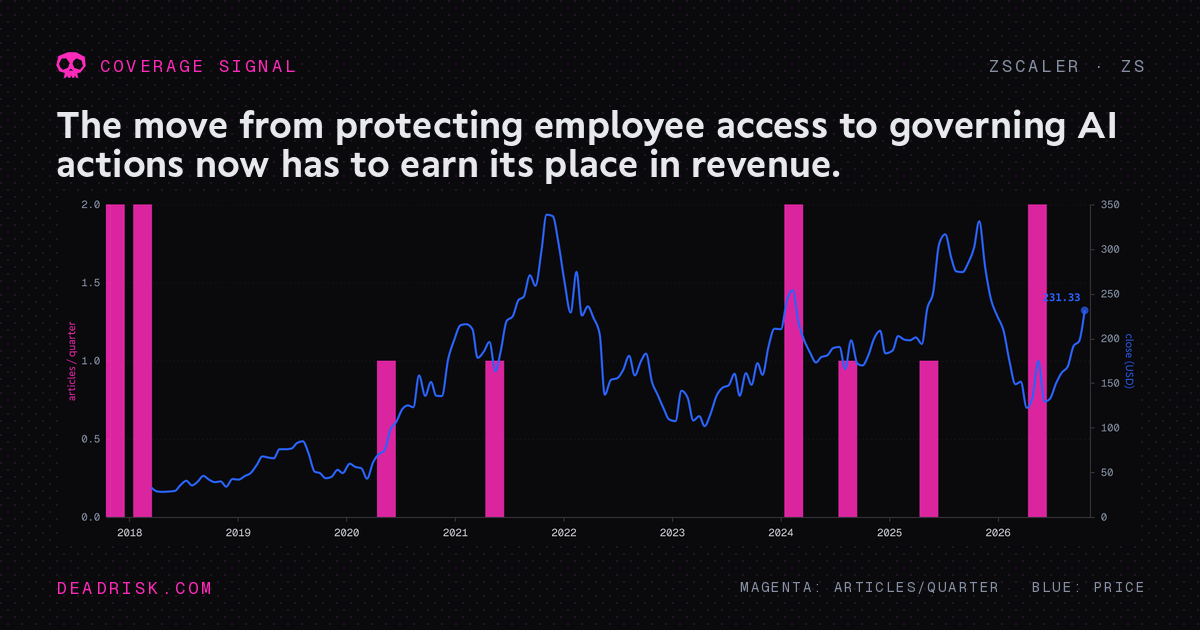
The tape · quarterly coverage amplitude · live quarter blinking
Zscaler’s next test is whether security can grow beyond the number of employees a customer has. Its September financial update describes a business that now protects users, workloads, branches and agents. The practical claim is that software should check each connection to an application, rather than admit a user or agent to a broad network. AI extends that task: a single employee may set many agents to work, and each can make repeated calls to tools and data. Revenue must follow those actions for the new market to matter.
There is evidence of that shift. Zscaler’s fiscal 2026 shareholder letter says metered products outside its seat-based model supplied about 30% of new and expansion annual contract value. Annual recurring revenue tied to those products more than doubled. This measures contracts, not each quarter’s recognized revenue. It nevertheless gives the product story a test beyond launch announcements: can customers expand spending through more protected traffic and workloads as well as more people?
The latest results set a firm baseline. In the quarter ended July 31, 2026, revenue reached $898.2 million, up 25% from a year earlier. Annual recurring revenue, or ARR, reached $3.771 billion, also up 25%. Red Canary contributed to both. Excluding that acquisition, ending ARR grew 20%, and new ARR added during the quarter grew 17%. The distinction matters: a larger platform can grow through purchases while demand for its existing products follows a slower path.

The earlier record centers on buying tools that expand the scope of protection. Cloudneeti in April 2020 added cloud-configuration security. Smokescreen in May 2021 brought deception technology. Avalor in March 2024 added a security-data business in a $350 million deal. Those transactions made the company’s direction broader than protecting a browser session. They also make it necessary to ask which capabilities Zscaler built, which it bought, and how well customers use them together.
The Red Canary agreement in May 2025 extended that arc into managed detection and response. By the July 2026 year-end, Red Canary supplied $144 million of annual revenue and $141 million of ending ARR, according to the company’s results. Full-year reported revenue grew 25% to $3.353 billion; excluding Red Canary, it grew 20% to $3.209 billion. Both figures belong in the record. Treating all reported growth as demand created by fresh products would overstate the change.
AI security now provides a more direct product test. Zscaler made AI Guard generally available in January 2026. The product inspects prompts and responses, blocks attacks such as prompt injection, and enforces company rules on data and content. Its red-team tools can test an application, then use the results to help set guardrail policies. That joins testing with enforcement rather than leaving a list of defects for another team to resolve.
The June agent-security announcements extended the plan to agent communications, endpoint activity and the links between identities and data. Availability still limits what can be inferred. At the September results, Zero Trust Exchange for Agents and Endpoint AI Security remained in early access; the company expected them to scale in the second half of fiscal 2027. They should not be counted as mature products already driving the reported year.

The spectrogram
Signal decomposition · what the record is made of, by quarter · brightness = share of edges · drift = how far the story moved in meaning
In 2024Q1 the record was 100% acquisition; by 2025Q2 it is 100% acquisition. A price chart shows what a name did; the spectrogram shows what its story is made of.
The brains
Panel not seated
Fewer than the full panel of lenses have read this name. The gauge shows n/3 until it fills.
The machine
The October 22, 2026 TEXXR pull returned 17 Zscaler edges across 11 distinct first-seen dates. The same-day CoreWeave pull returned 291 total edges, including one undated, across 103 distinct first-seen dates. These count extracted relationships and the dates they first appeared, not unique stories or customers. Zscaler’s record is thin beside that comparator, and several rows describe the same event. Six edges on May 26–27, 2026, concern revenue, guidance and the market response to one earnings report. The two Reuters corpus records point to the same original report.
That concentration is useful context for the May earnings coverage. The report paired a revenue beat with a weaker forward forecast. The graph therefore records a conflict between current delivery and expected growth, rather than six independent signs of trouble. Likewise, the two Avalor edges dated March 14–15, 2024 describe one acquisition. A row count without that reading would exaggerate how often the business changed.
The broader connection is to cyber resilience: limiting what a compromised identity can reach, then finding and containing damage. Zscaler’s role differs from Rubrik’s recovery focus. Access policy can restrict an agent before a tool call; recovery software addresses the harm after an allowed or missed action. The overlap creates room for integration, but it also creates competition for the same security budget. The product boundary, rather than the shared AI label, is the useful distinction.
The money

Currency: USD. Revenue/net income/capex/FCF cross-checked against filed XBRL.

The record
The next fiscal reports should show whether organic demand holds as acquisition comparisons change. Zscaler’s fiscal 2027 forecast calls for revenue of $3.908 billion to $3.938 billion, growth of roughly 17%, and ARR of $4.396 billion to $4.426 billion. New ARR, the pace of large-customer expansion and the contribution from metered products will help explain any gap between that outlook and the broader AI-security narrative.
A second test is the conversion of launches into durable sales. The September shareholder letter reports Security for AI bookings growing more than 50% from the prior quarter. It defines bookings as commitments over the full contract term. That is useful evidence of demand, but it does not establish an equivalent rise in recurring annual sales. Dated general-availability notices for the two early-access agent products, followed by revenue or ARR disclosure, would make the claim stronger.
Cash costs deserve the same attention. Fiscal 2026 free cash flow was $779.1 million, or 23% of revenue. Stock compensation was $821.9 million. Fourth-quarter cash flow fell as equipment and internal-software spending rose. The observable question is whether expansion supports both the network it needs and the shares it issues to employees. Revenue velocity alone cannot answer that.
| Quarter | Articles | QoQ | Q-end price | QoQ | The record reads |
|---|---|---|---|---|---|
| 2017Q4 | 2 | — | — | — | first quarter on record |
| 2018Q1 | 2 | +0% | 28.07 USD | — | attention held |
| 2020Q2 | 1 | -50% | 109.50 USD | +290.1% | attention cooled as price rose |
| 2021Q2 | 1 | +0% | 216.06 USD | +97.3% | price rose, attention steady |
| 2024Q1 | 2 | +100% | 192.63 USD | -10.8% | attention rose as price fell |
| 2024Q3 | 1 | -50% | 170.94 USD | -11.3% | attention and price fell together |
| 2025Q2 | 1 | +0% | 313.94 USD | +83.7% | price rose, attention steady |
| 2026Q2 | 2 | +100% | 141.15 USD | -55.0% | attention rose as price fell |
Sources
- Zscaler Q4 and FY2026 results — Zscaler, September 3, 2026 → original release.
- Q4 fiscal 2026 shareholder letter — Zscaler, September 3, 2026 → original letter.
- Accelerating AI Initiatives with Zero Trust — Zscaler, January 27, 2026 → original product note.
- New product innovations to secure agentic AI — Zscaler, June 9, 2026 → original release.
- Zscaler sees downbeat quarterly revenue — Reuters, May 26, 2026; corpus records May 26–27 → original report, TEXXR May 26, TEXXR May 27.
- Zscaler agrees to acquire Red Canary — CyberScoop, May 28, 2025 → original report, TEXXR.
- Zscaler buys Avalor — Globes, March 14–15, 2024 corpus dates → original report, TEXXR March 14, TEXXR March 15.
- Smokescreen acquisition and earnings — ZDNet, May 27, 2021 → original report, TEXXR.
- Cloudneeti acquisition — SiliconANGLE, April 9, 2020; corpus April 10 → original report, TEXXR.
- TEXXR entity and edge pulls, October 22, 2026: Zscaler 17 edges/11 first-seen dates; CoreWeave 291 total edges, including one undated, across 103 distinct first-seen dates. Counts refer to returned graph rows, before story deduplication.