The argument
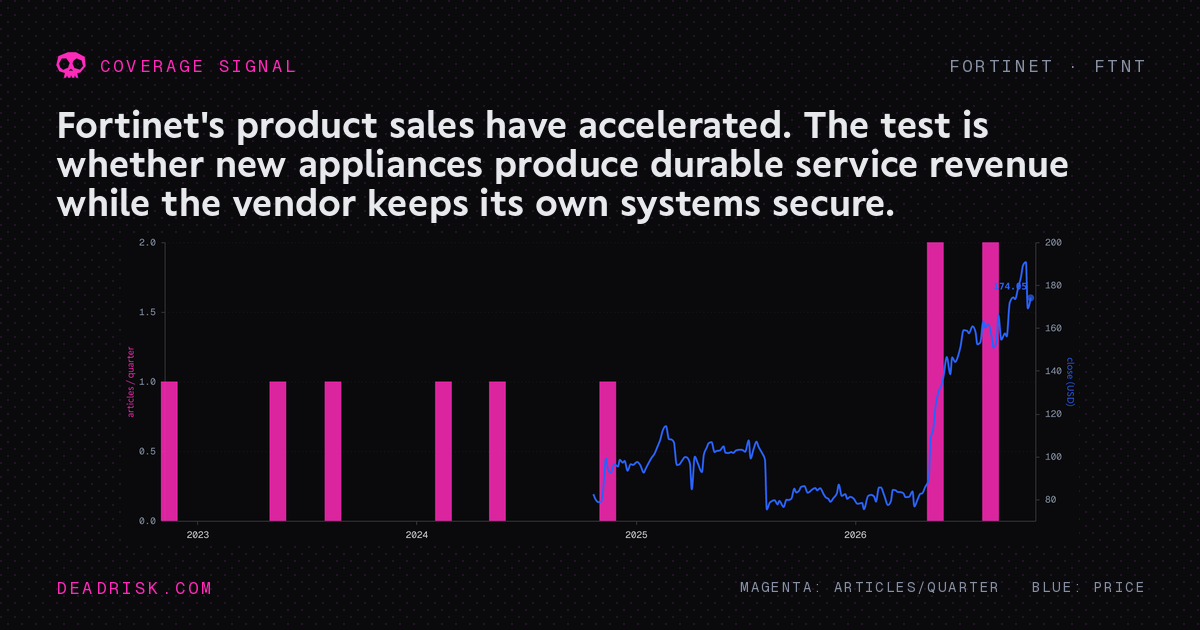
The tape · quarterly coverage amplitude · live quarter blinking
Fortinet brings chip design into the cyber resilience story. Its equipment inspects traffic, and the company sells services around that installed equipment. This makes the business different from a software subscription whose main constraint is a sales team. Hardware performance, replacement timing and service attachment all matter. A faster appliance can lower the cost of inspecting traffic, but the financial benefit depends on what customers pay and keep paying.
The second-quarter release, published July 29, reports revenue growth of 26%, with product sales up 52% and service revenue up 14%. Those rates describe different parts of the business. A strong equipment quarter can precede more service revenue; it does not establish that all of the business has reached the equipment growth rate. The gap between product and service growth is the question this dossier will track.
Fortinet also reported a 34% GAAP operating margin. That gives its product cycle a different financial base from a vendor still funding growth through large operating losses. It does not settle valuation. Profitability, growth and the price of the shares remain three separate questions. The coverage argument rests on the operating transition and its risks.

TEXXR’s October 22 query returned 16 Fortinet edges across 12 distinct first-seen dates, compared with 291 total CoreWeave edges, including one undated, across 103 distinct first-seen dates, using the same endpoint and a 500-edge limit. Neither result reached that limit. This is a much smaller record than the compute story it sits beside. It is also broader than one announcement. The count measures extracted relationships, not independent investigations or customers.
Read those relationships before treating them as momentum. Three October 2024 edges describe different aspects of one FortiManager disclosure: the flaw, its exploitation, and the timing of customer warnings. The June 2026 cache contains two dated entries that point to the same VPN-credential report. Counting them as separate failures would exaggerate the evidence. Counting their repeated appearance as product demand would reverse its meaning. The cached records establish what the coverage discussed, not a sales forecast.
The July 21 event changes the subject. Fortinet and Intel announced development of SP6, a future security processor. That is a concrete engineering agreement with a named partner. It is not proof that SP6 has shipped, won a particular customer, or contributed to the reported quarter. The link to Intel’s dossier matters because one contract creates two different questions: manufacturing work for Intel and product economics for Fortinet.
The evidence of present product activity comes from a different source. July’s results list the FortiGate 1200G with FortiSASE Outpost, FortiSOC and an expanded FortiEndpoint. These launches address enforcement, security operations and endpoint controls. Their presence in one release shows product breadth. It does not disclose the standalone revenue or retention of each product. The quarter’s sales growth supports the broader commercial picture; attributing it to any one launch would require more detail than the release provides.
The sequence suggests a useful distinction for future coverage. The company can gain attention for an attack, an appliance launch, a chip agreement or earnings. Those events have different effects on customer trust and cash generation. A graph that groups them under one cyber theme still needs an analyst to explain which claim each event can support.

The spectrogram
Signal decomposition · what the record is made of, by quarter · brightness = share of edges · drift = how far the story moved in meaning
In 2024Q2 the record was 100% acquisition; by 2024Q4 it is 100% controversy. A price chart shows what a name did; the spectrogram shows what its story is made of.
The brains
Panel not seated
Fewer than the full panel of lenses have read this name. The gauge shows n/3 until it fills.
The machine
The most useful connection is between the cost of inspecting traffic and the cost of maintaining trust. Fortinet’s SP6 announcement argues that custom processors improve performance and efficiency. That is the vendor’s design thesis. To become an economic advantage, it must survive customer pricing, support expense, competing products and replacement cycles.
Hamilton Helmer’s framework supplies a test rather than an answer. A cheaper way to perform a security task can support a cost advantage. An installed base can support switching costs. Neither follows automatically from owning chip designs or having customers. If price competition gives the savings back, the buyer receives the advantage. If customers replace appliances without keeping services, installation does not become durable revenue.
The vulnerability coverage belongs in the same analysis. The corpus shows that security equipment itself can become the subject of security reporting. That creates a question about patch delivery and customer operations as well as product design. The dated record sets a standing test: whether operational trust keeps pace with product expansion.
The comparison with Zscaler is therefore about where enforcement runs and how customers pay for it. The comparison with Rubrik is about what customers need after prevention fails. These are different tasks within a security budget. Grouping the companies together does not make their revenue interchangeable.
The money

Currency: USD. Revenue/net income/capex/FCF cross-checked against filed XBRL.

The record
- At the next quarterly report, compare product growth with service growth. July’s 52% versus 14% split is the dated starting point. A durable improvement should show beyond the equipment sale itself.
- Separate SP6 development milestones from availability and adoption. A manufacturing agreement, a released appliance and customer orders are different stages. Record the date of each when disclosed.
- Track disclosed uptake of FortiSOC and FortiSASE Outpost. Product names establish scope. Paid usage, repeat purchases and service attachment would establish commercial progress.
- Read cash conversion over several quarters. July reported $966 million of quarterly free cash flow. Collection timing and equipment cycles make one quarter a poor substitute for a full-year record.
- Follow product-security disclosures with their patch timelines. Keep related articles together, so a repeated pickup does not become an invented second incident.
| Quarter | Articles | QoQ | Q-end price | QoQ | The record reads |
|---|---|---|---|---|---|
| 2022Q4 | 1 | — | — | — | first quarter on record |
| 2023Q2 | 1 | +0% | — | — | attention held |
| 2023Q3 | 1 | +0% | — | — | attention held |
| 2024Q1 | 1 | +0% | — | — | attention held |
| 2024Q2 | 1 | +0% | — | — | attention held |
| 2024Q4 | 1 | +0% | 94.48 USD | — | attention held |
| 2026Q2 | 2 | +100% | 153.62 USD | +62.6% | attention and price rose together |
| 2026Q3 | 2 | +0% | 178.76 USD | +16.4% | price rose, attention steady |
Sources
- Fortinet, Q2 2026 financial results, July 29, 2026. Primary source for results, listing and launch descriptions.
- Intel and Fortinet, SP6 development agreement, July 21, 2026; TEXXR record.
- FortiManager disclosure coverage, October 24, 2024; original report and TEXXR record. Used to describe the coverage record.
- VPN-credential report, June 17–18, 2026; original report, first record and second record. These entries share one original URL.
- TEXXR entity/profile and hyperedge queries, October 22, 2026: Fortinet 18 indexed articles, 16 returned edges, 12 distinct first-seen dates; CoreWeave 132 articles, 291 total edges including one undated, 103 distinct first-seen dates. Same endpoint, limit 500; neither capped. Edge dates and article counts measure different things.
- Hamilton Helmer, 7 Powers.