The argument
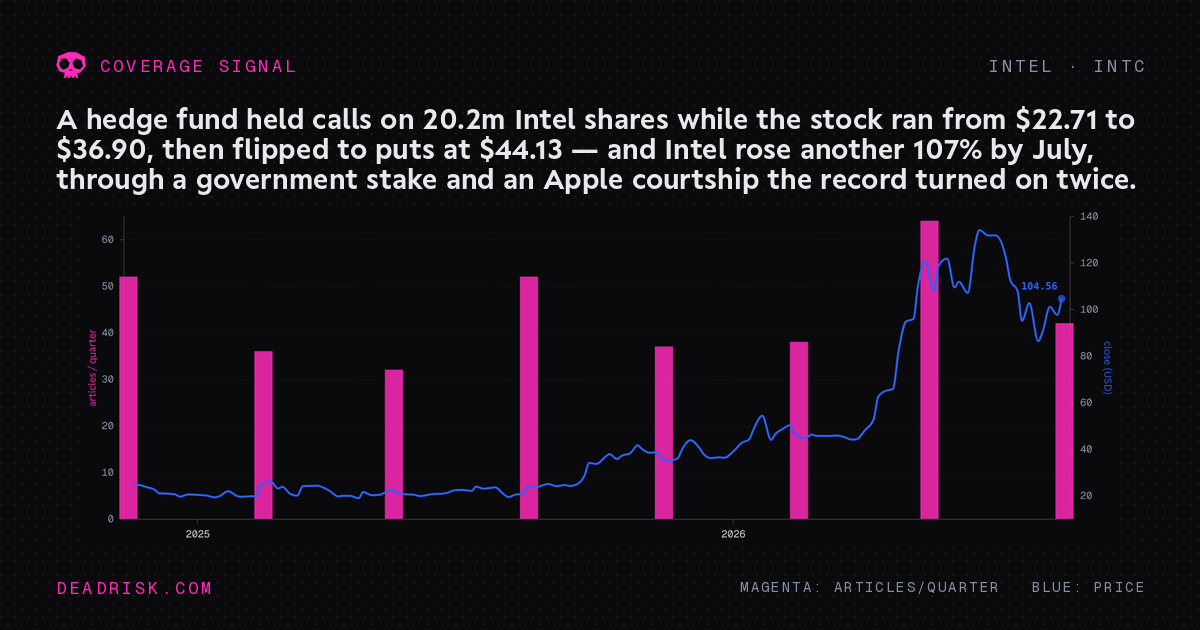
The tape · quarterly coverage amplitude · live quarter blinking
Intel (NASDAQ: INTC) makes the CPUs behind most of the world’s PCs and servers, and it wants to make chips for everyone else too — Intel Foundry, its bet on becoming a contract manufacturer in the business TSMC has cornered. That second ambition is why Intel sits in the AI-capex buildout at all: a decade of missed process nodes turned “can Intel actually build the next thing” into a live question the market re-prices every earnings call.
Situational Awareness LP, the fund Leopold Aschenbrenner runs, reported calls on 20,237,400 Intel shares in its 13F for the quarter ended 31 March 2025 (filed 14 May 2025, source) — valued at $459.6m, the value of the shares those calls referenced at that quarter’s $22.71 close, not a premium paid or capital at risk. A 13F cannot say what a fund paid, or why it holds a position; it discloses a snapshot at quarter-end. It reported that same position, unchanged in share count, at each of the next three quarter-ends, as Intel’s close carried the reported value to $746.8m by 31 December 2025 (filed 11 February 2026). The filings do not say when the calls were opened, why the position later changed, or what else sat in the book alongside it — only what was disclosed at each snapshot date. What they disclose next: the 13F for the quarter ended 31 March 2026 (filed 18 May 2026, source) shows those calls gone, replaced by puts on 3,605,400 shares worth $159.1m at that quarter’s $44.13 close, next to a residual common-stock line of just 202,344 shares. See Situational Awareness LP’s full book for the rest of that fund’s 2026 filings.

Intel’s troubles deepened in the months after that first disclosed position: a $2.9 billion quarterly loss reported in July 2025, and its marquee 18A manufacturing process running at roughly 5% yield that August, according to Reuters sourcing — the process the whole foundry bet depended on. Then the government stepped in: on 23 August 2025, the US took a 10% equity stake in Intel by converting CHIPS Act grants to equity, with Commerce Secretary Howard Lutnick saying the government would not sit on the board. INTC closed up more than 5% that day, at $24.80. Weeks later Nvidia followed with its own stake — a transaction announced in September and executed by SEC filing that December: 214.7 million shares at $23.28 each, about $5 billion. Two of Intel’s largest counterparties in one autumn were the US government and its most dominant competitor, both buying in. That is the first turn the registry’s admission note points to — the coverage record moving from “troubled chipmaker” to “chipmaker somebody just rescued.”
The second turn is commercial, and it shows up in the numbers rather than the politics. Intel’s 18A process finally shipped in volume: the Panther Lake laptop chips it enables reviewed well in January 2026. On 1 April, Intel agreed to pay $14.2 billion to buy back Apollo’s 49% stake in the Fab 34 joint venture in Ireland — taking full ownership of a fab rather than sharing it, funded with new debt — and said it would join the Terafab consortium. Over the nine trading sessions from 31 March to 13 April 2026, Bloomberg reported INTC adding more than $100 billion in value on that news, up 53% and crossing a $300 billion market cap. Three weeks later, on 23 April, Q1 2026 revenue came in up 7% year over year to $13.58 billion, beating estimates and sending INTC up more than 20%; the next session, 24 April, it closed up 23.6%, its best day since October 1987. April closed as the best month in the company’s history on the Nasdaq — up 114%.
Then came the courtship. On 5 May, INTC jumped more than 12% to a new all-time high on a report that Apple had opened early-stage talks with Intel to make chips for its devices in the US — the same CNBC piece that described Intel as going “from commanding the strategic heights of compute infrastructure… to being grateful for some fab work.” On 18 June, President Trump said Apple had agreed to work with Intel to design and build chips in America; the claim was still unconfirmed reporting, but INTC rose 10.64% on it anyway. By 24 July, Q2 2026 revenue landed at $16.1 billion, up 25% year over year and its fastest quarterly growth rate in about 15 years, on what Intel’s own call described as unprecedented demand. There was friction inside the same run — Intel acknowledged “some” shortages of Panther Lake and Wildcat Lake chips that June, the same 18A process the whole comeback rests on, running short of the demand it created. By 30 July, Intel’s as-traded close was $91.13 — up 106.5% from the $44.13 close on 31 March 2026, the quarter-end when Situational Awareness LP’s disclosed calls had turned to disclosed puts. Measured instead from the $22.71 close at the fund’s first disclosed position, 31 March 2025, the stock is up about 301%. Intel’s most recent close on file, 31 July 2026, was $90.20.

The spectrogram
Signal decomposition · what the record is made of, by quarter · brightness = share of edges · drift = how far the story moved in meaning
In 2024Q1 the record was 31% financial; by 2026Q1 it is 41% launch. A price chart shows what a name did; the spectrogram shows what its story is made of.
The brains
Intel’s operating record has improved, but the supplied evidence cannot establish a margin of safety at the $104.47 close on September 8, 2026.
Intel’s 18A recovery shows a product benefit, but the record has not shown a barrier that rivals cannot copy or outscale.
Intel’s one-year rise from $28.76 to $121.78 has given a real operating recovery a price-led comeback story that the record cannot yet separate from buyer recruitment.
The machine
TEXXR’s knowledge graph carries 500 hyperedges touching Intel, and the predicate mix over the two-year edge-arc traces the same turn the price does. In 2025Q3 — the quarter the government stake and Nvidia’s investment both landed — financial edges ran 40% of the quarter’s total, with the graph’s top co-entities that quarter reading Nvidia, U.S. government, United States, Lip-Bu Tan: a company defined by who was propping it up. By 2026Q1, the picture had inverted. Launch edges ran 41% and competitor edges 20% — up from 0% in 2024Q1 — with the leading co-entities AMD, GPUs, the 2nm 18A process, and Core Ultra Series 3 processors: a company defined by what it was shipping and who it was up against. Across that full span, regulatory edges fell 10 percentage points and partnership edges fell 9 as a share of the quarter — but the co-entity network’s Jaccard similarity between 2024Q1 and 2026Q1 is 0.89, high overlap: most of the names tied to Intel two years ago are still tied to it now. What changed is which predicate dominates the record, not who shows up in it.
The money

Currency: USD. Revenue/net income/capex/FCF cross-checked against filed XBRL.

Positioning: how much of INTC is sold short, on the record brokers file twice a month. It lags by design — read it as where the crowd stood, not where it stands.
The record
Signals in the coverage record, not trade ideas:
- Whether 18A yield holds at volume. The same process that shipped Panther Lake to strong reviews in January 2026 was the subject of an acknowledged shortage by June. Whether that is the same yield constraint recurring, or new capacity strain from demand outrunning supply, is not something the record resolves — it is the open question under the whole turnaround.
- Whether the Apple talks turn into a signed deal. Every edge on it so far — the May report, the June Trump statement — is tagged rumored. A confirmed contract, or its absence, is the test of whether the “bidding war” framing survives contact with paperwork.
- The US government’s 10% stake. An equity position in a major public chipmaker is not an ordinary structural feature. Whether Washington’s stake grows, gets sold down, or comes with strings attached is worth tracking on its own, apart from the stock price.
- The competitor-predicate share, which the edge-arc shows moving from zero to a fifth of Intel’s quarterly record in two years. Whether that keeps climbing — Intel covered as a product rival rather than a subsidy case — or reverts is the cleanest read on whether the turn is durable.
- Coverage volume itself. 2026Q1’s 112 edges are the densest quarter in the graph. Whether that holds through the next earnings cycle or falls back, the way a re-rating spike usually does, is worth watching against the price.
| Quarter | Articles | QoQ | Q-end price | QoQ | The record reads |
|---|---|---|---|---|---|
| 2024Q4 | 52 | — | 20.05 USD | — | first quarter on record |
| 2025Q1 | 36 | -31% | 22.71 USD | +13.3% | attention cooled as price rose |
| 2025Q2 | 32 | -11% | 22.40 USD | -1.4% | attention cooled, price flat |
| 2025Q3 | 52 | +62% | 33.55 USD | +49.8% | attention and price rose together |
| 2025Q4 | 37 | -29% | 36.90 USD | +10.0% | attention cooled as price rose |
| 2026Q1 | 38 | +3% | 44.13 USD | +19.6% | price rose, attention steady |
| 2026Q2 | 64 | +68% | 139.63 USD | +216.4% | attention and price rose together |
| 2026Q3 open | 49 | -23% | 116.03 USD | -16.9% | attention and price fell together (quarter in progress) |
The peers
Intel lives or dies by the same constraint as these names — small equal-weighted groups, one constraint each. Not investment products: see all categories.
The silicon everyone else is buying — the compute constraint, 1.9 independent bets across 6 names
Where the chips actually get made — the fabs constraint, 2.1 independent bets across 9 names
Sources
Filings: Situational Awareness LP 13F-HR, period 2025-03-31, filed 2025-05-14 (accession 0002045724-25-000002) — calls on 20,237,400 Intel shares, value $459.6m, matching that quarter’s $22.71 close (not a cost basis or premium paid). Same fund, period 2025-12-31, filed 2026-02-11 (accession 0002045724-26-000002) — same call position, value $746.8m at the $36.90 close. Same fund, period 2026-03-31, filed 2026-05-18 (accession 0002045724-26-000008) — puts on 3,605,400 shares, value $159.1m at the $44.13 close, alongside a residual 202,344-share common position. Source: SEC EDGAR, filer CIK 0002045724.
Prices: as-traded daily closes, data/prices/intc.json (Massive/Polygon grouped daily, adjustment_basis: as_traded), as of 2026-07-31.
Edges: TEXXR knowledge graph, Intel edge profile (500 edges) and edge-arc by quarter, 2024Q1–2026Q1 (queried 2026-08-02): the US government’s 10% stake (79282), its value rising to $36B (389245), Nvidia’s $5B share purchase (236592), the Fab 34 buyback (235904), the $300B+ market cap (263124), the best day since 1987 (389172), the 18A supply shortage (401777), the rumored Apple partnership (403748), and Q2 2026 revenue (408830).