The argument
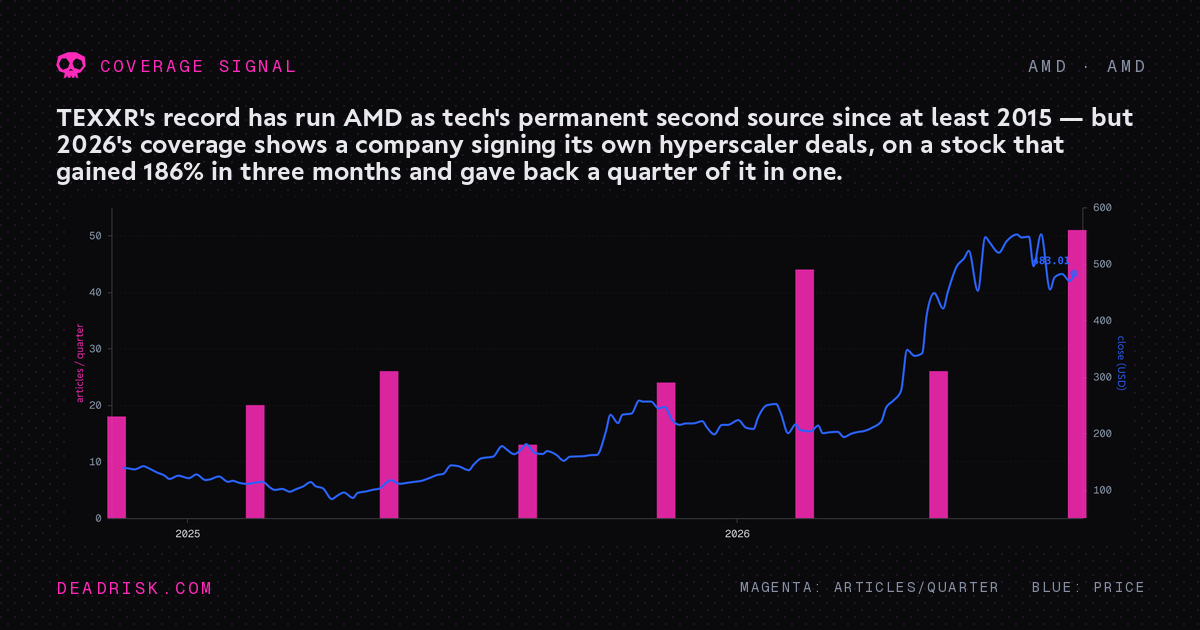
The tape · quarterly coverage amplitude · live quarter blinking
Situational Awareness LP, the fund Leopold Aschenbrenner runs, reported put options on 4,764,100 AMD shares in its 13F for the quarter ended 31 March 2026 (filed 18 May 2026, source) — valued at $969.2 million, the value of the shares those puts referenced at that quarter’s $203.43 close, not a premium paid or capital at risk. The same filing lists a separate long position of 99,138 AMD shares, worth $20.2 million. A 13F cannot say whether the puts were a hedge or an outright bet against the stock, or when either position was opened; it discloses only a snapshot at quarter-end. What happened after that snapshot is checkable: AMD closed at $485.39 on 30 July 2026, so the value of the shares those puts referenced had risen to roughly $2.31 billion — up about 139% in the four months since the quarter’s close. See Situational Awareness LP’s full book for the rest of that fund’s 2026 filings.
AMD (NASDAQ: AMD) is DeadRisk’s second-order name in chips: not a model maker, not a hyperscaler, but the accelerator maker investors treat as the AI buildout’s second bet, alongside Nvidia. TEXXR’s archive carries AMD back to the first quarter of 2015, when the company was telling reporters it couldn’t just be “the cheaper solution” and was betting its future on a new Zen CPU architecture and GPUs built around high-bandwidth memory. Eleven years later, HBM-equipped AI chips are exactly what AMD sells, and the question in that 2015 headline — genuine alternative, or permanent runner-up — is still the one this record is built to test.
AMD’s fiscal 2025 revenue reached $34.64 billion, up 34% from fiscal 2024’s $25.79 billion. Net income rose 164% to $4.34 billion from $1.64 billion; free cash flow rose 180% to $6.74 billion from $2.41 billion. AMD reports its next quarter on 4 August 2026.

The year opened on disappointment. AMD’s fourth-quarter results, reported 4 February 2026, were AMD’s first $10 billion quarter — revenue up 34% year over year to $10.3 billion, Data Center revenue up 39% to $5.4 billion — but a first-quarter guide of $9.8 billion undershot what investors wanted, and the stock dropped more than 15%. Three weeks later the tone flipped: Meta agreed to acquire up to 6GW of AMD Instinct GPUs, AMD’s AI-accelerator chip line, in a deal valued at more than $100 billion, with an option that could see Meta own up to 10% of AMD and deploy its first gigawatt within the year.
The rest of the spring confirmed the turn. AMD’s first-quarter results, 6 May 2026, beat on both lines — revenue up 38% to $10.25 billion, Data Center revenue up 57% to $5.8 billion — and the stock jumped more than 15%, closing above $400 for the first time. Two weeks later AMD pledged more than $10 billion to Taiwan’s chip-packaging ecosystem, with TSMC ramping production of Venice, AMD’s next-generation server-chip line. None of that made AMD immune to the sector’s own weather: on 5 June, Broadcom’s earnings miss dragged US chipmakers down more than $1 trillion in a single session, and AMD fell 10.86%. The stock recovered anyway, closing at $580.91 on 30 June — its 52-week high, and 186% above the March quarter-end mark that Situational Awareness LP’s put referenced.
July compressed a year’s worth of news into three weeks. AMD unveiled Helios — its first rack-scale AI system, a whole server rack of chips sold as one product — built to rival Nvidia’s next-generation Vera Rubin platform, priced at an estimated $5 million-plus per rack and slated to ship later in 2026 to Microsoft, Meta and OpenAI among others. Two days later, AMD and Anthropic signed a server deal worth tens of billions: Anthropic will buy up to 2GW of MI450, AMD’s next flagship AI-accelerator chip, starting in the first half of 2027, and AMD will invest up to $5 billion in Anthropic itself. A week later, Core Scientific and AMD announced a deal for AMD to secure more than 500 megawatts of US data-center capacity starting in 2027, with an option to scale to 2.5 gigawatts. The stock did not celebrate quietly: it fell to a post-peak low of $429.56 on 29 July — down 26% from the June high — as disappointing SK Hynix earnings dragged chip stocks, AMD included, into a broader selloff, before chip stocks rallied on strong Microsoft and Lam Research earnings and AMD closed up 13% on 30 July. A stock that falls 26% one way and rallies 13% the other inside a month is a stock the market has not settled on.

The spectrogram
Signal decomposition · what the record is made of, by quarter · brightness = share of edges · drift = how far the story moved in meaning
In 2024Q1 the record was 29% launch; by 2026Q1 it is 36% financial. A price chart shows what a name did; the spectrogram shows what its story is made of.
The brains
AMD's earnings have strengthened, but the supplied record cannot establish a Graham margin of safety at the September 4 quote.
AMD shows demand and cash-flow growth, but the record has not proved a barrier that turns either into continuing Power.
AMD’s earnings and contracts support the AI story, but its price swings and coverage framing leave buyer-recruitment feedback unproved.
The machine
TEXXR’s most recent 500 tracked AMD edges run financial (28.6%), launch (23.6%) and partnership (21.4%) — nearly three-quarters of the record — with regulatory (7.4%), controversy (4.2%), acquisition (3.8%) and personnel (3.0%) making up most of the rest. Competitor-predicate edges are almost absent: just 1.2%, six edges out of 500. That’s true even though one edge in the record literally labels AMD “the main challenger to Nvidia in the artificial intelligence processor market”, and another groups AMD with Intel against a Nvidia-Qualcomm-MediaTek push into the AI data-center CPU market. The graph the corpus actually extracted is not mostly a rivalry story. It’s a record of AMD signing its own contracts: the Meta GPU commitment that could hand Meta 10% of AMD’s stock, the Anthropic deal that bundles a chip sale with a $5 billion AMD investment into the buyer, a Helios rollout aimed at three hyperscalers simultaneously, and a Core Scientific power deal built to scale five-fold. Whatever “permanent runner-up” means for AMD’s stock, the extracted graph treats 2026’s AMD less as Nvidia’s shadow and more as a company the record’s biggest names are choosing to deal with directly.
The money

Currency: USD. Revenue/net income/capex/FCF cross-checked against filed XBRL.

Positioning: how much of AMD is sold short, on the record brokers file twice a month. It lags by design — read it as where the crowd stood, not where it stands.
The record
Signals in the coverage and filing record, not trade ideas:
- The 4 August earnings print. AMD reports its next quarter two days after this record was compiled. Data Center revenue growth and any update on MI450 shipment timing will move both the stock and the pace of the next quarter’s coverage.
- Whether 2026Q3’s coverage pace holds. 52 articles landed in roughly the first month of the quarter — already ahead of 2026Q1’s 44-article count, the highest full quarter on record. Whether that rate holds through September is a read on whether 2026 was AMD’s inflection or its peak.
- The MI450 and Helios delivery dates. Anthropic’s MI450 shipments are promised from the first half of 2027; Helios is due to hyperscalers “later in 2026.” Large chip-supply promises slip more often than they land on schedule — whether these do is the test of everything built on top of them.
- The Core Scientific option. 500+ megawatts is a lease. 2.5 gigawatts, if AMD exercises the option, is a different company’s worth of power commitment. Whether it gets exercised, and on what timeline, is worth tracking against future filings, not the announcement.
- Whether Meta’s equity option turns into a filing. An option to take up to 10% of AMD would be a multi-billion-dollar stake — the kind that ties a customer’s own balance sheet to the price of the chips it’s buying. A SEC filing making it real, or a report that it lapsed, is the next hard data point.
- The competitor-edge share. At 1.2% of AMD’s graph, rivalry with Nvidia is a minor thread in what the corpus actually extracted, even as press coverage keeps the comparison front and center. Whether that share grows as more head-to-head chip stories land, or stays this thin, says something about whether AMD’s 2026 is genuinely being covered as a two-horse race.
| Quarter | Articles | QoQ | Q-end price | QoQ | The record reads |
|---|---|---|---|---|---|
| 2024Q4 | 18 | — | 120.79 USD | — | first quarter on record |
| 2025Q1 | 20 | +11% | 102.74 USD | -14.9% | attention rose as price fell |
| 2025Q2 | 26 | +30% | 141.90 USD | +38.1% | attention and price rose together |
| 2025Q3 | 13 | -50% | 161.79 USD | +14.0% | attention cooled as price rose |
| 2025Q4 | 24 | +85% | 214.16 USD | +32.4% | attention and price rose together |
| 2026Q1 | 44 | +83% | 203.43 USD | -5.0% | attention rose as price fell |
| 2026Q2 | 26 | -41% | 580.91 USD | +185.6% | attention cooled as price rose |
| 2026Q3 open | 35 | +35% | 630.63 USD | +8.6% | attention and price rose together (quarter in progress) |
The peers
AMD lives or dies by the same constraint as these names — small equal-weighted groups, one constraint each. Not investment products: see all categories.
Sources
Edges: TEXXR knowledge graph, AMD edge profile (500 edges, queried 2026-08-02): the Meta $100B+ GPU deal and its 10%-stake option (98632, 98633), the Q4 revenue and Data Center print (95591, 95592), AMD named “the main challenger to Nvidia” (95570), the Q1 revenue and Data Center beat (390244, 390267), the Taiwan investment (400520), the Anthropic MI450 partnership and $5B investment (408595, 408596), the Helios launch to Microsoft/Meta/OpenAI (408285), the Core Scientific power deal (409296), and the Nvidia-Qualcomm-MediaTek-vs-Intel-AMD competitor edge (406922).