The argument
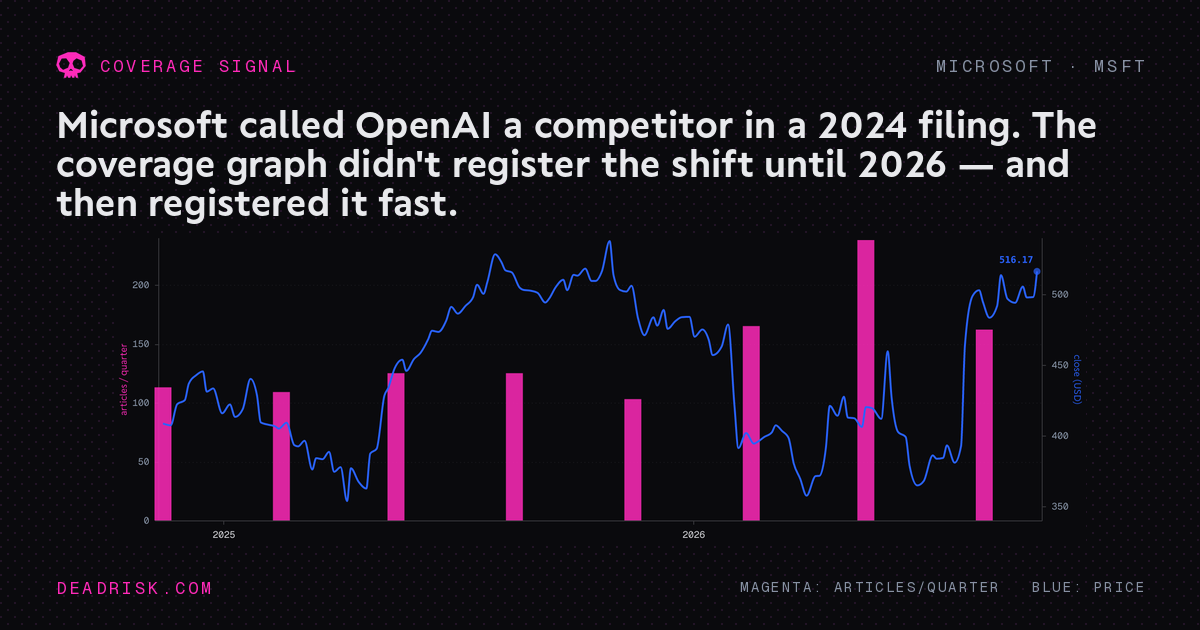
The tape · quarterly coverage amplitude · live quarter blinking
Microsoft (NASDAQ: MSFT) sells cloud infrastructure, productivity software, and Windows. Since 2019 it has also been a major OpenAI backer — by October 2025 a stake of about 27% in a restructured OpenAI Group PBC, valued at roughly $135 billion, giving Microsoft commercial access to a frontier AI lab’s models without building one from scratch.
DeadRisk carries Microsoft as a mag7, big-tech name inside The AI Capex Supercycle — one of the deepest corpora we hold, and not a stock-picking exercise. The number worth reading here isn’t the capex line every hyperscaler now reports each quarter. It’s what Microsoft’s own record says about the company it depends on most: the OpenAI contract was rewritten in October 2025 and again in April 2026, Microsoft started replacing OpenAI’s models with its own inside Excel, Outlook, PowerPoint, and Bing. The paper trail runs earlier: Microsoft’s 2024 annual report had already named OpenAI a competitor.

The filing came first. In its annual report for fiscal 2024, Microsoft added OpenAI as a competitor — alongside its usual search and advertising rivals — days after OpenAI showed off its own SearchGPT prototype. The record barely reacted.
Underneath, the contract strained on terms nobody outside it could see. In June 2025, people familiar told the WSJ, Microsoft was pushing to remove the “AGI clause”, which let OpenAI cut off Microsoft’s access to its most advanced models once its board declared artificial general intelligence reached. In September a non-binding memorandum kept the clause, modified. The same month, The Information reported Microsoft would add Anthropic’s Claude to some Office 365 features after Claude Sonnet 4 beat GPT-5 on some tasks.
The restructuring landed October 28, 2025: Microsoft’s stake was valued at $135 billion, about 27% of OpenAI Group PBC, down from 32.5%, with access to OpenAI’s models through 2032 — including systems built after AGI — while OpenAI won the right to build some products with other partners. The next day the cost showed up on Microsoft’s own income statement: the stake cut $3.1 billion from net income. Three months on, Microsoft rolled out the Maia 200, its second in-house AI chip, on January 26, 2026. Two days later, Microsoft reported Q2 capex up 66% to $37.5 billion — spending above estimates that sent MSFT down 10.0%, from $481.63 to $433.50.
March 2026 compressed the pattern. On the 17th, Microsoft named Jacob Andreou, a 33-year-old former Snap executive, to run a consolidated Copilot team, freeing Mustafa Suleyman to build models. The next day the Financial Times reported that Microsoft was weighing legal action against Amazon and OpenAI over whether AWS could sell an “OpenAI Frontier” product without breaching Microsoft’s agreement: one report, never confirmed. In April, in an internal memo, OpenAI’s revenue chief said the partnership had “limited our ability” to reach clients through AWS’s Bedrock.
Late April brought the second renegotiation: Microsoft agreed to stop paying OpenAI a revenue share, OpenAI won the right to serve products through any cloud (Azure first in line, no longer exclusive), and the amendment removed the AGI clause. Microsoft kept a non-exclusive license to OpenAI’s models through 2032. OpenAI’s payments to Microsoft run through 2030 under a total cap that The Information put at $38 billion, down from a formula that could have reached $135 billion. By July the in-house swap had begun: Bloomberg reported Microsoft was replacing OpenAI and Anthropic models with its own MAI models in Excel and Outlook to cut AI costs, then in PowerPoint and Bing images, where Suleyman put MAI at roughly 85% cheaper to run. On July 29, fiscal Q4 added $480 million of net gains on the OpenAI stake to net income and $3.2 billion on Anthropic; Reuters counted capex up 70%+ to $41 billion, and an accounting change cut the calendar-2026 capex forecast to $175 billion from $190 billion. MSFT rose 15.5% the next session, from $390.54 to $451.10.
Fiscal Q1 2027, reported October 28 after the close, tested that spending against Microsoft’s own plan. Microsoft’s release gave revenue of $92.3 billion, up 19%, and Azure revenue of $33.2 billion, up 48%. Capex including finance leases was $45.2 billion, up from $34.9 billion a year earlier and below Microsoft’s own projection of about $50 billion. Coverage also printed $39.4 billion; that is the cash-flow line for additions to property and equipment, which leaves finance leases out. Free cash flow was $18.6 billion, which is operating cash flow of $58.0 billion less that narrower $39.4 billion. It fell 27% from $25.7 billion a year earlier. The same day, Alphabet reported Cloud up 103% and free cash flow of negative $9.1 billion on $51.4 billion of capex. Microsoft spent less than it planned and stayed cash-positive.
It is still borrowing. On October 29 Microsoft filed a preliminary prospectus supplement (424B2, accession 0001193125-26-437008) to sell notes in ten tranches, two floating-rate and eight fixed. Every amount, rate and maturity is blank, and the filing lists capex, buybacks, acquisitions and repaying debt among the uses. We found no final size. TEXXR holds one unconfirmed report of at least $25 billion (edge #524929, rumored). Debt stood at $35.5 billion on September 30, down from $40.3 billion at June 30. Bloomberg reported on October 26 that Microsoft was offering buyouts to about 60,000 workers, VP level and below, out of 223,000 at the end of June (TEXXR #1297807, 67 records that day); offered, not taken. And Microsoft booked $10 billion of Q1 revenue from OpenAI, nearly 11% of the total (edge #524770), so the rival is also a customer.

The spectrogram
Signal decomposition · what the record is made of, by quarter · brightness = share of edges · drift = how far the story moved in meaning
In 2024Q1 the record was 33% launch; by 2026Q1 it is 37% financial. A price chart shows what a name did; the spectrogram shows what its story is made of.
The brains
Panel not seated
Fewer than the full panel of lenses have read this name. The gauge shows n/3 until it fills.
The machine
TEXXR’s edge-arc tool tracks not just how much gets said about a company but what kind of thing gets said. On Microsoft its 2026 reading needs a caution first: the tool changed how it extracts edges that quarter. Microsoft’s edge count jumped from 165 in 2025Q4 to 903 in 2026Q1, and a competitor label absent from the eight quarters before — zero of 1,654 labeled edges — appeared that quarter across every large name we checked. A rise from 0% to 9% is the new label, not new rivalry. Against its peers, measured the same way, Microsoft’s share is the lowest: 10 of its 109 labeled edges in 2026Q1, against 11% for Google, 12% for Apple and Amazon, 14% for Meta, and 23% for OpenAI and Nvidia. The record files Microsoft under rivalry less often than any of them, even in the quarter it was reported to be weighing a suit against its own partner.
Extraction volume is not event count, a caution the Oracle dossier already put on record. The Financial Times report on Microsoft weighing legal action against Amazon and OpenAI, filed March 18, 2026, appears as nineteen near-identical edges in TEXXR’s graph: one report registering with unusual force, not nineteen disputes. It sits, unresolved as rumored, beside a confirmed edge from four weeks later in which OpenAI’s revenue chief said the Microsoft relationship had limited its reach to Amazon’s customers. That corroborates the tension from the other side without confirming Microsoft ever filed anything.
The money

Currency: USD. Revenue/net income/capex/FCF cross-checked against filed XBRL.

Positioning: how much of MSFT is sold short, on the record brokers file twice a month. It lags by design — read it as where the crowd stood, not where it stands.
5 of the 18 AI-heavy funds in our 13F panel reported a long position in Microsoft at 30 Jun 2026, against 7 of 18 at 31 Mar 2026. By share count: 2 added, 1 unchanged, 2 cut, 2 exited.
| Fund | Value, 30 Jun 2026 | Shares | Since 31 Mar 2026 | Options (underlying) |
|---|---|---|---|---|
| Coatue Management LLC | $1.10bn | 2.94m | added +18% | |
| Tiger Global Management LLC | $846m | 2.27m | cut -9.3% | |
| Viking Global Investors LP | $544m | 1.46m | cut -37% | |
| Altimeter Capital Management, LP | $473m | 1.27m | added +7.1% | |
| Value Aligned Research Advisors, LLC filed 17 Aug 2026 | $0.1m | 374 | unchanged | calls on $349m · puts on $201m |
| Appaloosa LP | exited, from $33m | |||
| Whale Rock Capital Management LLC | exited, from $20m |
From each fund's Form 13F-HR. A 13F shows holdings at quarter-end, filed up to 45 days later (17 of the 18 books on 14 Aug 2026, the rest as dated), not trades: a change compares share counts on two dates and says nothing about when or at what price shares moved. Values are as filed at quarter-end. Option rows give the value of the underlying shares, not the premium paid. Ordinary short positions do not appear in a 13F. The panel is a fixed list of funds, not a ranking; the 13Fs of NVIDIA and Alphabet are left out as corporate stakes.
The record
Signals in the coverage record worth tracking, not trade ideas:
- Whether the MAI swap reaches Copilot’s core reasoning model. The record shows Microsoft replacing OpenAI in Excel, Outlook, PowerPoint, and Bing image generation: supporting surfaces. Copilot’s primary chat and reasoning engine is not confirmed swapped; the 30 million-plus paid-seat figure for Q4 FY26 covers the Microsoft 365 Copilot subscription as a whole, not use of this engine.
- Whether the notes price, and at what size. The 424B2 left every amount blank. A final pricing supplement would settle the $25 billion report.
- Whether spending stays under plan. Q1 capex came in about $5 billion under the ~$50 billion projection. One quarter does not say whether that is timing or a lower plan; the next projection will.
- Whether the buyouts are taken. The offer covers about 60,000 of 223,000 workers. Acceptances and any charge will show in later filings.
- Microsoft as Anthropic’s landlord. Anthropic’s S-1 commits it to spend at least $44.9 billion with Microsoft between November 2026 and May 2033. The committed period opens next month, inside fiscal 2027,.
- Whether the reported $38 billion OpenAI cap holds. A third renegotiation, in either direction, would show how settled the new terms are.
- Whether the March 2026 legal threat is ever confirmed as filed litigation, or stays
rumored.
| Quarter | Articles | QoQ | Q-end price | QoQ | The record reads |
|---|---|---|---|---|---|
| 2025Q1 | 109 | — | 375.39 USD | — | first quarter on record |
| 2025Q2 | 125 | +15% | 497.41 USD | +32.5% | attention and price rose together |
| 2025Q3 | 125 | +0% | 517.95 USD | +4.1% | price rose, attention steady |
| 2025Q4 | 103 | -18% | 483.62 USD | -6.6% | attention and price fell together |
| 2026Q1 | 165 | +60% | 370.17 USD | -23.5% | attention rose as price fell |
| 2026Q2 | 238 | +44% | 373.02 USD | +0.8% | attention rose, price flat |
| 2026Q3 | 167 | -30% | 512.90 USD | +37.5% | attention cooled as price rose |
| 2026Q4 open | 260 | +56% | 523.88 USD | +2.1% | attention rose, price flat (quarter in progress) |
The peers
Microsoft lives or dies by the same constraint as these names — small equal-weighted groups, one constraint each. Not investment products: see all categories.
Who is actually paying for it — the capital constraint, 2.3 independent bets across 8 names
Sources
Edges (TEXXR knowledge graph) - #47425 — controversy/confirmed: Microsoft’s annual report lists OpenAI as a competitor across AI offerings, search, and news advertising. - #74445 — controversy/rumored: Microsoft pushes to remove the “AGI clause” from its OpenAI contract. - #84977 / #84978 — financial/partnership, confirmed: Microsoft holds ~$135B (~27%) of OpenAI Group PBC; OpenAI commits an additional $250B in Azure services. - #85271 — financial/confirmed: Microsoft’s OpenAI investment cuts $3.1B from fiscal Q1 net income. - #94237 — product/confirmed: Microsoft unveils the Maia 200, its second-generation in-house AI accelerator. - #180332 — legal/rumored: Microsoft weighs legal action against Amazon and OpenAI over AWS’s “OpenAI Frontier” (one of nineteen near-identical extractions of the same report). - #269368 — partnership/confirmed: OpenAI’s memo says the Microsoft partnership limited its ability to reach clients via Bedrock. - #389327 / #389328 — partnership/financial, confirmed: OpenAI can serve products on any cloud provider; Microsoft no longer pays OpenAI a revenue share. - #389366 — legal/confirmed: Microsoft and OpenAI remove the AGI IP clause. - #390916 — financial/confirmed: New terms cap OpenAI’s payments to Microsoft at $38B. - #404859 — competitor/confirmed: Microsoft consolidates Copilot under Jacob Andreou to catch up with OpenAI and Anthropic. - #406930 — launch/rumored: Microsoft begins replacing OpenAI and Anthropic models with MAI models in Excel and Outlook. - #408818 / #408819 — launch/financial, confirmed: Microsoft replaces OpenAI’s image models with MAI in PowerPoint and Bing; MAI is ~85% cheaper to run. - #409538 / #409539 — financial/confirmed: Q4 capex hits $41B, up 70% YoY; an accounting change lowers the 2026 capex forecast to $175B from $190B. - #524757 / #524759 / #524758 — financial/confirmed: Q1 capex $45.2B, below the $50B projection; Q1 revenue $92.3B; Q1 free cash flow $18.6B. - #524877 — financial/confirmed: Azure revenue $33.17B, up 48%. - #524770 — financial/confirmed: $10B of Q1 revenue from OpenAI, nearly 11% of the total. - #524929 — financial/rumored: Microsoft reportedly seeking at least $25B in a US investment-grade bond sale.
Price levels are as-traded closes from DeadRisk’s archive of as-traded closes, not split-adjusted: $481.63 (2026-01-28) to $433.50 (2026-01-29), a 10.0% decline; $390.54 (2026-07-29) to $451.10 (2026-07-30), a 15.5% gain. Microsoft reported after the close on 2026-10-28, which was $531.01 (2026-10-27: $531.33, a 0.1% decline); the archive holds no close after the report yet.