Trend pillar
The Capital Sink
Every theory of a capital glut ends with the money coming back out — paid out, competed away, or left idle. This buildout is the first one built so that it doesn't.
The Thesis
The build is taking cash before owners can. The test is not whether AI infrastructure produces revenue. It is whether that revenue covers operating costs, replacement spending and the financing used to build it, with cash left to distribute.
Amazon, Alphabet, Microsoft and Meta have different balance sheets and cash cushions. Yet their capex is rising faster than their free cash flow. That is a cash-conversion finding, not a claim that the investment will never pay. Annual spending plans, quarterly cash flow and long-lived obligations also measure different things. None can stand in for a project-level return.
The mechanics are the ordinary shape of an asset-heavy business. Investment adds productive stock; use and obsolescence consume it. This page follows three tests: cash after investment, financing exposure, and deals in which a supplier also funds or rents from its customers. The street can count installed compute. Owners need to know what remains after keeping it useful.
The Evidence
Start with the archive, but keep its claim in bounds. TEXXR counts records whose headline or summary contains a term over matched January 1–August 28 windows. “Capex” appears in 2 records in 2023, 11 in 2024, 23 in 2025 and 59 in 2026. “Buyback” appears in 19, 21, 17 and 30. These are counts of coverage, not counts of corporate decisions.
The archive’s attention shifted toward capex. Whether cash allocation shifted is a separate question for the financial records.
Test 1: cash conversion. On February 9, The Information said the 2026 capex ramp could wipe out free cash flow at Amazon, Google and Meta, leaving buyback cuts or borrowing as possible responses. On May 8, the Financial Times projected about $4B in third-quarter free cash flow for those three plus Microsoft, and the group’s lowest full-year total since 2014. Those are forecasts, not realised cash.
The Financial Times reported record first-quarter capex of $130B for the four and estimated $725B for 2026, up 77% from $410B in 2025. Bloomberg’s earlier 2026 estimate was about $650B, up 60% from a derived prior-year base of about $406B. The two publisher estimates differ by $75B, a derived 12% of Bloomberg’s figure. That is not a like-for-like revision of company guidance. Alphabet separately guided to $180B–$190B of 2026 capex and said it expected a significant increase in 2027.
Realised cash shows why the forecast matters. Reuters reported Meta’s second-quarter free cash flow fell 91% year over year to $784M; the same report put its 2026 capex guidance at $130B–$145B. The Financial Times reported buyback cuts and higher capex among hyperscalers, alongside about $85B of planned Alphabet equity offerings. The Information said nearly 40% of that plan would cover taxes on employee equity awards. Issuance is not, by itself, proof of a capital shortage: its uses include obligations other than the buildout.
The spending measure needs care too. Reuters said a Microsoft accounting change reduced a 2026 capex forecast from $190B to $175B without changing spending plans; it also reported fourth-quarter capex above $41B, up more than 70% year over year. A lower reported forecast in that case does not mean fewer assets are being ordered.
Depreciation is another check, not a substitute for cash flow. Bloomberg’s account of Exponential View put first-quarter global AI sales excluding China at $25B against estimated depreciation of $21B for data centres and chips. The derived difference is $4B, or 19% of the depreciation estimate. The underlying figures are not matched by company, geography, revenue recognition, margin, operating cost or capital base. Sales exceeding estimated depreciation does not establish break-even or fund replacement.
Test 2: external financing and off-balance-sheet exposure. In August, the Wall Street Journal counted about $3T of AI-related commitments off the balance sheets of nine tech companies, against roughly $600B of reported capex. Commitments were a derived five times that capex figure, but are not spending in the same period. Nikkei’s separate five-company study estimated $1.65T of off-balance-sheet debt at Alphabet, Microsoft, Amazon, Meta and Oracle, roughly eight times its 2022 level. That was $300B, or a derived 22%, above those companies’ $1.35T of on-balance-sheet debt. Bloomberg separately reported the five added about $350B of debt over five years. These records have different scopes and definitions; their totals cannot be added.
The mechanisms include data-centre SPVs used by Meta and xAI and GPU-backed debt pioneered by CoreWeave. They can change recourse, timing and visibility without removing the need for someone to pay. The latest proposed variation is not a closed deal: Financial Times sources said Amazon discussed an $8B chip SPV with investors to hold Grace Blackwell chips and lease them back for its US data centres. Until terms and recourse are disclosed, the report establishes talks, not Amazon’s eventual liability or an $8B reduction in its capex.
Test 3: circular counterparties. Reuters described Nvidia’s OpenAI investment as equity for non-voting shares, with OpenAI able to use the proceeds to buy Nvidia chips. Nvidia also agreed to rent 10,000 chips from Lambda for $1.3B over four years, and offered to rent unused GPUs from young cloud providers for a revenue share.
CNBC reported more than $40B of equity commitments made during 2026 through May. Nvidia later disclosed $18B still committed for its fiscal year and $47.9B held in private companies as of late July. Its planned server rentals reached $26B over six years, twice the commitment disclosed three months earlier. CNBC also reported Nvidia’s $500B financing-package announcement after SEC guidance on data-centre securitisations. Those are different instruments, not one additive exposure total. The shared risk is that customer funding, GPU utilisation, asset values and chip sales can depend on the same counterparties. The cited records do not measure chip demand absent Nvidia’s support.
The Companies
Nvidia sits on both sides of the counterparty test: supplier and financier, and in some arrangements renter or backstop. A chip shipment, a private holding and a lease obligation are distinct records. Reading only the shipment misses how the other two can depend on the customer’s ability to use the chips.
The DeadRisk market layer gives an annual cash baseline. Amazon recorded FY2025 capex of $131.8B, up 59% from FY2024, while free cash flow fell 77% to $7.7B. Alphabet recorded $91.4B of FY2025 capex, up 74%, while free cash flow rose 1% to $73.3B. The midpoint of its 2026 capex guide is a derived 2.5 times that prior-year free cash flow; the periods and measures differ. Meta recorded $69.7B of FY2025 capex, up 87%, while free cash flow fell 15% to $46.1B. Microsoft recorded $115.9B of FY2026 capex, up 80%, while free cash flow fell 6% to $67.0B. Each increased capex faster than free cash flow against its own prior fiscal year. The annual figures do not say which projects earned their cost of capital.
The capacity build has a local constraint as well as a funding constraint. Amazon said it had stopped using county NDAs for data-centre projects; Wired reported the company acknowledged backlash that was leading to moratoriums. Amazon also planned more than $1B over five years for infrastructure and other projects in US host communities. That is a planned outlay to address siting friction, not evidence that approvals or project returns are secured.
SpaceX reported $18.4B of second-quarter capex, versus $2.8B in the second quarter of 2025. Its AI segment accounted for $15.8B against $2.56B of AI revenue, a derived capex-to-revenue ratio of 6.2 to one for the quarter. Oracle is in Nikkei’s five-company debt scope. The Financial Times identifies CoreWeave with the GPU-backed model. The cited records give no equivalent exposure figure for Nebius; treating these firms as interchangeable would hide the missing measure.
One supplier chose a different use of cash. In August, SK Hynix announced a roughly $29B buyback to calm concern about the durability of AI spending. It is one company’s allocation decision, not a sector baseline.
The chokepoint rotation follows who keeps the dollar. The capex supercycle follows who funds the build. The token ceiling tests whether demand arrives in time. Here the question is what the funding and replacement bill leave behind.
The Lenses
Hamilton Helmer gives the first test. In 7 Powers, a Benefit materially lifts cash flow through higher prices, lower costs or lessened investment needs. Required reinvestment works against that third route. His valuation equation uses market size, growth, share and m: the long-run margin above the cost of capital. The records establish spending and some operating scale. They do not establish m.
Helmer’s Barriers test matters as much as Benefit. Capacity that rivals can finance and install may not preserve excess returns. A project audit therefore needs cash earned after maintaining and replacing the asset, measured against its cost of capital. Neither revenue growth nor installed compute settles it.
Benjamin Graham supplies the ownership test. The principle in Security Analysis is that stockholders are entitled to earnings on their capital except to the extent they decide to reinvest them. The useful distinction is between spending required to stay in business and spending chosen for growth. More required replacement reduces the cash available now; deferring distributions makes an estimate depend more heavily on later years.
The $/GW arithmetic sets out this site’s assumptions for compute economics. The audit has two lines: cash after replacement spending, then cash distributed to owners. Neither a revenue total nor a financing commitment supplies both.
What Moved
The October check is on customer revenue, not another capex budget. CNBC reported on October 9 that OpenAI’s annualized revenue at September’s end was $20B below a previously reported annualized figure. CNBC also recorded declines in Nvidia, Oracle and CoreWeave shares following that report. The $20B compares two reported run rates. It is not a disclosed cash shortfall, unpaid invoice or measure of any supplier’s exposure. The street reacted across three names; their contracts still need separate tests.
Wall Street Journal sources said Meta declined Anthropic’s request for more compute earlier in 2026. The report gives no price, available-capacity figure or utilisation rate. Google Cloud’s Gemini agent can handle multiday work across Workspace, Microsoft 365 and Slack, VentureBeat reported October 10. A product use case and a refused request show different sides of capacity allocation. Neither supplies cash after replacement and financing.
- 2025-09-05Nvidia agrees to rent 10,000 of its own chips back from Lambda for $1.3B over four years.
- 2025-09-23Reuters describes the Nvidia–OpenAI deal as two transactions: an equity investment, then chip purchases that can be funded by it.
- 2025-10-29Foxconn says it will deploy Nvidia's humanoid robots at the Houston plant that builds AI servers for Nvidia.
- 2025-11-01Meta and xAI use SPVs to raise tens of billions for data centres, keeping the debt off their balance sheets.
- 2025-11-20Nvidia discloses plans to rent $26B of servers over six years — double the commitment shown three months earlier.
- 2026-02-06Bloomberg estimates combined 2026 capex at Alphabet, Amazon, Meta and Microsoft near $650B, up 60% from a derived prior-year base of about $406B.
- 2026-02-09Analysis: the capex ramp will all but wipe out free cash flow at Amazon, Google and Meta, forcing buyback cuts or more borrowing.
- 2026-03-22Musk announces Terafab, a Tesla and SpaceX project to make chips for Tesla, xAI and SpaceX.
- 2026-04-30Big-four capex hits a record $130B in Q1 and tracks to $725B for the year, up 77% from $410B in 2025. Alphabet says 2027 capex will increase significantly.
- 2026-05-08Combined free cash flow at the big four is projected to fall to ~$4B in Q3, with the full-year total at its lowest level since 2014.
- 2026-06-14Hyperscalers cut buybacks and boost capex; Alphabet plans ~$85B of equity offerings.
- 2026-06-25Global AI sales excluding China reach $25B in Q1, against an estimated $21B of data-centre and chip depreciation.
- 2026-07-21Off-balance-sheet debt at five US tech giants is estimated at ~$1.65T, up ~8x since 2022 and above their $1.35T of balance-sheet debt.
- 2026-07-30Meta reports Q2 free cash flow down 91% year over year to $784M. Microsoft's accounting change lowers a capex forecast from $190B to $175B without changing spending plans.
- 2026-08-17Nine top tech companies are found to carry ~$3T of AI-related off-balance-sheet commitments against ~$600B of reported capex.
- 2026-08-19SK Hynix announces a ~$29B buyback to calm worries about the durability of AI spending.
- 2026-08-27Nvidia discloses $18B committed to equity investments for the rest of the fiscal year and $47.9B held in private companies as of late July.
- 2026-08-29Meta is reported testing robots to swap cables and reset servers in its data centres.
Deployment is moving into the build process itself. Reuters reported Foxconn’s Houston robot plan for a plant making Nvidia servers. Wired reported Meta’s data-centre robot tests for tasks including cable swaps and server resets. Reuters described Cadence’s chip-design agent as speeding some tasks by up to tenfold for chipmakers including Nvidia. Musk announced Terafab, a Tesla and SpaceX chip project for Tesla, xAI and SpaceX. These are plans, tests and task-level results. None establishes a lower total build cost.
September coverage also moved upstream. Radical Ventures estimated AI neolabs raised $24B in the two quarters before its September 25 report, nearly five times the pre-ChatGPT funding it counted for OpenAI and Anthropic. The Financial Times said many lacked products, markets or revenue. The Wall Street Journal reported Amazon’s planned $100M robotics plant in Indiana targeted a 2028 opening; it said Amazon robots already operated at more than 300 facilities and assisted with 75% of orders as of September 2026. Funding and deployment are observable. Payback still needs a cash record.
Sources
Word counts are drawn from TEXXR’s archive over matched Jan 1–Aug 28 windows in each year, counting records whose headline or summary contains the word; the archive held 7,919 records in the 2023 window and 14,563 in 2026, which is why normalised rates rather than raw counts carry the argument. Both terms were sampled for false positives and returned none. Capex, free-cash-flow and debt figures are as reported on the dates cited, and are not restated to a common basis across companies. Article IDs resolve at texxr.com/<id>.
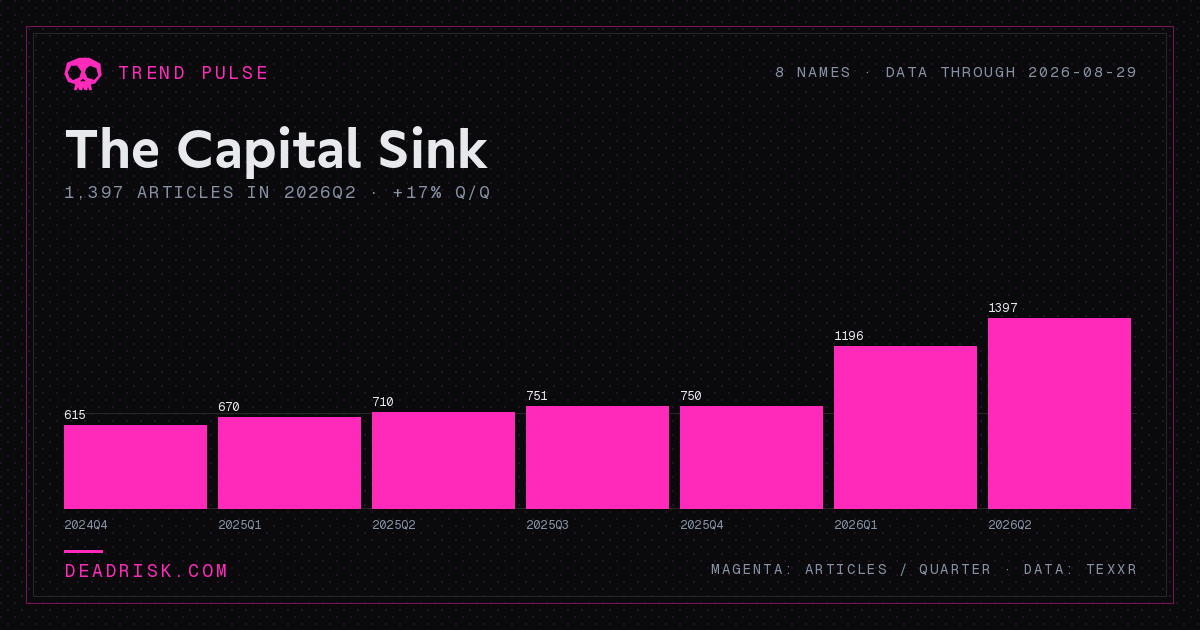
Across 8 member names, 2026Q3 drew 1,381 articles against 1,397 in 2026Q2. The largest single move was CoreWeave, -69%.
Coverage data as of 2026-10-13 · the essay above was last revised 2026-10-12