The argument
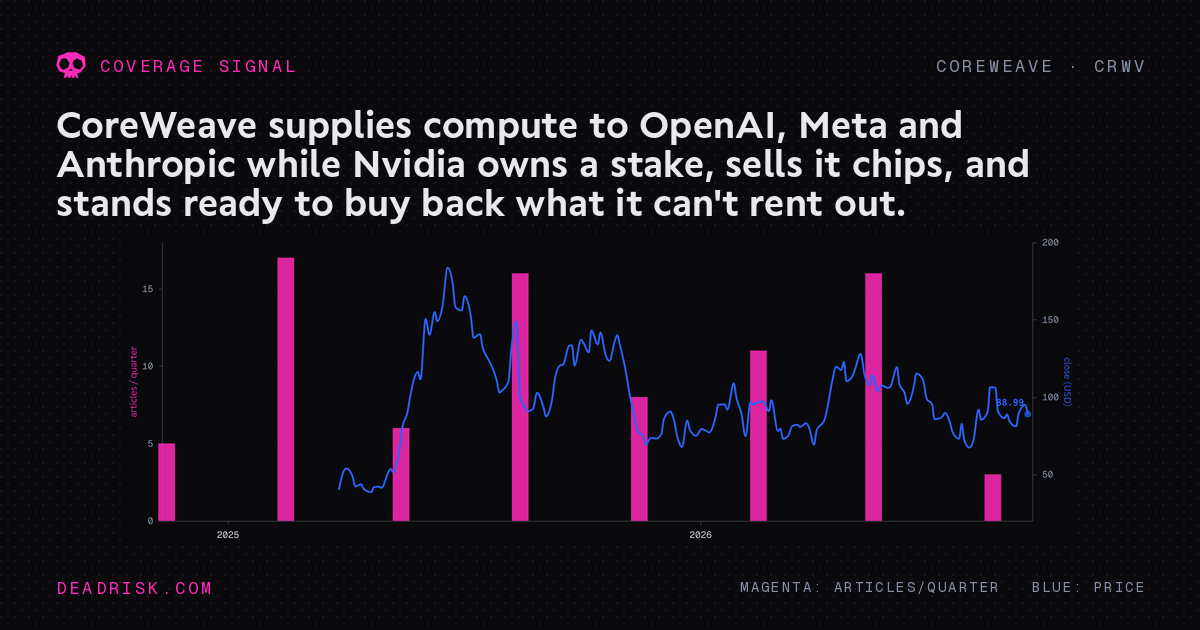
The tape · quarterly coverage amplitude · live quarter blinking
Nvidia occupies three sides of the CoreWeave trade: it supplies the GPUs, owns part of the company, and buys capacity CoreWeave cannot sell elsewhere under a $6.3 billion backstop through April 2032. CoreWeave priced its Nasdaq IPO at $40 a share on March 27, 2025, selling 37.5 million shares — cut down from a planned 49 million at $47–$55 — for $1.5 billion, the largest US tech offering since 2021. The stock opened at $39 and closed at $40 on debut day, flat, in what the coverage record called a downsized, lackluster listing.
The company rents out Nvidia GPUs by the hour. It began as an Ethereum-mining operation, pivoted to GPU cloud computing once Ethereum moved off proof-of-work, and by mid-2023 was already renting to Microsoft: 700 clients, a $2 billion valuation, fewer than 250 staff. At the IPO, Nvidia held a 5.96% stake after a $250 million anchor order; it added a further $2 billion investment in January 2026. Since September 2025, Nvidia has agreed to buy back unsold cloud capacity through April 2032 for $6.3 billion. Little independent analysis exists on a company that has only traded publicly since March 2025. That is what makes it a fit for the assembly job below: pulling the scattered record — S-1 disclosures, earnings, financing filings, discussion threads — into one place. See The AI Capex Supercycle for the spending cycle CoreWeave sits inside.

TEXXR’s corpus carries a CoreWeave mention as early as November 12, 2021, describing “a specialized cloud service for GPU-based workloads” — three and a half years before the IPO. Coverage stayed thin through 2023 and 2024, tracking a company signing $2.3 billion in Nvidia-collateralized debt and, later, roughly $10 billion in contracts with Microsoft running through 2030. The volume didn’t move until the IPO quarter, and the corpus’s own quarterly count shows the jump plainly (see What to Watch’s baseline below).
The IPO surfaced the dependency at the center of the company. CoreWeave’s S-1 disclosed that Microsoft made up 62% of 2024 revenue, with the top two customers together accounting for 77% of $1.9 billion in sales. Days before the filing, CoreWeave denied a Financial Times report that Microsoft had walked back some agreements; the record separately shows Microsoft passing on a roughly $12 billion capacity option that OpenAI then picked up. FT coverage the same week framed CoreWeave’s debt — near $7.5 billion coming due by the end of 2026, against thin operating cash flow — as requiring investors to take “a leap of faith,” and compared the structure to WeWork’s.
What followed reads as a customer-diversification campaign run in public. OpenAI signed an $11.9 billion, five-year contract weeks before the IPO, taking $350 million of CoreWeave stock through a private placement. Meta signed for $14.2 billion in September 2025, then added $21 billion more in April 2026, running 2027 through 2032. Anthropic signed its first CoreWeave deal in April 2026. Jane Street — not an AI lab — committed roughly $6 billion in compute spend and took a $1 billion equity stake the same month. By May 2026, OpenAI’s compute commitments had left it holding roughly $2.6 billion of combined CoreWeave and Cerebras stock: a supplier it pays, that it now partly owns — see Cerebras’s report for the other half of that stake.
CoreWeave agreed to buy Core Scientific for $9 billion in July 2025; its shareholders rejected the deal that October. One month later, CEO Michael Intrator disclosed construction delays at a data-center provider; CRWV fell 16.3% that session. By December 2025, the Wall Street Journal tallied a $33 billion market-value loss over six weeks, alongside short-seller Jim Chanos’s public bet. Q1 2026 earnings, reported in May, beat estimates — revenue up 112% year over year to $2.08 billion, with a $99.4 billion backlog — but a light Q2 forecast still dropped shares roughly 10% in the same session. Q2 revenue reached $2.58 billion, up 112% year over year and $20 million above the $2.56 billion estimate. Q2 backlog was $104 billion, up $4.6 billion from Q1, a derived increase of 4.6%. Founders, meanwhile, have sold $2.3 billion of stock since the lockup lifted in August 2025, cutting their combined stake by close to a quarter. Nvidia’s own August 2025 earnings benefited from the trade: CFO Colette Kress attributed part of a $2.2 billion “net other income” gain to its CoreWeave equity — a gain that coverage noted would, on its own, rank as roughly the 44th most profitable member of the S&P 500. See Nvidia for the supplier side of that relationship. CRWV closed at $89.12 on September 10, 2026, down 6.1% that day, 1.3% over 30 days, and 23.9% over one year in the DeadRisk market layer.
That is the central finding: contracts diversified, but the economic loop became more circular. Nvidia is supplier, shareholder, and capacity backstop. OpenAI is customer and shareholder. The counterexpectation was that new customer names would reduce disclosed concentration and move risk outside the supplier-customer loop. CNBC’s Q2 report gave no updated customer shares. The record proves expansion. It does not yet prove independence.

The spectrogram
Signal decomposition · what the record is made of, by quarter · brightness = share of edges · drift = how far the story moved in meaning
In 2024Q1 the record was 50% launch; by 2026Q1 it is 67% financial. A price chart shows what a name did; the spectrogram shows what its story is made of.
The brains
Counter-positioning explains why hyperscalers let a neocloud take share — the open question is whether that barrier survives a chip supplier acting as landlord too.
Safety of principal presumes a demonstrated earnings record — CoreWeave offers a backlog and two years of public financials instead.
Debt cycles ask whether borrowed money generates enough income to service itself — CoreWeave's GPU-collateralized leverage is still answering that question.
The machine
267 hyperedges touch CoreWeave in TEXXR’s knowledge graph. Financial edges dominate at 52.4%, partnership at 13.9% — two-thirds of everything extracted about the company, ahead of controversy (12.4%) and acquisition (9.4%). Running CoreWeave, Nvidia, Microsoft, and OpenAI as a four-entity constellation turns up 98 edges across 24 months, and every entity connects to every other: no isolated node, a genuinely closed circuit rather than a hub with spokes.
The graph also holds a thread worth naming rather than hiding, because it’s flagged, not confirmed. A widely discussed November 2025 commentary, logged beside the coverage of CoreWeave’s 16.3% single-day drop, characterized its customer base as effectively five names: OpenAI, Microsoft (mostly reselling to OpenAI), Google, Meta, and Nvidia. TEXXR’s graph carries that claim tagged as rumored commentary, not a confirmed fact — the difference between what a filing says and what a trader on the timeline says matters, and the record keeps them apart.
The money

Currency: USD. Revenue/net income/capex/FCF cross-checked against filed XBRL.

Positioning: how much of CRWV is sold short, on the record brokers file twice a month. It lags by design — read it as where the crowd stood, not where it stands.
Order flow is signed before it becomes revenue — the earliest of the three views. From the capital-flow ledger.
The record
- The coverage baseline. TEXXR’s quarterly article count — the number of corpus items mentioning CoreWeave in each calendar quarter — sat at one in 2023Q4 and one in 2024Q1. It reached 17 in the IPO quarter, 2025Q1, then peaked twice more at 16 in 2025Q3 and 2026Q2. The 2026Q3 count is three, a derived 73.5% below the eight-quarter average of 11.3. This measures attention in the corpus, not demand for CoreWeave’s capacity.
- Customer concentration in the next filing. The S-1’s 62%/77% Microsoft-led concentration is the number to hold against future filings — not press releases about new deals, but the disclosed share of revenue. CNBC’s Q2 2026 report did not provide an updated customer share.
- The SPV and GPU-backed debt structure. CoreWeave pioneered financing data centers through special-purpose vehicles that move debt off its balance sheet; one analysis sized its total at $2.6 billion against Oracle’s $66 billion and Meta’s $30 billion in the same comparison. Whether that gap closes, and how, is a structural signal.
- Cash conversion against capex. The DeadRisk market layer records FY2025 operating cash flow of $3.1 billion, up 11% from $2.7 billion in FY2024. Capex rose 18% to $10.3 billion from $8.7 billion. Free cash flow fell to -$7.3 billion from -$6.0 billion, while total debt rose 181% to $29.8 billion from $10.6 billion. Revenue grew 168% over the same period, from $1.9 billion to $5.1 billion.
- Backlog conversion. Q2 2026 backlog was $104 billion against $99.4 billion in Q1, a derived increase of $4.6 billion, or 4.6%. Q2 revenue was $2.58 billion against the $2.56 billion estimate. The test is conversion into revenue as power comes online, not backlog size alone. The market data provider schedules the next earnings release for November 11, 2026, based on its calendar captured August 26; issuers can move scheduled dates.
- Power definitions. CNBC’s Q2 coverage described 1.5 GW as contracted power on August 11. Its August 12 summary described active power as rising by nearly 500 MW to 1.5 GW. Those labels are not interchangeable. Future company disclosures need to establish the comparable base.
- Insider selling pace. Founders sold $2.3 billion of stock since the August 2025 lockup expired; whether that rate holds, slows, or accelerates is in the filing record, not in guesswork.
- Derivatives exposure. Reuters reported in July 2026 that CoreWeave was exploring hedges against falling memory and storage chip prices — a new instrument layered onto a company already carrying GPU-collateralized debt.
| Quarter | Articles | QoQ | Q-end price | QoQ | The record reads |
|---|---|---|---|---|---|
| 2024Q4 | 5 | — | — | — | first quarter on record |
| 2025Q1 | 17 | +240% | 37.08 USD | — | attention rose |
| 2025Q2 | 6 | -65% | 163.06 USD | +339.8% | attention cooled as price rose |
| 2025Q3 | 16 | +167% | 136.85 USD | -16.1% | attention rose as price fell |
| 2025Q4 | 8 | -50% | 71.61 USD | -47.7% | attention and price fell together |
| 2026Q1 | 11 | +38% | 77.47 USD | +8.2% | attention and price rose together |
| 2026Q2 | 16 | +45% | 99.54 USD | +28.5% | attention and price rose together |
| 2026Q3 open | 3 | -81% | 82.98 USD | -16.6% | attention and price fell together (quarter in progress) |
The peers
CoreWeave lives or dies by the same constraint as these names — small equal-weighted groups, one constraint each. Not investment products: see all categories.
Renting the compute out again — the capital constraint, 1.6 independent bets across 5 names
Sources
Edges: TEXXR knowledge graph, CoreWeave edge profile (267 edges, queried 2026-07-18) and four-entity constellation (CoreWeave, Nvidia, Microsoft, OpenAI; 98 edges, 24 months). TEXXR momentum data, CoreWeave quarterly coverage volume, 2023Q4–2026Q3 (queried 2026-07-18).