The argument
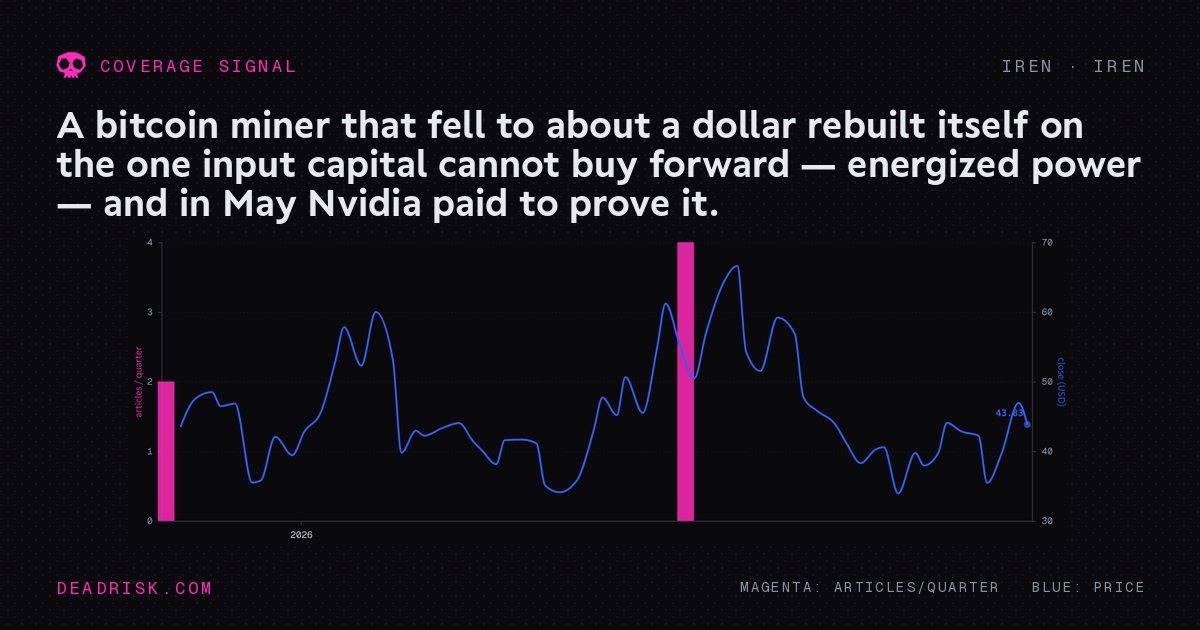
The tape · quarterly coverage amplitude · live quarter blinking
IREN (NASDAQ: IREN) is a Sydney-based company that spent its first years mining bitcoin under the name Iris Energy, and now rents Nvidia GPUs to companies that cannot get power any other way. The pivot is the whole story, and it is the same story The Power Wall tells from the other side: in an AI build-out where money is no longer the scarce input, the assets that matter are the ones you cannot order forward — a grid connection, an energized site, a signed interconnect. IREN spent a decade accumulating exactly those to run mining rigs. It turns out they are worth far more pointed at GPUs.
That is what makes it a frontier-tier name rather than a mining stock. The rigs were never the asset. The asset was queue position, and the record can now watch a buyer put a price on it.
TEXXR’s archive holds only seven IREN-tagged articles, the first from November 3, 2025 — a thin record for a company this size, and the thinness is the tell. IREN did not become news by launching a product. It became news the day power got scarce.

The low point is on the record. TEXXR’s graph carries the detail that IREN’s stock, near $1 in 2022, had risen roughly 300% by late 2025 — a miner left for dead by the crypto winter, holding power contracts nobody was bidding for.
The bidding started on November 3, 2025. Microsoft signed a five-year, $9.7 billion deal to buy AI compute from IREN — a headline number for a company most of the market still filed under mining. The same day, and this is the pairing that matters, Microsoft’s own CEO said the constraint was electricity, not chips: GPUs sitting in inventory he could not plug in. Two weeks later the Wall Street Journal framed the trade plainly — crypto miners were pivoting to AI because they held the one thing the boom had run short of. The customer named the shortage and bought the cure in the same news cycle.
The price arrived in May 2026. Nvidia and IREN announced a deal to deploy up to 5 gigawatts of AI infrastructure, with Nvidia taking the right to invest $2.1 billion — a right that vests only as GPUs go into IREN’s campuses, and fully vests at 600,000 of them. Read the structure and it is not a passive stake. Nvidia’s capital tracks IREN’s delivery; the chipmaker gets paid to make sure the power actually converts. Days later IREN bought Mirantis for $625 million — the Kubernetes-management firm — buying the software layer that turns a powered building into a service a customer can rent. And IREN was only one line in a larger pattern: Nvidia had by then committed more than $40 billion in equity across the AI build-out, taking stakes in the companies that buy its chips — the same loop CoreWeave sits inside, one turn out.
The financials underneath are still a company mid-transformation, and the honest read does not hide it. On its May 7 earnings call, IREN reported quarterly revenue of $144.8 million — down from $184.7 million the quarter before, because mining revenue is falling faster ($111.2 million, from $167.4 million) than AI cloud is climbing ($33.6 million, from $17.3 million). The net loss was $247.8 million, most of it a $140.4 million non-cash write-down on the mining hardware being torn out to make room for GPUs. The company is demolishing its old business to build the new one, and the income statement shows the demolition before it shows the building.
What holds the thesis up is the funding, not the current earnings. IREN said roughly 95% of the GPU capital expenditure for its Microsoft contract is covered by customer prepayments and GPU-backed financing, at an average rate near 3%. The customer pays in advance; the chips serve as collateral; IREN converts power into compute largely on other people’s money and books the annuity. It is targeting $3.7 billion of contracted annual recurring revenue by the end of 2026 against a base of $3.1 billion — the number to hold future filings against, not the mining run-off.

The spectrogram
Signal decomposition · what the record is made of, by quarter · brightness = share of edges · drift = how far the story moved in meaning
The brains
Panel not seated
Fewer than the full panel of lenses have read this name. The gauge shows n/3 until it fills.
The machine
Twelve hyperedges touch IREN, and their timing is the finding. Eight of the twelve land in the single week of May 7–11, 2026 — the Nvidia deal, its $2.1 billion investment right, the 5GW commitment, the Mirantis acquisition, all extracted within days. Before November 2025 the graph holds nothing at all. This is not a company with a decade of relationships in the record; it is a company that acquired all of them at once, when a chipmaker and a hyperscaler decided its power was worth contracting.
The graph also keeps the softer claim honest. A November 2025 edge sits tagged rumored, not confirmed: market commentators arguing that power-and-energy names like IREN and Cipher Mining would be the boom’s real beneficiaries. The record files the thesis as commentary until a signed deal turns it into fact — which, six months later, one did.
The money

Currency: USD. Revenue/net income/capex/FCF cross-checked against filed XBRL.

Positioning: how much of IREN is sold short, on the record brokers file twice a month. It lags by design — read it as where the crowd stood, not where it stands.
The record
Signals in the coverage and filing record, not trade ideas:
- The conversion ratio. Mining revenue is falling by design; AI cloud revenue is climbing. The quarter the second clears the first is the quarter the pivot stops being a bet. It is two lines on the income statement, reported quarterly.
- ARR under contract vs. delivered. The $3.1 billion contracted, $3.7 billion target sits against capacity that is mostly not yet online. Contracted revenue is not delivered revenue; the gap is the execution risk, and it is disclosed.
- The prepayment share. The ~95%-financed structure on the Microsoft build is what makes the model work. Whether later contracts carry the same customer prepayments — or whether IREN starts funding builds off its own balance sheet — is the structural signal.
- The queue itself. IREN’s moat is a cornered resource in Hamilton Helmer’s exact sense — energized power on terms rivals cannot match. The thing that would erode it is the same thing that would erode every name on this wall: interconnection-queue reform that lets capital buy power forward again. A cornered resource that policy can uncorner is contested, not held.
| Quarter | Articles | QoQ | Q-end price | QoQ | The record reads |
|---|---|---|---|---|---|
| 2025Q4 | 2 | — | 37.77 USD | — | first quarter on record |
| 2026Q2 | 4 | +100% | 45.73 USD | +21.1% | attention and price rose together |
The peers
IREN lives or dies by the same constraint as these names — small equal-weighted groups, one constraint each. Not investment products: see all categories.
Renting the compute out again — the capital constraint, 1.6 independent bets across 5 names
The rigs that became data centres — the siting constraint, 1.5 independent bets across 11 names
Sources
Financial results (revenue, net loss, ARR, prepayment structure) are from IREN’s earnings call for the quarter ended March 2026, held May 7, 2026. Company primary source, not a corpus article.
Edges: TEXXR knowledge graph, IREN edge profile (12 edges, queried 2026-07-22): the May 2026 Nvidia-deal cluster (390543, 390581, 390580, 390804), the Mirantis acquisition (390767), and the November 2025 pivot edges (87065, 87066, 87067), with the power-beneficiary thesis logged as rumored (85639).