Trend pillar
The Power Wall
The AI buildout's real limit isn't cash — it's permission to plug in. Grid queues, moratoriums, and the listed names on the scarce side of the wall.
Oracle and xAI Bypass Grids, Then Face Local Permit Opposition
The Thesis
Developers bypass the grid, then meet the permit office.
On 18 July 2026, Reuters reported that HumansFirst said it ran 142 protests across 42 US states that day. Four days earlier, New York’s governor had signed a one-year moratorium blocking new environmental permits for data centers above 50MW. New York was the first state to enact such a pause. On 18 July, The Information reported that Oracle had switched from gas turbines to costlier fuel cells at Project Jupiter in New Mexico. The permit failure added billions of dollars to Oracle’s planned cost.
Developers can face grid-connection waits of up to seven years. On-site turbines, fuel cells and reactors bypass that queue. They still need local air, water, noise and construction approvals. The Oracle and xAI records published from 14 to 18 July show the handoff. Grid scarcity becomes permit scarcity.
Money remains available through the AI-capex loop. This page tracks the physical and political limits: queue position, equipment, permits and local consent. It does not forecast stock prices.
The Evidence
Coverage counts measure publication frequency. Permit supply, project delays and construction activity need separate records.
For this screen, the corpus contains every unique TEXXR article record dated from 1 January 2024 through 21 July 2026. Dates follow the source publication date. The case-insensitive search runs on each indexed headline and TEXXR summary. Every series first requires data center* or data centre*. The siting series then requires one of permit*, zon*, moratorium*, ordinance*, oppos* or protest*. The power series requires one of power, grid*, MW, megawatt*, turbine* or nuclear. The capex series requires AI or artificial intelligence and one of capex*, capital expenditure*, spend* or invest*. Each record counts once per series per calendar quarter, even when it matches several terms. One record may enter more than one series.
The siting series returned 2 article records in 2024 Q2 and 22 in 2026 Q2. The derived ratio is 11.0x across eight quarter-to-quarter intervals. The same screen returned 11 records from 1 to 21 July 2026, compared with 22 during all 91 days of 2026 Q2. The 2026 Q3 figure is comparable under the same query, but it remains a partial-period count. No completed-quarter rate is inferred.
Coverage pairing data centers with power terms rose from 11 article records in 2024 Q1 to 79 in 2026 Q1. That is a derived 7.2x increase across eight quarter-to-quarter intervals.
The separate capex series reported in the capex pillar rose by a derived 6.3x from 2024 Q1 through 2026 Q2, a nine-interval window. Siting-screen coverage rose 11.0x from 2024 Q2 through 2026 Q2, an eight-interval window. TEXXR therefore published siting-conflict coverage faster than capex coverage across those windows. The counts establish a change in coverage frequency. They do not establish that permit constraints grew faster than spending.
Higher bills moved the fight into politics. Bloomberg reported that power on PJM, the largest US grid, averaged $136.53/MWh in 2026 Q1, up 76% year over year. The derived 2025 Q1 baseline was about $77.57/MWh. Bloomberg attributed the increase directly to data-center demand. In July, PJM’s market monitor calculated that the latest capacity auction would add $6.3 billion to customer bills across 13 states and Washington DC through 2029. PJM had already told large data centers in January that they would have to bring their own generation or curtail. The grid operator expects demand to grow 4.8% a year for a decade. Politico reported that industry participants feared New York’s pause could embolden more state restrictions heading into the midterms.
Local support fell. In Virginia, home of the largest data-center cluster on earth, the share of voters comfortable with new construction fell to 35% in 2026 from 69% in 2023, a derived decline of 34 percentage points. A national Quinnipiac poll in March 2026 found 65% opposed building data centers in their own community. Pew data cited by the Financial Times found 67% of planned data centers are rural, compared with 87% of existing sites in urban and suburban areas. New projects are moving into places with little local precedent for hosting them.
Opponents delayed projects. A June study reported by NBC News found opponents had blocked or delayed at least 75 US projects worth roughly $130 billion in 2026 Q1. It counted 833 organized opposition groups across 49 states, twice the prior-year total of about 417. Seattle’s council voted 9-0 for a one-year moratorium in June. New York was already at least the sixth state to introduce pause legislation when it filed its bill in February. Maine’s governor vetoed a similar bill in April. The New York Times reported that she objected because the bill failed to exempt one project in a distressed mill town.
Developers built their own generation. The Wall Street Journal was documenting on-site power plants built to bypass the grid as early as October 2025. By that December, developers were reaching for aeroderivative turbines and diesel generators. Electrek reported that Musk quietly bought APR Energy, a mobile-turbine operator, for an implied $1 billion. Reuters then found that xAI had installed far more turbines without permits at its Memphis site than it had acknowledged, with the pollution falling hardest on Black neighbourhoods. The Memphis turbines drew EPA scrutiny and a civil-rights lawsuit.
Equipment stayed short. Bloomberg reported that a domestic shortage of transformers and switchgear forced US builders to rely on Chinese imports, delaying construction. That supply chain sits beside the export-control politics running through the China stack.
PJM cut one forecast. In January, PJM cut its summer 2027 peak-demand forecast to about 160GW from 164GW, a derived reduction of about 4GW, or 2.4%. Bloomberg reported that some announced projects lacked firm service or construction commitments. PJM’s revision separates announced projects from contracted demand. The record leaves a guaranteed-shortage claim unsupported.
The Companies
Queue position, signed permits and on-site generation define the scarce side of this wall. The companies below report one or more of those assets.
Applied Digital and TeraWulf held interconnection agreements and energised shells from bitcoin mining, then began converting them to AI compute. Their queue positions predated the conversions. TeraWulf’s July lease with Anthropic is a 20-year deal worth about $19 billion for roughly 400MW in Kentucky. The disclosed total covers site capacity and does not isolate the value of queue position. CoreWeave leases capacity rather than owning the interconnect. Microsoft entered talks for hundreds of megawatts at the Abilene site after Oracle walked away from its expansion. The same site changed prospective tenants without adding megawatts.
Two names join the registry with this pillar. $IREN, another miner conversion, announced a deal with Nvidia in May to deploy up to 5GW of AI infrastructure, with Nvidia holding the right to invest $2.1 billion. $BE — Bloom Energy — is the fuel-cell maker Oracle used after its planned turbines hit permit hurdles. Their partnership expanded in April to as much as 2.8GW of capacity, days after Oracle received a warrant to buy $400 million of Bloom stock. Oracle’s supplier agreement and equity warrant put customer demand and supplier financing in the same transaction.
The category baskets cover power generation, grid equipment, nuclear restarts, data-center land and interconnects, miner conversions and energy storage. Each category page reports internal correlation. The listed names may share exposure to the same interconnection and equipment constraints.
Developers kept setting capacity targets in gigawatts. Zuckerberg announced Meta Compute in January with a target of “tens of gigawatts” this decade. France booked €110 billion of proposals in a single week, about 10GW — as the FT put it, roughly ten nuclear reactors’ worth. Those proposals still depend on local approvals.
The Lenses
The Helmer lens treats an interconnection agreement as a possible cornered resource, one of the seven powers. Rivals cannot recreate queue position quickly when grid waits run for years. Policy can weaken that position. The White House was drafting a voluntary data-center pact in February 2026, after Trump and Northeastern governors asked PJM to fund new generation in January. A shorter queue would reduce the scarcity value of existing agreements.
The Shiller lens tracks how local opposition spreads through narrative economics. NBC News counted 833 groups across 49 states in June 2026, twice the prior-year number. Microsoft tried to interrupt that spread in January by pledging to cover its power costs and reject local tax breaks. The available record has not established whether those terms changed local support.
What Moved
The DeadRisk market layer recorded all five evidence-bearing names higher on 8 September 2026 versus the 7 September close. Bloom Energy closed at $277.22, up 9.6%. TeraWulf closed at $17.86, up 8.2%. Applied Digital closed at $28.31, up 7.4%. IREN closed at $46.93, up 5.0%. Oracle closed at $162.52, up 2.4%. The derived median one-day gain was 7.4%.
The longer tape was less uniform. Over the 30 days through 8 September, Bloom Energy rose 31.6%, IREN 21.1%, TeraWulf 10.3% and Oracle 7.6%, while Applied Digital fell 2.6%. Over the year through that close, Bloom Energy rose 418.8%, Applied Digital 103.5%, TeraWulf 94.1% and IREN 79.2%, while Oracle fell 31.1%. These are price observations. They do not establish a common cause or a change in permits, queue times or equipment supply.
The operating baseline remains construction-heavy. The DeadRisk market layer, not an issuer filing, records Oracle’s FY2026 capital expenditure at $55.7 billion for the year ended 31 May 2026, up 162% from $21.2 billion in FY2025. Revenue rose 17% to $67.4 billion from $57.4 billion. Operating cash flow rose 54% to $32.0 billion from $20.8 billion, but free cash flow fell to negative $23.7 billion from negative $394 million. Total debt rose 50% to $156.2 billion from $104.1 billion.
The same market-layer record puts Applied Digital’s FY2026 capital expenditure at $2.9 billion for the year ended 31 May 2026, up 320% from $681.6 million in FY2025. Revenue rose 167% to $611.3 million from $228.6 million. Operating cash flow improved to $89.7 million from negative $115.4 million, while free cash flow fell to negative $2.8 billion from negative $797.0 million. Total debt rose 460% to $5.1 billion from $910.8 million.
The miner-conversion records show the same financing pressure on older reporting periods. IREN’s capital expenditure reached $1.4 billion in FY2025 ended 30 June 2025, up 186% from $479.9 million in FY2024. Its free cash flow fell to negative $1.1 billion from negative $427.7 million, while total debt rose to $964.2 million from $1.3 million. TeraWulf’s capital expenditure reached $1.1 billion in FY2025 ended 31 December 2025, up 296% from $267.9 million in FY2024. Its free cash flow fell to negative $1.2 billion from negative $292.4 million, while total debt rose to $5.2 billion from $491.2 million.
Bloom Energy’s supplier profile differs. The market layer records $56.8 million of capital expenditure in FY2025 ended 31 December 2025, down 4% from $58.9 million in FY2024. Free cash flow rose 73% to $57.2 million from $33.1 million. Total debt rose 96% to $3.0 billion from $1.5 billion. These company records move the financing side of the wall. They do not show that any company secured more permits or shortened an interconnection queue.
Bloomberg, citing sources, reported on 3 September that Crusoe’s roughly $13 billion deal with Jane Street runs for five years and covers GPUs and other cloud infrastructure for AI training and inference. That is a derived average contract value of about $2.6 billion a year. Bloomberg also reported that Crusoe has contracts to supply AI computing power to Oracle. The report gives no megawatt figure, permit status or power source. Contracted compute demand is not evidence that the physical wall eased.
The market data provider’s calendar, captured on 26 August 2026, schedules Oracle’s next earnings release for 10 September, Applied Digital’s for 8 October, Bloom Energy’s for 27 October, IREN’s for 5 November and TeraWulf’s for 9 November. Those are provider dates, not filed dates, and issuers can move them.
- 2026-08-18All eight evidence-bearing names close lower than the prior session, from CEG at -4.09% to WULF at -11.25%; the derived median decline is 6.85%.
- 2026-08-11Anthropic, Macquarie, and Singapore's GIC form Theseus Infrastructure to develop AI computing sites — with Anthropic committing to cover consumer electricity price increases.
- 2026-08-09Amazon backs a 7.65GW gas plant for an off-grid Texas data center.
- 2026-08-01xAI says the 69 unpermitted gas turbines powering Colossus will not be fully removed until July 2027.
- 2026-07-22Pillar launch. Siting-conflict coverage stands at 22 articles for 2026 Q2, up from 2 in 2024 Q2, with 11 more logged in the first three weeks of Q3.
- 2026-07-18Oracle's Project Jupiter switches from gas turbines to fuel cells after permit hurdles, at a cost of billions more.
- 2026-07-18HumansFirst organises 142 protests across 42 states in a single day.
- 2026-07-16Musk buys mobile-turbine operator APR Energy for an implied $1 billion, taking generation in-house.
- 2026-07-15PJM's market monitor puts the latest auction's cost to customers at $6.3 billion through 2029.
- 2026-07-14New York becomes the first state to enact a data-center permit moratorium, covering sites above 50MW.
- 2026-06-13Study finds at least 75 US projects worth ~$130B blocked or delayed in one quarter; opposition groups double to 833.
Sources
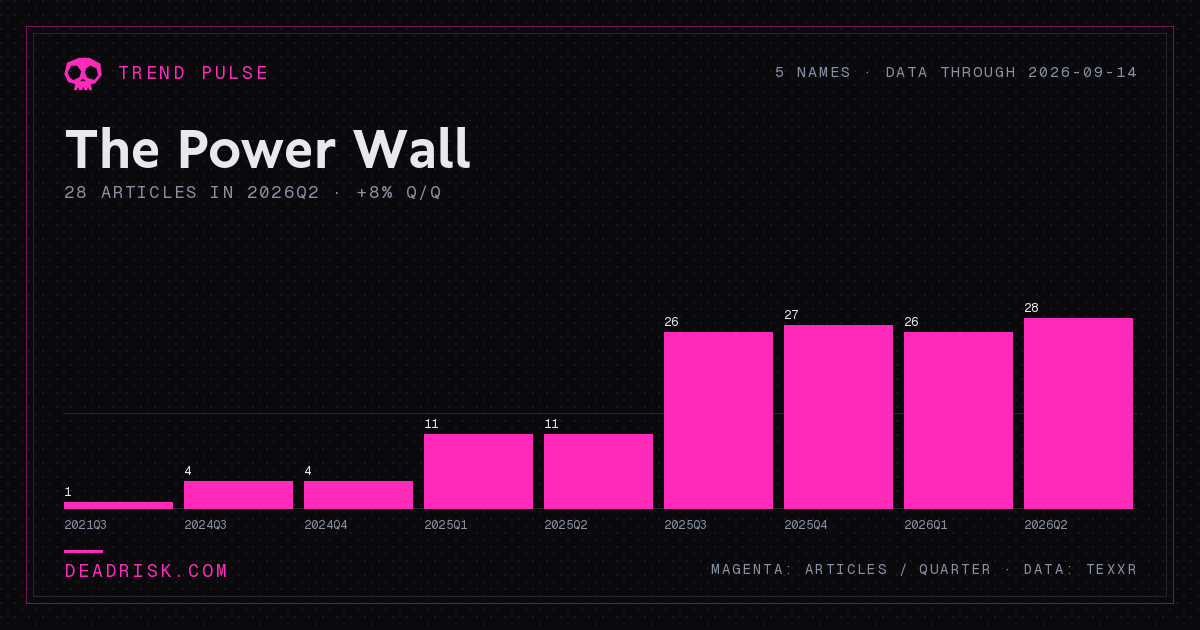
Across 5 member names, 2026Q2 drew 28 articles against 26 in 2026Q1. The largest single move was Oracle, -8%.
Coverage data as of 2026-09-15 · the essay above was last revised 2026-09-09