The argument
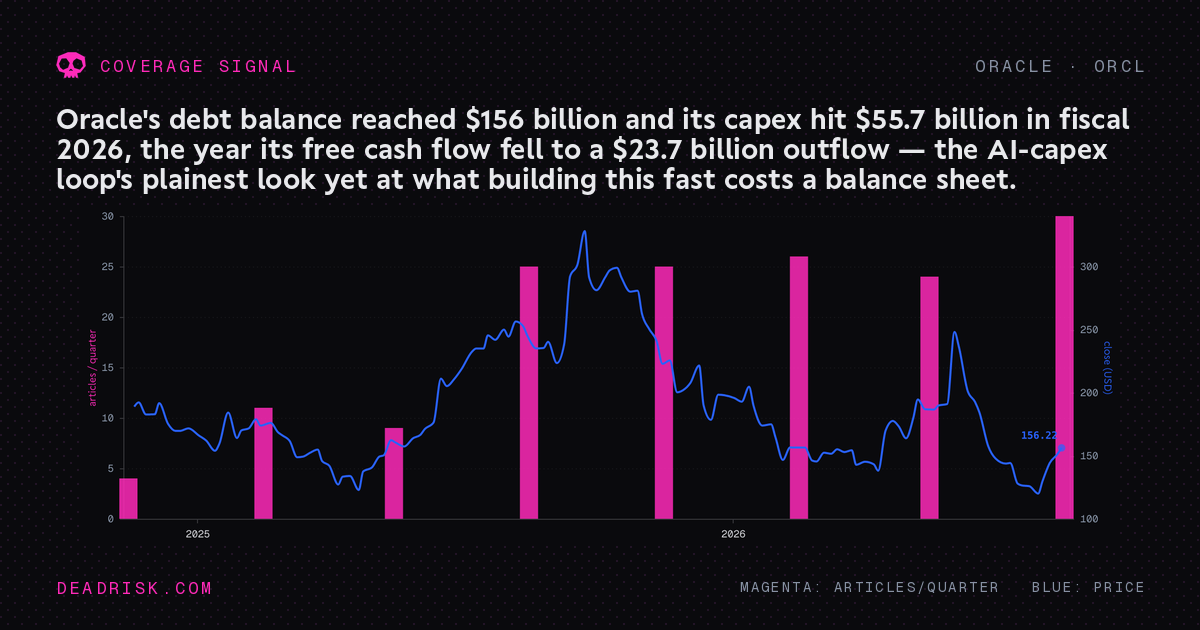
The tape · quarterly coverage amplitude · live quarter blinking
Oracle (NYSE: ORCL) has sold databases since 1977. What put it in this registry is not the database business — it is what Oracle borrowed to build cloud capacity for a customer that does not yet earn what it has promised to pay. In fiscal 2026 (ended May 31), Oracle’s capital expenditure hit $55.7 billion, up from $21.2 billion the year before, and free cash flow swung from -$394 million in fiscal 2025 to -$23.7 billion in fiscal 2026 — a company that generated $11.8 billion of free cash flow as recently as fiscal 2024 spending itself into a cash outflow larger than its own net income. Total debt reached $156.2 billion, up from $104.1 billion a year earlier.
DeadRisk carries Oracle as a second-order, big-tech name inside The AI Capex Supercycle and The Power Wall — not a company whose product is AI, but the clearest example yet of what a hyperscaler’s balance sheet costs to run once it commits to being one of AI’s biggest landlords. The clearest single thread through that cost runs through Bloom Energy: when Oracle’s gas turbines for a New Mexico data center could not clear permitting, it pivoted to Bloom fuel cells, in a deal signed days after Oracle received a warrant to buy $400 million of Bloom’s own stock. That dossier tells the story from the supplier’s side. This one tells it from the buyer’s.

The origin point has an address: Abilene, Texas. In May 2025, Bloomberg toured the first Stargate site, eight near-identical structures under construction, with builder Crusoe spending roughly $12 billion — the plan was for Abilene to be the first of many. By July, OpenAI had agreed to rent an additional 4.5 gigawatts of Oracle data center capacity, on top of an already-disclosed roughly $30 billion-a-year contract. Two months later, the number jumped an order of magnitude: the Wall Street Journal reported that OpenAI had signed a $300 billion, roughly five-year contract for Oracle computing power, 4.5 gigawatts starting in 2027 — Oracle’s sources said the vast majority of the revenue it had newly disclosed would come from this one customer.
What follows can be dated. That it was raised specifically to fund this contract cannot — the record does not establish that link. Within two weeks of the $300 billion report, Oracle sought to borrow $15 billion through a corporate bond sale, in the same account that disclosed Oracle’s cash flow had turned negative for the first time since 1992. A month later, banks prepared a $38 billion debt sale tied specifically to two Oracle data centers — $23.25 billion for a Texas site, $14.75 billion for one in Wisconsin. By mid-December, a filing showed Oracle had signed roughly $150 billion of new data-center lease commitments in a single three-month window, pushing its total capacity commitments to $248 billion. Days later, Financial Times analysis put $66 billion of that construction debt outside Oracle’s own balance sheet, financed through special-purpose vehicles — more than Meta’s $30 billion, xAI’s $20 billion, or CoreWeave’s $2.6 billion in the same comparison. Every earnings report through this stretch showed the market keeping its own scorecard, independent of the headline number: Oracle’s Q2 revenue came in at $16.06 billion, below the Street’s $16.21 billion estimate, and ORCL dropped more than 15% the same session, as Oracle raised its full-year capex forecast to roughly $50 billion — up from $35 billion guided just three months earlier.
Oracle also became, briefly, something other than a debtor. In January 2026, as TikTok’s new US joint venture was finalized, Oracle took a 15% stake alongside Silver Lake, Abu Dhabi’s MGX, and the Dell Family Office. But the capex story kept pulling harder. In February, Oracle said it would raise $45 billion to $50 billion in 2026 through debt and equity to build capacity for AMD and OpenAI, and a day later launched an $25 billion bond offering alongside a $20 billion equity sale — the largest US high-grade bond deal since Meta’s $30 billion sale the previous October, and one the Financial Times covered under a headline naming “concerns over rising debt” directly. By March, Q3 revenue beat estimates at $17.19 billion, up 22%, and ORCL jumped more than 10% — the same week that Bloomberg reported Oracle and OpenAI had walked away from a planned Abilene lease, which Microsoft then picked up instead: the first Stargate site changing hands entirely, four months after the fact was first reported.
April brought the Bloom Energy expansion to 2.8 gigawatts. June brought a fourth straight earnings beat — Q4 revenue of $19.18 billion, up 21% — and a fourth straight drop: ORCL fell more than 10% on guidance that Oracle would need to raise nearly $40 billion more in debt and equity in fiscal 2027. Two and a half weeks later, Oracle posted its worst week since 2001, down 19% in five sessions, “amid concerns about its debt load and AI investments.” July compounded it: a Nikkei Asia investigation put combined off-balance-sheet debt at Alphabet, Amazon, Meta, Microsoft, and Oracle at roughly $1.65 trillion, up eightfold since 2022; the Financial Times reported that Amazon, Oracle, Meta, and Microsoft together accounted for roughly 50,000 of the roughly 140,000 US tech jobs cut in 2026 to date; and credit default swap prices tied to Oracle, SpaceX, Alphabet, and Nvidia rose to record highs. Oracle did also land a genuine, non-AI-capex win in the same stretch — a Pentagon agreement worth up to $7 billion over up to ten years, to consolidate the department’s on-premises software licenses. By August 1, the New York Times ran a long profile of Larry Ellison’s debt-fueled push to remake Oracle around Stargate, OpenAI, and a close relationship with the Trump administration.
One filing holds a single line on Oracle. Situational Awareness LP filed a 13F-HR on 18 May 2026, for the quarter ended 31 March 2026 (accession 0002045724-26-000008); one line item in it is a put position on Oracle referencing $1.07 billion of underlying shares — the value of the stock the option references, not a bet size, not capital at risk, and not a short position of that scale, since a 13F cannot show what the fund paid for the option or whether it still held it. DeadRisk’s own analysis of that filing found that from the 31 March 2026 period-end to 30 July, every semiconductor name in the fund’s separately disclosed put book — Micron, AMD, Intel, Broadcom, ASML, TSMC, Nvidia — rose. Oracle was the one name in that same put book that fell, down roughly 13% over the same window by DeadRisk’s own price archive (a close of $147.11 on 2026-03-31 against $127.56 on 2026-07-30, as-traded, unadjusted for splits). Whether that single line was speculation or a hedge against Oracle-specific credit risk, the filing itself cannot say.

The spectrogram
Signal decomposition · what the record is made of, by quarter · brightness = share of edges · drift = how far the story moved in meaning
In 2024Q1 the record was 60% financial; by 2026Q1 it is 58% financial. A price chart shows what a name did; the spectrogram shows what its story is made of.
The brains
Panel not seated
Fewer than the full panel of lenses have read this name. The gauge shows n/3 until it fills.
The machine
TEXXR’s knowledge graph returns 500 hyperedges for Oracle — the API’s maximum single-entity return, so the true count runs higher. The extraction pipeline classifies 62.0% of them (310 of 500) as financial, 14.4% as partnership, and 12.0% as acquisition, with personnel, controversy, launch, and regulatory edges filling most of the rest. That is a classification frequency, not an independent measure of Oracle’s debt or capex — it says the pipeline reads most of Oracle’s coverage as financial in kind, which is at least consistent with the story above rather than proof of it.
The single densest thread in the graph is one address. Eighty-nine edges reference Abilene, Texas: a launch edge from May 2025 naming it the first Stargate site, then a cluster of acquisition-typed edges — most dated to a single 48-hour window in March 2026, status split between rumored and failed — all reporting the same fact from slightly different summaries: Oracle and OpenAI had abandoned a planned lease of a Crusoe-built Abilene data center. That is not 89 separate events. It is the extraction pipeline registering, with unusual force, how hard one reversal hit the record — the inverse of Bloom Energy’s single Oracle edge, which registers how thin a record can be before a story makes it relevant. A separate, confirmed edge closes the loop: Microsoft leased the same site directly from Crusoe once Oracle and OpenAI walked away.
Two more edges mark where Oracle’s graph looks like something other than a capex story. One confirmed edge holds Oracle’s 15% stake in TikTok’s new US joint venture, alongside Silver Lake and Abu Dhabi’s MGX — ownership with no capex logic behind it. Another confirmed edge holds the Pentagon’s up-to-$7 billion software agreement, where Oracle is the vendor being paid rather than the buyer taking on debt. A third pair sits closer to the main story: two edges from the same week in late July 2026, one on credit-default-swap prices hitting record highs, one on the Nikkei off-balance-sheet debt study — the market pricing Oracle’s credit risk and a study of how that debt is structured, dated days apart.
The money

Currency: USD. Revenue/net income/capex/FCF cross-checked against filed XBRL.

Positioning: how much of ORCL is sold short, on the record brokers file twice a month. It lags by design — read it as where the crowd stood, not where it stands.
The record
Signals in the coverage and filing record, not trade ideas:
- Whether free cash flow returns to positive, and what debt does meanwhile — two separate numbers. Free cash flow ran +$11.8 billion (FY24), -$0.4 billion (FY25), -$23.7 billion (FY26); it can flip sign, and that is the figure to watch for a reversal. Total debt cannot “turn” the same way — it stood at $156.2 billion at fiscal 2026’s close, and whether the FY27 balance comes in higher or lower is the separate, plainer number. Fiscal 2027’s first data point lands at Oracle’s next scheduled earnings report, 2026-09-09.
- Whether more Stargate sites go the way Abilene did. One announced site already changed hands to a different tenant entirely. Whether other sites under construction — the states under consideration in mid-2025 included Texas, Michigan, Wisconsin, and Wyoming — hold through completion, or get reassigned the way Abilene was, is checkable site by site.
- The off-balance-sheet debt trajectory. The Financial Times estimated $66 billion of Oracle’s construction debt sat outside its balance sheet as of December 2025; Nikkei’s July 2026 estimate for five companies combined, Oracle among them, ran to roughly $1.65 trillion. Whether Oracle’s individual share of that widens in the next disclosure is a number to track, not infer.
- Whether an earnings beat ever holds. Q2 missed and dropped 15%+; Q3 beat and rose 10%+; Q4 beat and still dropped 10%+, on guidance for another ~$40 billion raise. Three different market reactions to three different results is itself the pattern — watch whether the September report breaks it.
- The Situational Awareness LP’s next 13F, for the quarter ended 30 June 2026, due to be filed by 14 August 2026. Whether the fund’s Oracle put — which referenced $1.07 billion of underlying shares in the filing for the quarter ended 31 March 2026 — was still in place, larger, or gone as of 30 June is a fact the new filing will state plainly, unlike almost everything else about why the position was there.
| Quarter | Articles | QoQ | Q-end price | QoQ | The record reads |
|---|---|---|---|---|---|
| 2024Q4 | 4 | — | 163.42 USD | — | first quarter on record |
| 2025Q1 | 11 | +175% | 137.45 USD | -15.9% | attention rose as price fell |
| 2025Q2 | 9 | -18% | 215.71 USD | +56.9% | attention cooled as price rose |
| 2025Q3 | 25 | +178% | 278.07 USD | +28.9% | attention and price rose together |
| 2025Q4 | 25 | +0% | 193.05 USD | -30.6% | price fell, attention steady |
| 2026Q1 | 26 | +4% | 146.09 USD | -24.3% | price fell, attention steady |
| 2026Q2 | 24 | -8% | 146.04 USD | +0.0% | both steady |
| 2026Q3 open | 27 | +12% | 137.10 USD | -6.1% | attention rose as price fell (quarter in progress) |
The peers
Oracle lives or dies by the same constraint as these names — small equal-weighted groups, one constraint each. Not investment products: see all categories.
Sources
Edges: TEXXR knowledge graph, Oracle edge profile (500 edges returned, the API’s maximum, queried 2026-08-02): the Abilene Stargate launch (71287), the OpenAI $300B contract (80917), two of the Abilene walk-away cluster (234866, 234969), the confirmed TikTok 15% stake (93777), the confirmed Pentagon agreement (408813), the credit-default-swap spike (409207), the off-balance-sheet debt study (408297), and the Bloom Energy fuel-cell pivot (408129).
13F: Situational Awareness LP, CIK 0002045724, 13F-HR for the quarter ended 2026-03-31, accession 0002045724-26-000008, filed 2026-05-18: one put position on Oracle Corp (CUSIP 68389X105), value $1,072,873,230, referencing 7,293,000 shares. Full filing history at the Situational Awareness fund page.
Fiscal-year financials (revenue, EBITDA, net income, free cash flow, capex, debt) are Oracle’s own reported figures, fiscal year ending 31 May, from DeadRisk’s fundamentals archive (data/market/orcl.json), cited by period end. Price levels are as-traded closes from DeadRisk’s point-in-time price archive (data/prices/orcl.json), not split-adjusted.