The argument
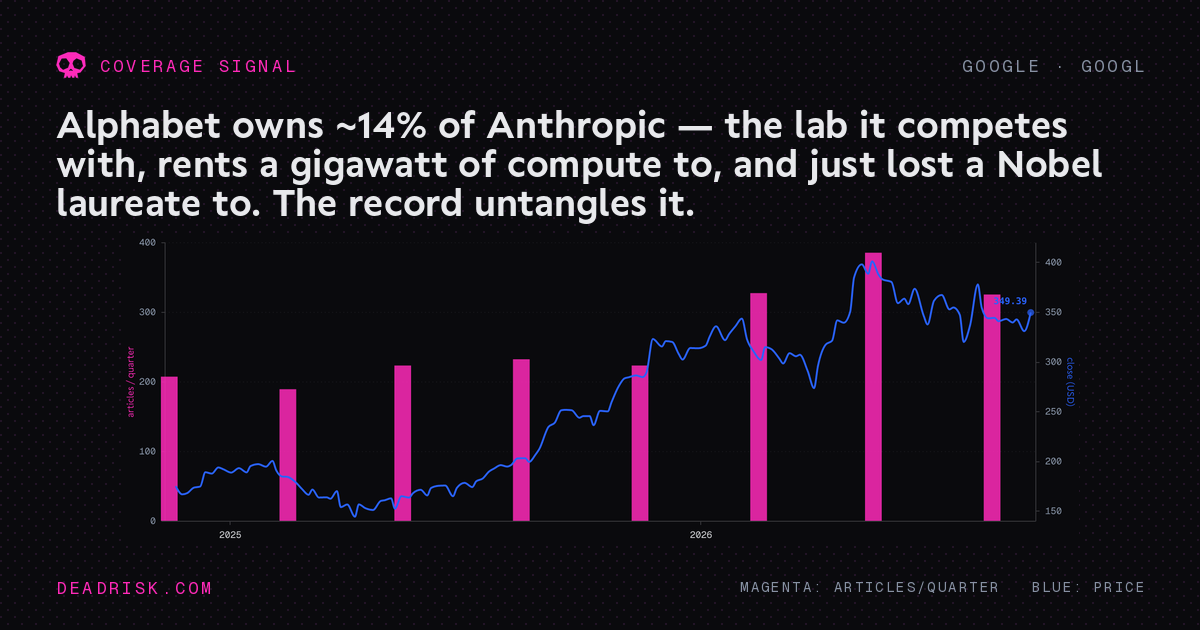
The tape · quarterly coverage amplitude · live quarter blinking
Alphabet Inc. (NASDAQ: GOOGL) is Google’s parent, and the two names still mean almost the same thing: search and ads drive most of the $119.8 billion Alphabet reported for the second quarter of 2026, up 24% year over year, with Google Cloud revenue up 82% to $24.8 billion. That is the business most headlines mean by “Google.”
It isn’t the whole business. Read Alphabet through TEXXR’s knowledge graph instead of its income statement, and a second company appears: a roughly 14% stake in the AI lab it competes with, a decade-old bet now sitting inside the largest IPO in history, a self-driving unit Alphabet keeps re-funding to avoid dilution, and a Nobel Prize-winning lab whose star scientist just left for the rival Alphabet partly owns. None of that is a line item on an earnings release. All of it is in the graph, which tracks what a company owns and deals with, not what it books as revenue.
TEXXR’s archive holds 10,999 Google-tagged articles back to December 16, 2014 — the deepest single-entity record in the corpus, still accelerating: 347 articles in the second quarter of 2026 alone, 1.5 times the trailing eight-quarter average of 237.
This is DeadRisk’s mag7 tier: the deepest corpus we hold on any single name, and not a stock-picking exercise. Benjamin Graham’s whole method was refusing to let a quoted price stand in for what a business actually owns. Alphabet is a clean modern test of that habit: most of what follows never touches its reported revenue at all.

The record’s other throughline is simpler to state and just as measurable: three years of coverage that ran as a company caught behind, then recovering. The turn began outside Google. In December 2022, sources told the New York Times that ChatGPT’s release had led Google to declare a “code red”, reassigning teams against the threat to search.
Gemini, the answer, took two years of mixed reviews to catch up, then arrived in full on November 18, 2025: Google called Gemini 3 its most intelligent model yet, with the Gemini app already at 650 million users — a figure Google put past 900 million across 230 countries by May 2026.
The market-cap chart plots onto nearly the same dates. Alphabet closed above $2 trillion for the first time in April 2024, reached $3 trillion in September 2025, then within five days in January 2026 passed Apple’s market cap for the first time since 2019 and crossed $4 trillion.
TEXXR’s predicate data marks the same turn as a structural break, not a coincidence. Across the eight quarters from 2024Q1 through 2025Q4, Google’s coverage held a stable mix — 44% launch edges, 16% regulatory, 10% controversy — drifting an average of 0.022 a quarter on TEXXR’s semantic-drift measure. In 2026Q1 that mix broke: regulatory edges fell from 16% to 6% of the total, competitor edges rose from zero to 11%, drift nearly tripled to 0.065, and network turnover — Microsoft and OpenAI dropping out of Google’s most-covered relationships, AI Overviews and Android entering — hit a 0.75 Jaccard score. The break lands in the same quarter Gemini 3 went fully live and Alphabet passed Apple. The record isn’t only saying Google recovered. It’s registering what the recovery changed: less coverage of regulators, more of rivals.
The recovery’s second act is easy to miss, because it does not look like winning. Through the first half of 2026 the frontier race — the benchmark leaderboard everyone watches — was not going Google’s way. Bloomberg reported that Gemini 3.5 Pro had fallen months behind schedule, held back for missing Google’s own internal targets, and on the July 22 earnings call CEO Sundar Pichai named the weak spot himself: coding and agentic coding, the exact ground where rivals lead. Measured only on the frontier, Google looked like it was slipping again.
The revenue said otherwise. The day before those earnings, Google shipped not a frontier model but Gemini 3.6 Flash, priced below the model it replaced, at $1.50 per million input tokens against $7.50 per million output, and better at coding and knowledge work while spending fewer tokens to get there. Flash is the workhorse — the model companies actually run at volume — and the volume is the tell. On the same call Google put its API throughput at roughly 22 billion tokens a minute, up from 16 billion a quarter earlier, while cloud revenue grew 82% and cloud operating margin jumped from 20.7% a year ago to 35.6%. The market grades the benchmark that names the smartest model. The income statement is scoring a different contest — who serves the most useful token at the lowest cost — and on that one Google is not visibly behind. It is the same fight The Power Wall tracks from the hardware side: when power is the binding input, a cheaper token is a cheaper megawatt, and efficiency stops being a footnote and becomes the product. Google’s rumored “Frozen v2” inference chip, built to run models more cheaply, is the same move one layer down in silicon — and the economics of that token, not the leaderboard, is the number that clears.
The bill lands on the same statement. Capital spending hit $44.9 billion in the quarter — more than the $39.1 billion Google generated in operating cash — and pushed free cash flow to negative $5.9 billion, the first negative quarter in Alphabet’s history as a public company, even as its trailing-twelve-month free cash flow stayed positive. Management raised full-year capital-spending guidance to $195–205 billion, up from roughly $185 billion in April. Read the two halves together and the position is sharp: Google is the low-cost producer at the model layer and, at the same time, spending hard enough on the physical layer to run cash-flow negative for the first time. The efficiency and the capital intensity are not in tension — they are the same bet, that the cheapest token wins only if you own enough capacity to serve it. It is the AI-capex trade written into one company’s cash statement.

The spectrogram
Signal decomposition · what the record is made of, by quarter · brightness = share of edges · drift = how far the story moved in meaning
In 2024Q1 the record was 44% launch; by 2026Q1 it is 45% launch. A price chart shows what a name did; the spectrogram shows what its story is made of.
The brains
Search and Cloud clear two of Helmer's seven cleanly; the DeepMind, Anthropic, SpaceX, and Waymo stakes sit outside all seven — priced by no framework in particular.
The equity stakes are the rare disclosed, quantifiable asset Graham liked hunting for — until the number attached to them turns out to be a private mark, not an earnings record.
The dominant Google-is-behind story ran three years; the record shows it reversing on a schedule tied to product launches, and once, to a single departure.
The machine
The acquisition that started it cost the least and paid out the most in prestige. A Wall Street Journal book excerpt puts Google’s 2014 price for DeepMind at $650 million, beating a competing Facebook bid. A decade later Demis Hassabis and John Jumper shared the 2024 Nobel Prize in Chemistry for AlphaFold, the protein-structure model built inside that subsidiary. In June 2026, Jumper said on X he was leaving Google DeepMind after nearly nine years for Anthropic — the second senior AI departure to a rival that week, and Bloomberg wrote that the exit “further strains Google’s efforts to compete with Anthropic and OpenAI.” Alphabet’s stock closed down 5.08% two days later — the market pricing one scientist’s move as competitive news. TEXXR’s graph logs it the same way: a competitor edge linking Google, Anthropic, and OpenAI, not a personnel edge alone.
Anthropic is the clearest case of Alphabet holding equity in a company it also fights. Google put roughly $300 million into Anthropic in February 2023 for about a 10% stake, then added $500 million upfront with $1.5 billion more committed that October. By March 2025, SEC filings showed the 14% stake, with no voting rights, no board seat, and no board-observer rights. In April 2026, Google agreed to invest $40 billion more — $10 billion in cash immediately, another $30 billion tied to performance targets. Google is also Anthropic’s landlord: an October 2025 cloud deal gave Anthropic access to a million TPUs and a gigawatt of capacity; an April 2026 expansion with Broadcom took that to roughly 3.5 gigawatts, while Google builds a $3.2 billion New York data center renting Anthropic its own TPUs, using what the Journal called “Nvidia’s playbook” to build a rival to Nvidia’s own chip business. Anthropic, in turn, plans to spend roughly $200 billion on Google’s cloud and chips over five years — more than 40% of Google Cloud’s entire disclosed revenue backlog. Investor, landlord, and rival, in the same filings.
SpaceX is the oldest stake, and the one the record can actually price. In early 2015 Google put $900 million into SpaceX — a $1 billion round — when SpaceX was valued near $10 billion. By April 2026, filings showed the stake near 5%, down from 6.11% a year earlier — a position Bloomberg estimated could top $100 billion if SpaceX’s planned IPO hit its target. SpaceX went public two months later as the largest IPO in history and closed its first days near a $2.65 trillion market cap — a level at which even a diluted 5% stake tops $100 billion, on an outlay under $1 billion. Alphabet had already booked an $8 billion unrealized-gains boost to a single quarter’s profit from the SpaceX position, a year before the IPO priced anything. Weeks after SpaceX’s debut, Google agreed to pay it $920 million a month for cloud compute running on Nvidia chips through 2029 — investor and customer, the same pattern as Anthropic.
The rest of the web is Alphabet declining to let go. Waymo, spun out of Google’s self-driving project in the 2017 “Other Bets” reorganization, has taken an Alphabet-led funding round in 2020, 2021, 2024, and again in February 2026, when Alphabet supplied $12 billion or more of a $16 billion round at a $126 billion valuation — re-upping each time rather than diluting out. Isomorphic Labs, launched by Alphabet in 2021 with Hassabis as CEO alongside his DeepMind role, turned DeepMind’s protein-folding research into a drug-discovery company that raised $600 million in 2025 and $2.1 billion more in 2026, led each time by Thrive Capital rather than Alphabet — the one arm where outside money leads.
The money

Currency: USD. Revenue/net income/capex/FCF cross-checked against filed XBRL.

Positioning: how much of GOOGL is sold short, on the record brokers file twice a month. It lags by design — read it as where the crowd stood, not where it stands.
The record
Signals in the coverage record worth tracking, not trade ideas:
- Whether the 14% Anthropic stake keeps growing. The April 2026 commitment adds up to $30 billion more once performance targets are hit — against a compute relationship deepening the other way, with Google building dedicated data centers to supply the lab it invests in.
- The SpaceX stake’s dilution path. Down to about 5% from 6.11% in a year, even as the position’s dollar value keeps rising with SpaceX’s public price. Does Alphabet re-up the way it does with Waymo, or let ownership keep shrinking as a percentage while it grows in value?
- The competitor-edge share in Google’s own graph — zero to 11% of all edges in a single quarter. Whether it keeps climbing as more of the coverage record concerns rivals rather than regulators.
- Talent flow out of DeepMind. Jumper’s move to Anthropic already reads as a market-moving event, not routine churn. Whether more departures follow, and whether the graph keeps tagging them as competitive edges rather than personnel ones.
- Whether Isomorphic Labs or Waymo raise outside capital at a pace that dilutes Alphabet’s position the way SpaceX’s has — the one open question for the two bets Alphabet still fully controls.
- Flash volume against frontier delay. Two numbers moving in opposite directions: Gemini 3.5 Pro slipping quarter by quarter, and API token throughput climbing (16B to 22B a minute in one quarter). Whether the cheap-token business keeps compounding while the frontier model stays late is the tension that decides whether “behind on benchmarks” ever shows up in the revenue.
- The free-cash-flow line. Q2 2026 was the first negative FCF quarter in Alphabet’s public history — capex ($44.9B) ran past operating cash flow ($39.1B). Whether that is a one-quarter build-out spike or the start of a run of negative quarters, and whether trailing-year FCF stays positive as guidance climbs toward $205B, is the capex thesis reading out in cash rather than in press releases.
| Quarter | Articles | QoQ | Q-end price | QoQ | The record reads |
|---|---|---|---|---|---|
| 2024Q4 | 207 | — | 188.32 USD | — | first quarter on record |
| 2025Q1 | 189 | -9% | 154.01 USD | -18.2% | attention and price fell together |
| 2025Q2 | 223 | +18% | 175.73 USD | +14.1% | attention and price rose together |
| 2025Q3 | 232 | +4% | 242.63 USD | +38.1% | price rose, attention steady |
| 2025Q4 | 223 | -4% | 312.59 USD | +28.8% | price rose, attention steady |
| 2026Q1 | 327 | +47% | 287.39 USD | -8.1% | attention rose as price fell |
| 2026Q2 | 385 | +18% | 357.37 USD | +24.4% | attention and price rose together |
| 2026Q3 open | 322 | -16% | 349.39 USD | -2.2% | attention cooled, price flat (quarter in progress) |
The peers
Alphabet lives or dies by the same constraint as these names — small equal-weighted groups, one constraint each. Not investment products: see all categories.
Sources
Edges (TEXXR knowledge graph) - #235114 — acquisition/completed: Google acquired DeepMind for $650M in 2014, beating Facebook to the deal. - #403944 — competitor: John Jumper’s departure further strains Google’s efforts to compete with Anthropic and OpenAI. - #404046 — financial: Alphabet shares fell as much as 7.2% intraday, the largest one-day drop since February, following DeepMind VP John Jumper’s departure. - #65451 — regulatory: Filings indicate Google holds no voting rights, board seats, or board observer rights in Anthropic. - #389141 — financial: Anthropic announces Google will invest $10B in cash now at a $350B valuation and may invest an additional $30B. - #402369 — partnership: Google agrees to pay SpaceX $920M per month for access to Nvidia chips under a cloud-services deal. - #386148 — financial: Google confirms it invested $900M into SpaceX’s $1B funding round. - #96958 — corporate: Isomorphic Labs is a spinoff of Google DeepMind. - #394019 — financial: Isomorphic Labs raises $2.1B in a funding round led by Thrive. - #327370 — partnership: Waymo began as Google’s Project Chauffeur initiative at Mountain View.