The argument
The tape · quarterly coverage amplitude · live quarter blinking
Meta Platforms (NASDAQ: META) sells advertising against the daily attention of more than three billion people who use Facebook, Instagram, WhatsApp, Messenger, and Threads. That business now funds the largest infrastructure bet in the company’s history: Meta is trying to build a superintelligence lab and its own frontier AI models in-house, rather than resell someone else’s.
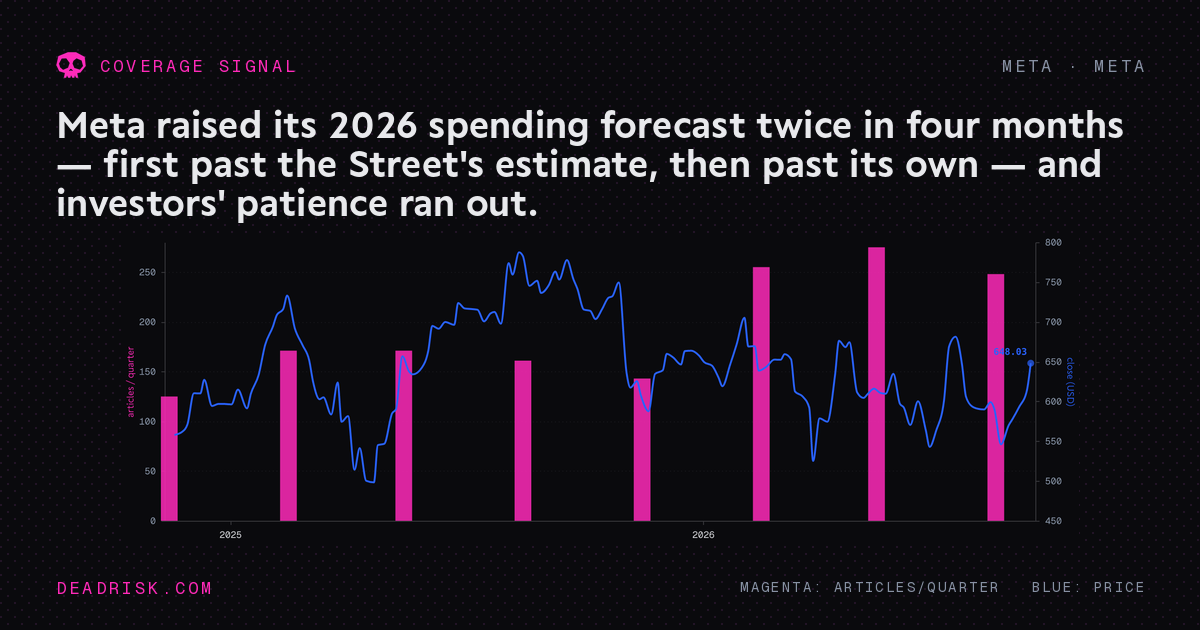
TEXXR’s archive shows the coverage pace has broken from its own pattern. Quarterly volume ran between 125 and 171 articles for two full years, 2024Q1 through 2025Q4 — a trailing eight-quarter average of about 151 — then jumped to 255 in the first quarter of 2026, 275 in the second, and 352 so far in the third, which is not yet three weeks old.
This is DeadRisk’s mag7 tier, and the point isn’t to call the stock. Benjamin Graham’s test was whether a price is justified by facts already on the table, and Meta’s own spending guidance — re-priced twice against the Street’s numbers inside four months — is the sharpest test case the AI-capex record has produced yet.

The company changed its name from Facebook to Meta in October 2021, betting that the metaverse was the next platform worth owning outright rather than renting from Apple or Google. The bet has been expensive and largely unrewarded: by March 2026, Reality Labs had lost more than $80 billion since the unit started reporting separately, and still made all of Meta’s hardware. The pivot away from that story started earlier than the AI headlines suggest. In February 2023, Mark Zuckerberg named 2023 the “Year of Efficiency” in the same breath he said Meta aimed to “become a leader in generative AI” — cost discipline and the AI bet arrived as one announcement, not two.
What followed was an open-model strategy Meta later reversed. Zuckerberg argued in July 2024 that “open source AI is the path forward,” warning that closed models risked vendor lock-in and state-backed espionage — a framing TEXXR’s graph shows commentators disputing at the time, given Llama’s licensing limits on large commercial users. The strategy then frayed from both ends. Inside FAIR, Meta’s research lab, insiders told Fortune the unit was “dying a slow death” as chief scientist Joelle Pineau left in April 2025, the same month a tuned, non-public Llama 4 Maverick variant topped a public leaderboard, forcing LMArena to rewrite its rules. Two months later, Zuckerberg announced Meta Superintelligence Labs, and by July 2025 he was walking back the open-source pledge itself, saying Meta needed to be “careful about what we choose to open source” once a model nears superintelligence. The new lab restructured four times in six months and cut roughly 600 roles, some inside FAIR itself, before reports surfaced in December that Llama’s successor, codenamed Avocado, might ship as a proprietary model. By July 2026 the reversal was complete: Meta launched a Meta Model API pricing new models at roughly 25% of what OpenAI and Anthropic charge — a metered product, not a free download.
The spending behind all of it is the story DeadRisk’s Graham page already uses as its central example. In January 2026, Meta guided 2026 capex to $115–135 billion, above the Street’s $110.6 billion estimate and nearly double the $72.2 billion it spent in 2025. Three months later, on the same day it reported Q1 revenue up 33% to $56.31 billion and net income up 61% — a record quarter by both measures — Meta raised the range again, to $125–145 billion, and the stock fell more than 10%. The market had shrugged off the January number. It punished the April one, on a quarter with nothing but good news besides the guidance. The quarter before that had already shown how volatile the earnings line can get underneath strong revenue: Meta’s Q3 2025 net income fell 83% year over year on a one-time $15.93 billion tax charge, even as revenue grew 26%. By May 2026, the cost side of the AI bet reached headcount directly: Meta laid off 8,000 people, or 10% of staff, reassigning thousands more to AI work, in what it called a push to become “AI-first.”

The spectrogram
Signal decomposition · what the record is made of, by quarter · brightness = share of edges · drift = how far the story moved in meaning
In 2024Q1 the record was 27% regulatory; by 2026Q1 it is 19% launch. A price chart shows what a name did; the spectrogram shows what its story is made of.
The brains
Muse turns Meta’s AI spending into a consumer service, but the launch discloses no cost gap or exit barrier that would add a second Power.
Record sales are funding record capex — a productive-debt story until the financing runs through vehicles built to keep it off the balance sheet.
Same guidance shape, four months apart — the market shrugged once and punished it once, with nothing else in the fundamentals to explain the gap.
The machine
TEXXR’s edge-arc tool measures how the kind of thing said about a company changes, not just how much gets said — and Meta’s mix has moved further than its headline count suggests. Between 2024Q1 and 2026Q1, competitor-predicate edges rose from 0% to 14% of Meta’s total, personnel edges rose 11 points, and regulatory and controversy edges each fell 9–10 points. The regime-detection tool flags 2026Q1 itself as a structural break — semantic drift of 0.078, roughly triple the prior eight quarters’ average, with Microsoft and TikTok dropping out of Meta’s most-connected entities and Apple and Manus entering. Read plainly: Meta’s graph used to be a company defending its products and its privacy record. It is becoming a company naming rivals and hiring against them — an AI-lab rivalry told through the predicate mix, not the article count.
That rivalry runs in both directions on compute. TEXXR’s record shows Meta acquiring Beijing-founded agent startup Manus for roughly $2 billion in December 2025, only to have Manus’s own investors reportedly discuss unwinding that buyout in July 2026, with Tencent in talks to become the lead investor instead — a live thread, not yet resolved either way. On the supply side, the corpus caught a genuinely fast-moving one: a July 3 SemiAnalysis piece floated that Meta could rent out its own compute in several forms, including a possible deal with Anthropic, framed as one option among several; a follow-on record from the same reporting, dated two days later, narrowed the possibility to Anthropic specifically; by July 17–18, sourced reporting had it as a specific arrangement worth roughly $10 billion over two years — vague hosting speculation into a priced deal in fifteen days, still logged as rumored.
The financing underneath is the same shape Nvidia and CoreWeave show from the supply side, run here from the demand side. Meta formed a joint venture with Blue Owl Capital to fund its $27 billion, 2-gigawatt Hyperion data center in Louisiana, its largest private capital deal ever, retaining roughly 20% equity — a structure that keeps the debt off Meta’s own balance sheet, one of several such special-purpose vehicles tech companies are now using for data-center financing, the kind of leverage Ray Dalio’s debt-cycle framework treats as a normal, recurring stage rather than a one-off. By July 2026 Meta had committed to spend $40 billion more on that same Louisiana campus, pushing its total price tag there past $250 billion. Meta is also on the buying side of the neocloud loop: it signed a $14.2 billion contract with CoreWeave in September 2025, then added another $21 billion to it in April 2026 — the same week its own capex guidance jumped again.
The money

Currency: USD. Revenue/net income/capex/FCF cross-checked against filed XBRL.

Positioning: how much of META is sold short, on the record brokers file twice a month. It lags by design — read it as where the crowd stood, not where it stands.
The record
Signals in the coverage record worth tracking, not trade ideas:
- A third capex re-guide. The market went from indifferent in January to punitive in April on the same kind of number. Whether a Q3 or Q4 guidance revision repeats that pattern, or breaks it, is the cleanest read on how much patience is left.
- The competitor-edge share. It moved from 0% to 14% of Meta’s total edges in five quarters. Watching whether it keeps climbing now that Muse Spark and the Meta Model API have actually shipped, or plateaus once the rivalry is fully priced into the record.
- The Manus unwind. A confirmed acquisition edge sits next to a rumored unwind. Whether that resolves into a reversed deal, a denial, or something the graph has to log as a contradiction the way it once did with Nvidia and Groq.
- The Anthropic compute-rental talks. Still rumored as of this writing, fifteen days after the first vague speculation. A status flip to confirmed, at whatever price, would be a genuine reversal — Meta renting out capacity to a rival lab rather than building only for itself.
- Personnel churn inside Superintelligence Labs. Four restructurings in six months and hundreds of FAIR cuts are already logged. More reorganization edges, or a stretch without one, says something about whether the lab has found its shape.
| Quarter | Articles | QoQ | Q-end price | QoQ | The record reads |
|---|---|---|---|---|---|
| 2024Q4 | 125 | — | 582.63 USD | — | first quarter on record |
| 2025Q1 | 171 | +37% | 574.04 USD | -1.5% | attention rose, price flat |
| 2025Q2 | 171 | +0% | 735.68 USD | +28.2% | price rose, attention steady |
| 2025Q3 | 161 | -6% | 732.48 USD | -0.4% | both steady |
| 2025Q4 | 143 | -11% | 658.91 USD | -10.0% | attention and price fell together |
| 2026Q1 | 255 | +78% | 571.60 USD | -13.3% | attention rose as price fell |
| 2026Q2 | 275 | +8% | 563.29 USD | -1.5% | both steady |
| 2026Q3 open | 248 | -10% | 665.60 USD | +18.2% | attention cooled as price rose (quarter in progress) |
The peers
Meta lives or dies by the same constraint as these names — small equal-weighted groups, one constraint each. Not investment products: see all categories.
Sources
Edges (TEXXR knowledge graph) - #94633 — financial: Meta expects 2026 capital expenditures of $115B–$135B, compared with a $110.6B analyst estimate and $72.2B in 2025. - #389589 — financial: Meta raises its 2026 capital expenditure guidance to $125B–$145B, up from prior $115B–$135B. - #389590 — financial: Meta’s shares fall more than 6% in after-hours trading following the capex guidance increase. - #407996 / #408020 — partnership/rumored: Meta is in talks to rent data-center computing power to Anthropic, potentially worth ~$10B over two years. - #90319 — personnel/confirmed: Manus’ talent joins Meta to help deliver agents across Meta products. - #90317 — acquisition/confirmed: Meta acquires Manus, integrating the company to deliver agents across Meta products. - #46571 — controversy: Commentators criticize Meta’s use of the term “open source” for Llama releases given its licensing restrictions. - #77286 — controversy: Meta says it will not open source a superintelligent AI like Llama.