Thinker lens
Ray Dalio
A buildout funded by cash and a buildout funded by debt are different objects. Dalio's template asks the one question that separates them.
The Lens
Ray Dalio’s template treats a debt crisis as arithmetic rather than a mood. Credit is the granting of buying power in exchange for a promise to repay, and granting it is ordinarily a good thing — too little credit growth does as much damage as too much. What decides whether a given pile of borrowed money ends well is a single test, applied over and over: does the borrowed money generate enough income to service itself?
Early in a cycle the answer is yes, and the answer is easy. Debt funds expansion, expansion funds revenue, revenue covers the interest, and the whole arrangement, as Big Debt Crises puts it, feels wonderful to live through. That is the trap. The same behaviour that is prudent in the early part of a cycle is reckless in the bubble, and nothing about the behaviour itself changes to tell you which phase you are in. What changes is the relationship between the debt and the income behind it.
Dalio’s markers for that turn are unglamorous and specific. Debt growing faster than the income that services it. Lending moving out of conventional banks and into new instruments built for the occasion. Collateral valued on the assumption that its price keeps rising. None of these is a prediction. Each is a thing you can look up.
Why It Matters Now
For most of the current AI buildout, the question did not arise. The companies committing the capital were throwing off enormous operating cash, and capex came out of it. A buildout financed from earnings does not have a credit cycle to be in.
That is no longer the whole picture. Debt is now a load-bearing part of how AI infrastructure gets paid for, and a growing share of it is structured to sit somewhere other than the borrower’s balance sheet. That shift is what makes Dalio’s template the right instrument for this trade rather than a borrowed metaphor. His test is not about whether AI works. It is about whether the specific dollars borrowed against specific hardware earn enough to repay themselves on schedule — and that is a question the coverage record can be made to answer, name by name.
The other lenses on this site ask different questions of the same companies. Graham asks what the business is worth. Shiller asks what story is moving the price. Dalio asks who lent the money and against what. See The AI Capex Supercycle for how the three read the same buildout.
Applied to Tech Markets
CoreWeave is where the template bites hardest, because the collateral and the customer are the same problem twice.
Its March 2025 S-1 showed roughly 77% of $1.9 billion in 2024 revenue coming from its top two customers, with Microsoft alone accounting for 62% of total sales. That is the income side of Dalio’s test standing on one counterparty’s continued demand. The asset side is worse: the chips financing the leverage are also the asset securing it, and unlike a warehouse or a rail line, a GPU’s earning power falls every time a faster one ships.
Then the financing structure. In February 2026 the Financial Times reported that tech companies were increasingly turning to GPU-backed debt — a model it credited CoreWeave with pioneering — using special-purpose vehicles to shift that debt off their balance sheets. Dalio’s template names this pattern directly as a bubble-phase marker: financing instruments proliferating outside conventional bank lending, built precisely because the underlying collateral would not otherwise clear a normal lender’s terms. The detail that matters is not that CoreWeave did it. It is that by 2026 the record shows other companies doing it too.
The backstop cuts the same way. In September 2025 CoreWeave announced a $6.3 billion order under which Nvidia guarantees to buy any cloud capacity not sold to customers, through April 13, 2032. Read as credit, that is a supplier — one that also holds equity in the buyer — underwriting the buyer’s revenue shortfall. It may well hold. But the framework’s question is whether the business earns enough to service its own debt, and a guarantee from the party selling it the collateral is an answer to a different question.
Full records: CoreWeave, Nvidia, Applied Digital, Nebius.
None of this says what any of these securities are worth. It says which of them are running on borrowed money, against what collateral, owed to whom, and by when — which is the whole of what Dalio’s template was ever built to show.
The Library
The lens comes from Principles for Navigating Big Debt Crises (2018), where Dalio sets out the archetypal cycle in five phases and then tests it against 48 historical cases, including Weimar Germany, the US Depression, Japan and 2008. The chapter-by-chapter notes on the shelf follow that structure.
It sits close to two other books here. Shiller’s Irrational Exuberance describes how the story that justifies the borrowing spreads; Dalio describes what the borrowing does to the balance sheet while that happens. Graham’s Security Analysis supplies the discipline of reading the filing rather than the price — which is the only way the debt figures get found at all.
Sources
- Dalio, Ray. Principles for Navigating Big Debt Crises (Bridgewater, 2018) — the archetypal cycle, phases 1–5, and the bubble-phase financing markers.
- “CoreWeave’s S-1 shows ~77% of its $1.9B revenue in 2024 came from its top two customers, one of them being Microsoft, which accounted for 62% of total sales” — Bloomberg, Mar 4, 2025. https://www.bloomberg.com/news/articles/2025-03-03/nvidia-backed-coreweave-files-for-ipo-revealing-growing-revenue · TEXXR record: https://texxr.com/883100
- “Tech companies are increasingly turning to GPU-backed debt, a model pioneered by CoreWeave, using SPVs to shift debt off their balance sheets” — Financial Times, Feb 26, 2026. https://www.ft.com/content/3ea1c95d-468e-4cc6-a221-492243e48a5b · TEXXR record: https://texxr.com/1164155
- “CoreWeave says it has signed a new $6.3B order with Nvidia that guarantees Nvidia will purchase any cloud capacity not sold to customers through April 13, 2032” — Reuters, Sep 15, 2025. https://www.reuters.com/business/coreweave-nvidia-sign-63-billion-order-cloud-computing-capacity-2025-09-15/ · TEXXR record: https://texxr.com/890198
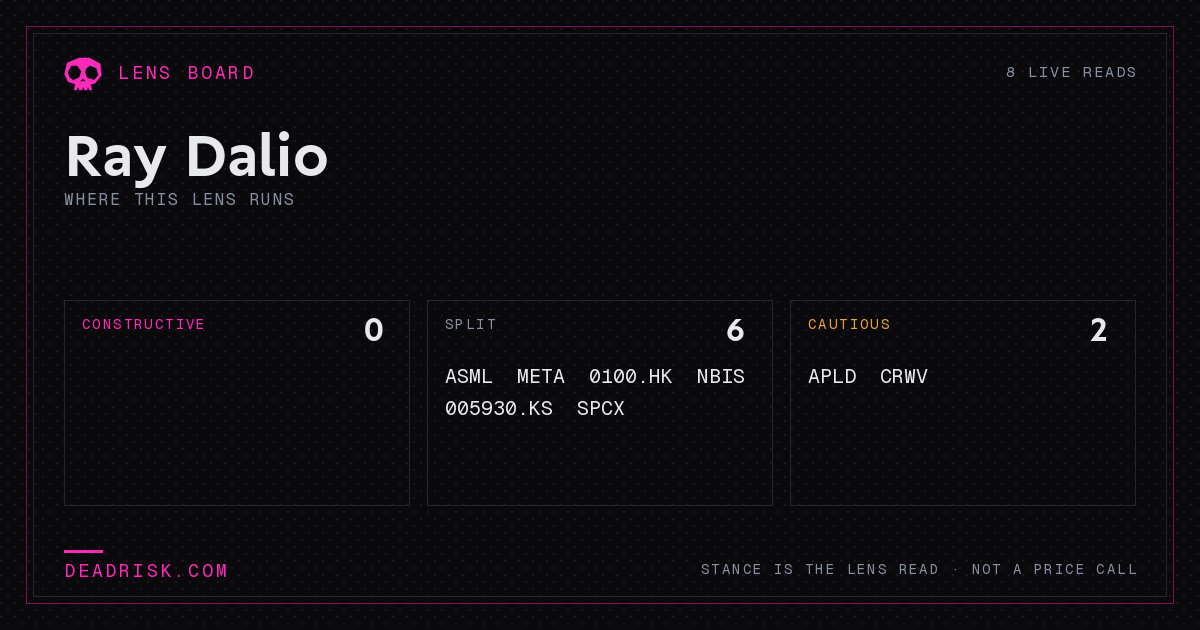
Where this lens runs
-
ASML ASML
cautious
China's share of ASML's sales fell from half to a fifth in about a year — a squeeze the record reads like a cycle, not a shock.
-
Meta META
cautious
Record sales are funding record capex — a productive-debt story until the financing runs through vehicles built to keep it off the balance sheet.
-
MiniMax Group 0100.HK
cautious
Two capital markets built in parallel, on the one fault line Dalio's template treats as decisive in a crisis.
-
Nebius Group NBIS
cautious
Senior unsecured convertible notes, not a GPU-collateralized vehicle — a cleaner instrument financing the same unproven income stream as its cohort.
-
Samsung Electronics 005930.KS
cautious
A 1,814% profit surge and a fresh round of capacity spending look identical at the top of a cycle and the start of one — the record can date the surge, not which it is.
-
SpaceX SPCX
cautious
One filer, three ledgers — an $86B raise funding a segment whose losses already exceed the group's.
-
Applied Digital APLD
averse
Credit that runs through one tenant's guarantee, funding conversion capex against two years of disclosed record.
-
CoreWeave CRWV
averse
Debt cycles ask whether borrowed money generates enough income to service itself — CoreWeave's GPU-collateralized leverage is still answering that question.