Thinker lens
Robert Shiller
A price's justifying story usually comes after the price, not before it — TEXXR's archive lets you watch that loop run through tech coverage.
The Lens
Robert Shiller’s claim is simple to state and hard to accept: a rising price does not just reflect a story about the world. It manufactures one. A price moves. A reporter needs an explanation by deadline. The explanation hardens into a claim — a new technology has changed the rules, this time is really different — and the claim spreads from outlet to outlet the way an infection spreads from person to person. New buyers arrive because they heard the story, not because they read the filing. Prices rise again. The story gets told louder, in more places.
Shiller called the mechanism a feedback loop and gave its cultural vehicle a name: new era thinking, the periodic conviction that permanently higher prices are now justified by structural change. In Irrational Exuberance he traces the pattern through dot-com stocks and home prices and states the causation plainly, backward from how most people assume it runs — that “the stock market often creates new era theories.” Reporters do not explain a price move after the fact. The price move recruits the explanation, and the explanation recruits the next buyer.
That reversal is the whole lens. Coverage is not a mirror held up to the market. Coverage is one of the market’s moving parts.
Why It Matters Now
DeadRisk exists because of that reversal. If narrative is a mechanism and not a mirror, a long enough record of coverage is not commentary on the market — it is data on the mechanism itself: how fast a story about a technology spreads, which outlets carry it first, how the framing shifts as the price does. TEXXR’s archive, twelve years of tech-news coverage, is built to measure exactly that. Calling this site “narrative economics with the receipts” is not a slogan borrowed from Shiller for flavor. He described the mechanism from theory and market history. This archive lets you watch the mechanism run, article by article, quarter by quarter, in the one sector where the current new-era story is loudest.
The AI buildout is that era’s leading new-era narrative: capital committed on the premise that a technology has permanently changed the growth math for a handful of companies. See The AI Capex Supercycle for what the coverage record shows about that story’s shape so far.
Applied to Tech Markets
Track “AI” as a concept, not a keyword, across TEXXR’s full archive, and the feedback loop shows up directly in the volume, independent of any single company’s earnings. Coverage ran a handful of mentions a quarter through 2020, TEXXR’s drift analysis flags an inflection in late 2021, and by the second quarter of 2026 the concept appeared in 419 articles in that quarter alone — a story spreading through outlets in close to the shape Shiller’s epidemic model describes.
Nvidia is the clearest node inside that story, and the record shows the loop running in reverse too. On July 9, 2026, Bloomberg reported the company had lost roughly $1 trillion in market value in under two months — down 16% from its May all-time high, trading at 18 times forward earnings, its lowest multiple since 2019. Seven other outlets covered the same reassessment that same week. That is a new-era narrative unwinding in measurable, dated form: the story that justified the multiple stopped spreading as fast as the multiple needed it to. See Nvidia for the full coverage record.
None of this says where the price goes next. It says, with a baseline and a date, how the story that moves the price has been spreading — which is the one thing Shiller ever claimed narrative analysis could show.
The Library
The library holds Irrational Exuberance (1st ed. 2000; 2nd ed. 2005), the book where Shiller built the feedback-loop and new-era-narrative machinery this page draws from. Narrative Economics (2019), his later book naming contagious stories as a general force in economic fluctuations, is not separately in the library — its central mechanism is the one worked out in Irrational Exuberance’s chapters on feedback theories and speculative epidemics, cited directly above. Everything on this page traces to that earlier book, and to a synthesis that reads Shiller’s feedback loop alongside Graham’s margin of safety, Keynes’s animal spirits, Marks’s pendulum, and Dalio’s credit cycle — five accounts of the same structural fact: bubbles form and unwind by mechanism, not by a crowd repeating the same mistake.
Sources
- Shiller, Robert J. Irrational Exuberance, 2nd ed. (Princeton University Press, 2005) — feedback-loop and new-era-narrative chapters.
- “Nvidia lost ~$1T in market value in less than two months, dropping 16% from its May all-time-high, trading at 18x forward earnings, its lowest level since 2019” — Bloomberg, Jul 9, 2026. https://www.bloomberg.com/news/articles/2026-07-08/nvidia-s-1-trillion-slide-sends-valuation-to-pre-ai-boom-levels · TEXXR record: https://texxr.com/1172298
- “AI coverage has been misinformed and sensationalized for decades, leading to unrealistic expectations and distracting from the actual consequences of AI” — The Guardian, Jul 30, 2018. http://www.theguardian.com/technology/2018/jul/25/ai-artificial-intelligence-social-media-bots-wrong · TEXXR record: https://texxr.com/931939
- TEXXR archive: coverage-volume and semantic-drift analysis of “AI” as a tracked concept, 2015Q3–2026Q2 (43 quarters, 2,923 articles, inflection flagged 2021Q4).
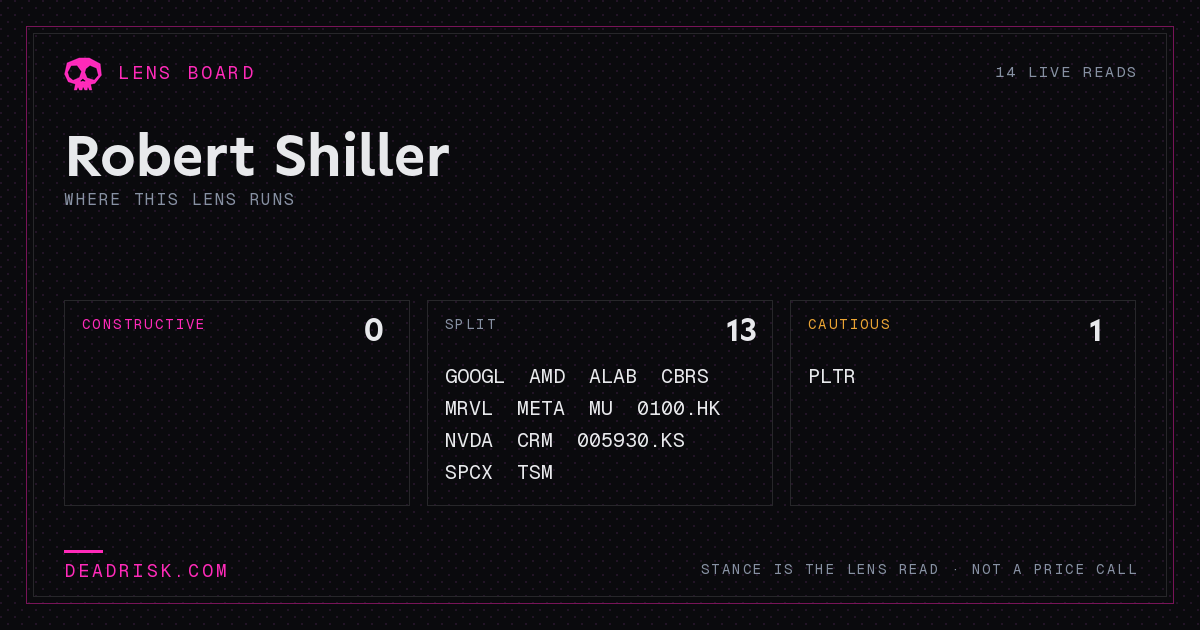
Where this lens runs
-
Alphabet GOOGL
cautious
The dominant Google-is-behind story ran three years; the record shows it reversing on a schedule tied to product launches, and once, to a single departure.
-
AMD AMD
cautious
AMD’s earnings and contracts support the AI story, but its price swings and coverage framing leave buyer-recruitment feedback unproved.
-
Astera Labs ALAB
cautious
Astera’s revenue growth supports its AI-connectivity story, while the pre-earnings price swing and customer concentration leave room for Shiller’s feedback loop.
-
Cerebras Systems CBRS
cautious
Cerebras has delivered strong Q1 growth, but its post-IPO price reversal and abrupt coverage surge show Shiller's feedback loop shifting from recruitment to reassessment.
-
Marvell Technology MRVL
cautious
Marvell’s expanded Google deal strengthens the operating story, but its price and coverage still show Shiller’s feedback loop outrunning disclosed shipment evidence.
-
Meta META
cautious
Same guidance shape, four months apart — the market shrugged once and punished it once, with nothing else in the fundamentals to explain the gap.
-
Micron MU
cautious
Micron’s revenue and capacity plans support the AI-memory story, but the record lacks the cash metrics and buyer evidence needed to prove a self-sustaining supercycle.
-
MiniMax Group 0100.HK
cautious
A feedback loop this textbook, running mostly through coverage the English-language record barely priced until the peak.
-
Nvidia NVDA
cautious
The coverage record hit its own high before the stock did — and then it cooled first too.
-
Salesforce CRM
cautious
Salesforce’s price rebound and Agentforce growth are spreading the agent-era story faster than the supplied record can verify its cash economics.
-
Samsung Electronics 005930.KS
cautious
Samsung's own record beat estimates on the day the sector was still selling it off, and the reversal two days later carried no new information about Samsung at all.
-
SpaceX SPCX
cautious
A combined valuation that moved from $250B to $1.25T with no second transaction is the feedback loop Shiller described, running in real time.
-
TSMC TSM
cautious
TSMC’s Q2 earnings validate AI demand, but higher capex, margin dilution, and below-average company coverage break the clean feedback-loop story.
-
Palantir PLTR
averse
Palantir's own predicate shift is the epidemic curve Shiller describes, measured instead of asserted.