Trend pillar
The China AI Stack
Export controls didn't stop China's AI buildout — the record shows they forked it, and Hong Kong just started pricing the fork.
The Thesis
Washington’s export controls aimed to slow China’s access to frontier-AI compute. Instead, China built a partly localized but interdependent stack, while imported hardware and foreign chipmaking tools remained material.
It spans chipmakers SMIC, Cambricon, Hua Hong, MetaX, Biren, and Enflame; model builders DeepSeek, Zhipu, MiniMax, and Moonshot; and, since January 2026, Hong Kong and Shanghai listings that price the stack.
Two events made this a market story. DeepSeek’s R1 release on January 27, 2025, erased close to $600 billion from Nvidia’s market cap, the largest one-day loss by a US company. Then the 2026 listings gave MiniMax and Zhipu liquid tickers through which releases, policy changes, and results hit prices directly.
TEXXR tracks dated chip bans, license changes, model releases, and listings before Western sell-side coverage reaches many of these companies. That gap is the story.
The Evidence
Start with the baseline the record itself supplies. TechInsights data, carried by Nikkei Asia, puts China’s chip self-sufficiency rate at roughly 14% in 2014, rising to 23% by 2023, with a projected 27% by 2027 (TEXXR #879496). That’s the corpus-only number this page rests on — a thirteen-year trend line with an explicit starting point, not a snapshot. It also sets up the tension the rest of the stack lives inside: a New York Times analysis from February 2026 found that despite $150 billion-plus invested over more than a decade, China is expected to produce just 2% of global AI chips in 2026, with memory storage output roughly 70 times below foreign chipmakers (TEXXR #1163482). Self-sufficiency is rising and China is still a rounding error in the chips that matter most. Both are true in the same record.
The chip-side timeline runs in fits and starts. In September 2023, a TechInsights teardown found Huawei’s Mate 60 Pro running a Kirin 9000s chip fabricated by SMIC on a 7-nanometer process (TEXXR #843789) — the discovery that triggered Washington’s October 2023 rule tightening, aimed at closing the loopholes that let the chip get built at all (TEXXR #845208). By December 2024, the follow-up teardown found Huawei’s next flagship running the same 7nm node, despite rumors of a 5nm jump — the advance had stalled (TEXXR #880228). A year later, TechInsights found Huawei’s Mate 80 Pro Max on an updated 7nm process, still with SMIC, still short of the 5nm mainstream Western foundries shipped years earlier (TEXXR #893605). By March 2026, Hua Hong was reported readying its own 7nm line with Huawei’s help — set to become China’s second domestic chipmaker at that node (TEXXR #1165295). Progress, but slow, and the gap to the frontier hasn’t closed.
The edge graph also catches the chipmakers’ coverage running two incompatible threads in the same month. On March 27, 2026, the US sanctioned SMIC over alleged chipmaking-tool shipments to Iran’s military — a regulatory edge and a controversy edge, both logged the same day (TEXXR edge #235221, #235220). Eight days later, SMIC and its domestic peers reported record 2025 revenue, driven by AI demand and the same self-sufficiency push the sanction was meant to slow (TEXXR edge #236016, #236069). A sanctioned military supplier and a record-revenue foundry, same company, eight days apart — the exact structural signature TEXXR’s own tooling flags as a juxtaposition, and a plainer illustration than most of why single-frame coverage misses this stack.
Then the shock. On January 27, 2025, DeepSeek’s R1 release sent Nvidia down 17%-plus, TSMC down 14%-plus, AMD and ASML down roughly 6% each, and Microsoft down about 3% (TEXXR #881778). Nvidia alone lost $600 billion in market value that day — more than twice the biggest one-day loss any US company had posted before it (TEXXR #881811). SemiAnalysis put DeepSeek’s own GPU spend north of $500 million; TechInsights called the release less a hit to Nvidia than “a bigger problem for companies like OpenAI” (TEXXR #881804). DeepSeek itself had started three years earlier as the research arm of a Chinese quant hedge fund, High-Flyer, whose founder Liang Wenfeng diverted 10,000 Nvidia chips into the project (TEXXR #881756). The shock became a template. On July 18, 2026 — the same day this page was written — Moonshot released Kimi K3, a 2.8-trillion-parameter model (TEXXR #1173102) that topped one coding benchmark ahead of Claude and scored within a point of GPT-5.6 Sol on another (TEXXR #1173210), and coverage read the market reaction as a rerun: Bloomberg headlined it “fueling a tech rout,” and Yahoo Finance said the release “triggered DeepSeek flashbacks for the stock market.”
The Nvidia H20 saga shows the same status flip running on the chip-export side alone. Washington cleared the China-specific H20 for sale in mid-2025, and by July Nvidia was ordering another 300,000 units from TSMC to meet demand (TEXXR #888414). Weeks later, Beijing told domestic firms to avoid the chip over alleged security concerns, and Nvidia told its suppliers to halt production (TEXXR #889331). By January 2026, Washington had replaced the ban with a case-by-case licensing regime for the H200 and AMD’s MI325X (TEXXR #1161412), and China approved its first batch of H200 imports for ByteDance, Alibaba, and Tencent that same month (TEXXR #1162278). By June, the US was still holding off on adding DeepSeek and memory maker CXMT to its export-control entity list, more than 100 other flagged firms in the same limbo (TEXXR #1171059). Four status changes in eleven months, on the same chip, is the shape of a policy that hasn’t settled — and every flip is a regulatory edge TEXXR’s graph already has dated.
The chip trade doesn’t stop at the chip. Hong Kong itself handled more than half of China’s $239 billion in chip imports in the first five months of 2026, a record share, up from roughly a third a decade earlier (TEXXR #1172071). The same city now hosting the listing wave is also the physical conduit the chips move through — capital and hardware routed through the same node.
The listing wave followed the same script one tier up. Hong Kong’s Hang Seng closed 2025 up 28%, its best year since 2017, on tech and AI names (TEXXR #1154342); PwC counted 76 mainland Chinese listings on the exchange in 2025, versus 30 the year before (TEXXR #1166133). Chip designer Biren opened the 2026 wave on January 2, surging as much as 119% intraday and closing up 76% after a $717 million raise (TEXXR #1154374). Zhipu (trading as Z.ai) listed January 8, raising roughly $560 million and closing up 13% (TEXXR #1154745). MiniMax followed one day later, on January 9, and doubled — shares closed up 109% on its $619 million raise, the loudest print of the wave (confirmed against CNBC and Bloomberg’s own debut-day reporting; TEXXR’s corpus carries the pricing and the follow-on model-launch pops but not yet a dedicated article on the debut itself — precisely the coverage gap this page argues is systemic). Both stocks moved again together in February, when Z.ai jumped nearly 30% on its GLM-5 launch and MiniMax rose 13.7% on its M2.5 release, the market re-pricing model announcements in real time (TEXXR #1163286). By April, Bloomberg found that half of Asia’s ten most volatile stocks were these same recent AI listings (TEXXR #1166297).
DeepSeek’s own private valuation is tracking the same curve in miniature. It closed a $7.4 billion round at a $50 billion-plus valuation in mid-June 2026 (TEXXR #1170968); by mid-July it was in talks on a fresh raise near $71 billion (TEXXR #1172591); a regulatory filing from an unrelated Chinese luggage maker, disclosing an indirect 0.83% stake held through a fund, priced the company at roughly $52 billion (TEXXR #1173169) — the kind of second-order paper trail that surfaces in filings no analyst was watching. As of today, China’s National AI Industry Investment Fund holds voting rights in that round; Tencent and JD, also investors, do not (TEXXR #1173219). That round lasted eleven days. DeepSeek told investors it was suspending the raise on July 25, after remarks attributed to founder Liang Wenfeng on US-China AI competition went viral (TEXXR #1173716) — $71 billion, stopped over commentary, not a product or revenue event.
A new top-tier name entered the stack the same week: CXMT, the Hefei memory maker export controls were built to slow — Shanghai-listed, not Hong Kong like the names above. Its shares closed up 466% on the July 27 debut, a roughly $487 billion market cap and China’s single most valuable listed company that session. The page’s earlier mention of CXMT was one line about export-list limbo (TEXXR #1171059, above) — this debut is the bigger story.
Kimi K3’s release carries a dispute the earlier entry missed, and not Moonshot’s first. Five days after the July 18 launch, White House OSTP Director Michael Kratsios said on X that “we have information that Moonshot AI distilled Anthropic’s Fable for the development of its K3 model” (TEXXR #1173513); the same day, Commerce’s Bureau of Industry and Security opened a formal probe into whether Chinese firms access advanced US chips to train models (TEXXR #1173574). It is the second such accusation against Moonshot the record has logged in six months — the first came from Anthropic itself, the February allegation this page already cites above. Moonshot shipped anyway five days later, under a bespoke license rather than a standard permissive one (TEXXR #1173800) — neither the accusation nor the probe delayed it.
Parameter counts kept climbing regardless: ByteDance is reportedly pretraining a model up to 10 trillion parameters, roughly three times K3’s size (TEXXR #1174524) — sourced, unconfirmed. Revenue is a separate scoreboard: Bloomberg reported Baidu’s fifth straight quarterly decline, down 4% and below estimate, framing it as Baidu lagging AI rivals (TEXXR #1175168) — not every name in the stack is winning on both.
The Companies
Chips. SMIC (0981.HK) is the anchor foundry — largest in China, sanctioned and record-revenue-reporting in the same month, not yet a DeadRisk report. Cambricon (688256.SH, Shanghai’s STAR market, not Hong Kong) designs AI training and inference chips; it posted its first profitable year in 2025, a $316 million net profit (TEXXR #1162564), after H1 2025 revenue rose 44 times year over year (TEXXR #889494). Hua Hong (1347.HK) is racing SMIC to a second domestic 7nm line. MetaX (Shanghai-listed) (TEXXR #893782) and Biren (6082.HK) (TEXXR #1154374) are the newest entrants, both debuting within weeks of each other in December 2025 and January 2026 with first-day pops in the 76%–755% range depending on exchange and float. A fifth name now sits above all of them by market cap: CXMT (688825.SH), the Hefei DRAM maker whose July 27 debut on Shanghai’s STAR Market — mainland, not Hong Kong — briefly made it China’s most valuable listed company at roughly $487 billion, then overtook Tencent outright at ~$524 billion two weeks later. None of the five names here is yet covered on this registry — the frontier-tier gap this trend exists to close.
Models. DeepSeek remains private, with no ticker, though its own coverage trail shows planning underway for a China listing as early as 2027. Zhipu, marketed abroad as Z.ai (02513.HK), listed first, on January 8, 2026, in a debut Bloomberg described as modest against the hardware names around it. MiniMax (0100.HK) doubled a day later — see MiniMax Group for the full coverage arc once it’s built out. Moonshot AI remains unlisted, a watchlist name whose Kimi K3 release just became the first test of whether the DeepSeek template repeats. As early as 2024, the Financial Times was grouping Zhipu, Moonshot, MiniMax, and 01.ai together as the startups chasing OpenAI’s model lead (TEXXR #864373); coverage since has taken to calling the group China’s “AI tigers.” Anthropic’s February 2026 allegation that DeepSeek, MiniMax, and Moonshot together prompted Claude more than 16 million times to train their own models (TEXXR #1163960) is itself a data point on how closely the two stacks now compete for the same frontier.
Applications. One rung up, Alibaba and Baidu have begun training AI models on their own internally designed chips, partly replacing Nvidia hardware (TEXXR #890106), and Alibaba has built a separate inference chip aimed at the same market H20 serves (TEXXR #889581) — second-order names, outside this registry’s frontier tier, but the demand side of the same stack. MiniMax’s own M3 coding model, priced at $0.12 per million input tokens against roughly $5 for Claude Opus 4.7, is the clearest instance of the cost pressure this stack applies upward (TEXXR #1169983).
The Lenses
Robert Shiller. A feedback loop needs a story that spreads faster than the facts justifying it, and the Hong Kong listing wave is that loop running in a market most Western coverage still treats as a curiosity. Zhipu and MiniMax priced within a day of each other in January 2026; by February, both stocks were moving again on model-release headlines rather than earnings. Shiller’s own description of the mechanism, from Irrational Exuberance, fits without adjustment: “tales about the market are everywhere,” and each debut becomes the tale that primes demand for the next one. None of that says whether the current prices are right. It says the coverage record shows a story spreading through a market in measurable, dated steps — which is the one thing Shiller ever claimed narrative analysis could show.
Benjamin Graham. Graham’s discipline was to keep the price separate from the business fact underneath it, and Cambricon is a clean test case. Its stock jumped 383% in 2024 alone (TEXXR #880838), then kept climbing to a 765%-plus two-year gain by late 2025 (TEXXR #892639; edges #86845, #86844, #95114) — and the company recorded its first full year of profit only in that same stretch, in 2025. A margin-of-safety investor doesn’t get to conclude the stock is overpriced or underpriced from that gap alone — Graham’s method demands the harder work of pricing the business itself. What the record does show, plainly, is that the price moved years ahead of the facts arriving to justify it, which is the exact condition margin of safety exists to guard against.
What Moved
- 2026-09-10MiniMax closed at HK$292, down 9.0% for the day and 11.0% over 30 days, according to the DeadRisk market layer.
- 2026-09-09The NSA, FBI, and CISA alleged that DeepSeek, Moonshot, and Alibaba conduct distillation “at an industrial scale” (Reuters).
- 2026-09-09Samsung, TSMC, Intel, and ASML agreed to shift from 6-inch to 12-inch photomasks; Samsung and TSMC committed to High NA EUV machines by 2028 and 2030 (Bloomberg).
- 2026-09-08The Financial Times reported that Huawei is investing in domestic lithography suppliers and helping them secure DUV-component deals with fabs including SMIC (FT).
- 2026-09-04Saudi Arabia's Humain launched humain-m3, an Arabic-language model developed with MiniMax (Bloomberg).
- 2026-09-01Tencent-backed Enflame priced 43 million Shanghai IPO shares to raise about $911 million (Bloomberg).
- 2026-08-29Tencent released Hy4 Preview, an open 770-billion-parameter model with a 1-million-token context window (Bloomberg).
- 2026-08-26MiniMax reported H1 2026 revenue of about $116.6 million, up 283% from H1 2025 (Bloomberg).
- 2026-07-18Page published.
Sources
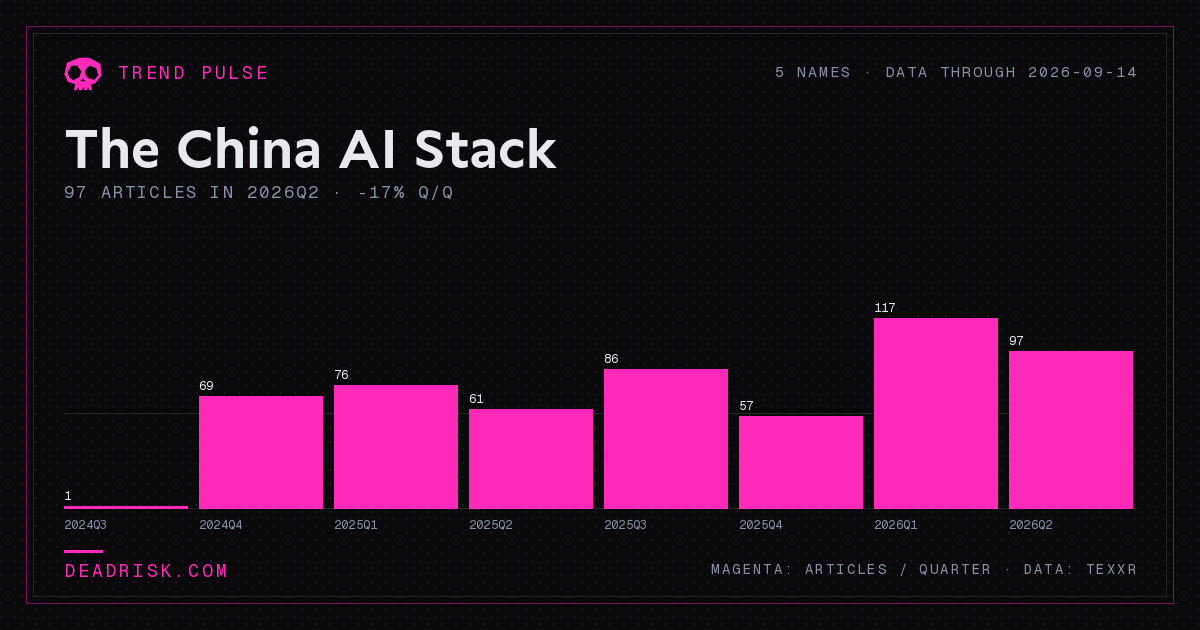
Across 5 member names, 2026Q2 drew 97 articles against 117 in 2026Q1. The largest single move was SMIC, -40%.
Coverage data as of 2026-09-15 · the essay above was last revised 2026-09-10