The argument
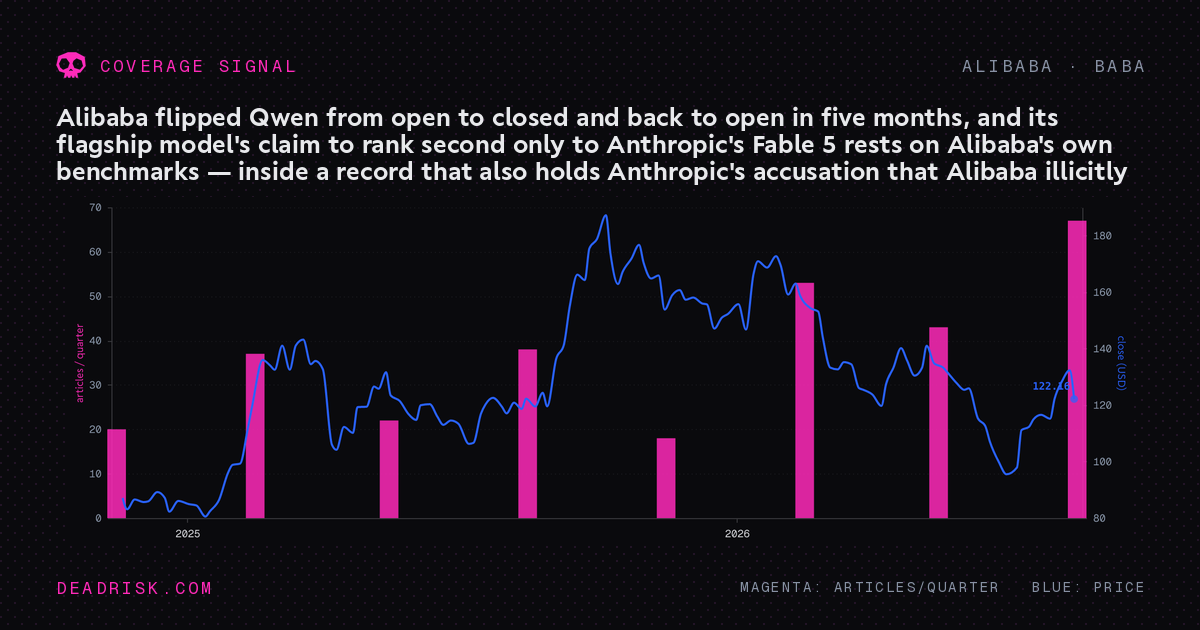
The tape · quarterly coverage amplitude · live quarter blinking
Alibaba (NYSE: BABA) is an e-commerce and cloud conglomerate that the registry files under ai-labs, on the strength of one product line: Qwen, the model family Alibaba Cloud trains and serves. That is the whole case for the sector tag — TEXXR’s corpus otherwise logs a company still built on Taobao listings, logistics, and the AliExpress storefront it has run for two decades. Qwen is why this page exists, and Qwen is also why the record is hard to read cleanly: over five months in 2026, Alibaba took its flagship model from open-weight, to a closed commercial license, to a preview it kept behind an API while claiming the preview rivaled the industry’s best, back to a promise — not yet kept, as of this writing — to open the weights again.
That promise is the second-order story a sector tag alone won’t tell you. Alibaba doesn’t just build AI models; it runs the compute layer — Alibaba Cloud, plus a proprietary chip line called T-Head — that every one of those model decisions sits on top of. A licensing flip on Qwen is also a decision about how much of that infrastructure investment Alibaba lets competitors use for free. The corpus holds that flip dated and sourced. It also holds something the flip’s own coverage doesn’t mention: an accusation, from the lab Alibaba’s newest model claims to trail by only a hair, that Alibaba got some of that performance by copying Anthropic’s own model.

Qwen was open-weight for most of its life. Alibaba debuted the Qwen3 family in April 2025 as open-weight “hybrid” reasoning models, and kept releasing open-weight Qwen3.5 and Qwen3.6 variants into early 2026. That run had a cost: on 2026-03-04, TechCrunch reported that the Qwen team’s tech lead, Junyang Lin, abruptly stepped down, with two more team members leaving the same week, a day after Alibaba shipped a new round of open-weight small models — one contributor’s comment, quoted in the piece, that leaving “wasn’t your choice,” is the only account in the record of what happened.
The reversal came three months later. On 2026-06-03, Alibaba released Qwen3.7-Plus under a closed license — a break from the open-weight pattern plain enough that a commenter in the article’s own discussion thread asked, in public, “open source, wen?” Three weeks after that, on 2026-06-25, Anthropic went public with an accusation that had nothing to do with licensing: Alibaba had illicitly extracted Claude’s capabilities, reportedly using roughly 25,000 fake accounts. BABA fell 4.74% the next session, from a close of $99.80 to $95.07, and kept sliding to a close of $94.81 the following day — the low point of the year the price record shows. Ten days later, on 2026-07-05, The Information reported that Alibaba had banned Claude Code internally and told employees to remove all Claude models from work computers, citing Anthropic’s own security concerns — a company that stands accused of extracting a rival’s model, blocking its own staff from using that rival’s tools, all inside two weeks.
Two weeks after the ban, the reversal ran the other way. On 2026-07-19, Alibaba previewed a 2.4T-parameter Qwen3.8 Max and said it was comparable to frontier AI models and “second only to Fable 5” — Anthropic’s current flagship, the same lab that three weeks earlier had accused Alibaba of copying its work. Alibaba said the preview would go open-weight “soon.” BABA rose 4.67%, from $114.97 to $120.34, over the two sessions the market had to react — and gave essentially all of it back within three more sessions, closing at $114.06 by 2026-07-23, almost exactly where it started. The market, in other words, did not treat “second only to Fable 5” as a rerating event. On 2026-08-03, Alibaba shipped the full Qwen3.8-Max, again claiming it topped rival Kimi K3 on benchmarks and again promising open weights — this time “next week.” Every one of those performance claims, across both the preview and the full release, is Alibaba’s own description of its own benchmark results. Nothing in the corpus shows an outside lab, leaderboard operator, or independent evaluation confirming the “second only to Fable 5” ranking; outlet after outlet in the related coverage frames it the same way the Bloomberg headline does — as something “Alibaba says,” “Alibaba claims.” A model that performs close to Claude is a plausible outcome of good engineering. It is also the outcome you’d expect if some of what it learned came from Claude’s own outputs, which is the accusation sitting five weeks earlier in the same record. The corpus cannot adjudicate between those two explanations — it only has the claim, sourced to the company making it, and the accusation, sourced to the company it names.

The spectrogram
Signal decomposition · what the record is made of, by quarter · brightness = share of edges · drift = how far the story moved in meaning
In 2024Q1 the record was 41% financial; by 2026Q1 it is 34% launch. A price chart shows what a name did; the spectrogram shows what its story is made of.
The brains
Alibaba’s revenue and Qwen downloads are measurable, but falling profit and missing long-run inputs leave Graham’s margin of safety unproved after the quote fell from $130.53 to $119.34.
Alibaba shows AI output, but the record lacks the debt and cash-flow data needed to show that its buildout pays for itself.
The machine
Alibaba’s last 500 hyperedges in TEXXR’s graph, dating to 2024, run 39.4% financial and 30.4% launch — a mix that says the record spends more time pricing Alibaba’s moves than describing new ones, roughly the inverse of a name still mostly shipping product. The financial share isn’t all Qwen: on 2026-07-29, the South China Morning Post reported that a CXMT IPO prospectus disclosed a roughly 5% Alibaba stake now worth more than $20 billion — a nearly 20x return, and a reminder that Alibaba’s exposure to the AI capex buildout runs through equity stakes in chipmakers, not only through its own model line. Regulatory edges sit at 7.6% of the total, including a 2026-07-08 Reuters report that Chinese authorities met with Alibaba, ByteDance, and Z.ai to discuss restricting overseas access to China’s top AI models — the regulatory backdrop the whole China AI stack pillar sits inside, and the one context in which “open-weight soon” is a policy question as much as a product one.
The money

Currency: USD. Revenue/net income/capex/FCF cross-checked against filed XBRL.

Positioning: how much of BABA is sold short, on the record brokers file twice a month. It lags by design — read it as where the crowd stood, not where it stands.
Order flow is signed before it becomes revenue — the earliest of the three views. From the capital-flow ledger.
The record
- Whether Qwen3.8-Max’s weights actually post. Alibaba named a date — “next week” from 2026-08-03 — for a promise it has already made and not kept once, on 2026-07-19. A second slip would be the more informative data point.
- Whether an independent benchmark run enters the record. Every “second only to Fable 5” claim so far is Alibaba’s own. A confirmed edge citing an outside evaluation, positive or negative, would be the first non-self-reported data point on the question.
- Anthropic’s accusation, still without a public resolution in the corpus. No article yet records a legal filing, a retraction, or a settlement — just the June 25 accusation and Alibaba’s July 5 internal ban.
- The overseas-access restrictions discussed in the July 8 regulatory meetings. If Beijing limits foreign access to Chinese models, “open-weight soon” gets read against a policy constraint, not just a product decision.
| Quarter | Articles | QoQ | Q-end price | QoQ | The record reads |
|---|---|---|---|---|---|
| 2024Q4 | 20 | — | 82.62 USD | — | first quarter on record |
| 2025Q1 | 37 | +85% | 128.85 USD | +56.0% | attention and price rose together |
| 2025Q2 | 22 | -41% | 112.38 USD | -12.8% | attention and price fell together |
| 2025Q3 | 38 | +73% | 177.10 USD | +57.6% | attention and price rose together |
| 2025Q4 | 18 | -53% | 145.25 USD | -18.0% | attention and price fell together |
| 2026Q1 | 53 | +194% | 124.32 USD | -14.4% | attention rose as price fell |
| 2026Q2 | 43 | -19% | 95.98 USD | -22.8% | attention and price fell together |
| 2026Q3 open | 63 | +47% | 108.76 USD | +13.3% | attention and price rose together (quarter in progress) |
The peers
Alibaba Group Holding lives or dies by the same constraint as these names — small equal-weighted groups, one constraint each. Not investment products: see all categories.
The other stack — the compute constraint, 2.3 independent bets across 7 names
Sources
Price series (as-traded, NYSE): $120.63 close 2025-07-31 to $122.25 close 2026-07-31, +1.34% over one year — a flat headline number that hides a 56.96% run to a $189.34 close on 2025-10-02 peak, followed by a 49.93% drawdown to a $94.81 close on 2026-06-26 trough, then a 28.94% recovery into July. Single-session reads: -4.74% ($99.80 to $95.07, 2026-06-24 to 2026-06-25, the Anthropic-accusation session) and +4.67% ($114.97 to $120.34, 2026-07-17 to 2026-07-20, the Qwen3.8 Max preview session), which faded to -0.79% net by 2026-07-23 ($114.97 to $114.06) — all computed from data/prices/baba.json, 2026-08-03. No session data is available in this file past 2026-07-31, so the market’s reaction to the 2026-08-03 Qwen3.8-Max full launch is not yet reflected in any figure on this page.
Edges (TEXXR knowledge graph, queried 2026-08-03): 99501, 99503, 401921, 404487, 404488, 406656, 406657, 408140, 408141, 408158, 409338, 409339, 410041, 410043, 410044. Edge profile for Alibaba since 2024-01-01: 500 edges, 39.4% financial, 30.4% launch, 7.6% regulatory, 6.6% partnership, 3.8% controversy.