Thinker lens
Benjamin Graham
The man who split price from value — a useful split when an industry prices the future before the facts arrive.
The Lens
Graham’s method comes down to one habit: never let the quote stand in for the thing. A stock’s price on any given day is not a verdict, it’s an offer — from a character Graham called Mr. Market, who shows up daily with a bid for what you own and an ask for what you might buy, priced high when he’s euphoric and low when he’s despondent. He is right often enough to be trusted and wrong often enough to be dangerous. The investor’s job isn’t to predict his mood. It’s to already have a number — an intrinsic value, built from the assets, earnings, dividends, and definite prospects a business actually has — and to insist on a gap between that number and the price paid. That gap is the margin of safety. No estimate of a business’s worth is precise enough to bet on the exact spread, so Graham left room for being wrong.
Speculation prices the story. Investment prices the business and waits for the market to agree, eventually, or not. This isn’t a personality trait or a temperament test. It’s an arithmetic discipline that happens to require temperament to hold to, because Mr. Market is loudest exactly when the gap between price and value is widest.
Why It Matters Now
The lens matters wherever price is set by narrative faster than by results, and that describes the AI capital cycle running through tech coverage right now. Hyperscalers are committing capital in amounts that outrun their own quarter-old guidance — see The AI Capex Supercycle — while the payoff is a multi-year bet nobody can price with Graham’s preferred inputs: current assets, current earnings, current dividends. The facts lag the announcements by design. That’s precisely the condition Graham built his framework to survive, not predict: when you can’t get a tight fix on intrinsic value, the discipline is to demand a wider margin, not a better forecast.
Applied to Tech Markets
Nvidia’s own coverage record is Mr. Market in real time. The company crossed a $4T market cap in July 2025, then $5T that October — up roughly a quarter in market value inside four months on the strength of AI system sales. By July 2026 it had shed about $1T from its May high, a 16% drop that left it trading at 18x forward earnings, its lowest multiple since 2019 — even as revenue kept setting records. That’s not a comment on where the stock goes next; the record doesn’t do forecasts. It’s the plainest illustration available of why Graham insisted on separating the quote from the business: whichever number was closer to “right,” both couldn’t be. See Nvidia for the full coverage arc.
Meta’s capex guidance tells a related story about the margin-of-safety question itself, not just the price swing. In January 2026 the company guided 2026 capex to $115B–$135B, above the Street’s $110.6B estimate and well above the $72.2B it spent in 2025. Three months later it raised that range again, to $125B–$145B — a further 7.4% jump — and the stock fell more than 10% on the news, despite record sales in the same report. That’s the tell: when spending guidance keeps re-pricing upward and the market’s reaction to more of it flips from tolerant to punitive within a quarter, nobody has actually settled what the spending is worth. Graham’s test was never “is the company growing” — it was whether a price is justified by facts already on the table. Right now, for the names carrying the AI capex load, the facts keep arriving after the price does.
None of this says whether the spending pays off. It says the coverage record shows a market repeatedly unable to hold a stable answer to a question Graham considered non-negotiable: what is the business actually worth, separate from what people currently feel about it.
The Library
Security Analysis (1934, with David Dodd) is the source text — dense, written for practitioners, and the place the vocabulary of intrinsic value and margin of safety was first laid down as arithmetic rather than intuition. It reads like a manual because it is one.
The Intelligent Investor (1949; the widely read edition carries Jason Zweig’s commentary) is the popularized, temperament-focused version — less spreadsheet, more discipline for holding to the spreadsheet when the market makes you doubt it. Its clearest line still holds: “Investment is most intelligent when it is most businesslike.”
Sources
- Benjamin Graham & David L. Dodd, Security Analysis
- Benjamin Graham (with Jason Zweig commentary), The Intelligent Investor
- “Nvidia lost ~$1T in market value in less than two months, dropping 16% from its May all-time-high, trading at 18x forward earnings, its lowest level since 2019” — Bloomberg, Jul 9, 2026. https://www.bloomberg.com/news/articles/2026-07-08/nvidia-s-1-trillion-slide-sends-valuation-to-pre-ai-boom-levels · TEXXR record: https://texxr.com/1172298
- “Nvidia opens at a $5T market cap, becoming the first company to hit the milestone” — Financial Times, Oct 29, 2025. https://www.ft.com/content/62933c70-261c-4b7a-a045-3f9f9cceccd7 · TEXXR record: https://texxr.com/891897
- “Nvidia hits a $4T market cap in intraday trading, the first company to do so” — CNBC, Jul 9, 2025. https://www.cnbc.com/2025/07/09/nvidia-4-trillion.html · TEXXR record: https://texxr.com/887696
- “Meta expects its 2026 capex to be $115B to $135B, compared with a $110.6B analyst estimate and $72.2B in 2025” — Bloomberg, Jan 29, 2026. https://www.bloomberg.com/news/articles/2026-01-28/meta-says-2026-spending-will-blow-past-analysts-estimates · TEXXR record: https://texxr.com/1162353
- “Meta raises its 2026 capex to between $125B and $145B, above analysts’ est. and marking a ~7.4% jump from its $115B-$135B forecast in January” — Bloomberg, Apr 30, 2026. https://www.bloomberg.com/news/articles/2026-04-29/meta-raises-outlook-for-capital-spending-in-2026-shares-slide · TEXXR record: https://texxr.com/1168006
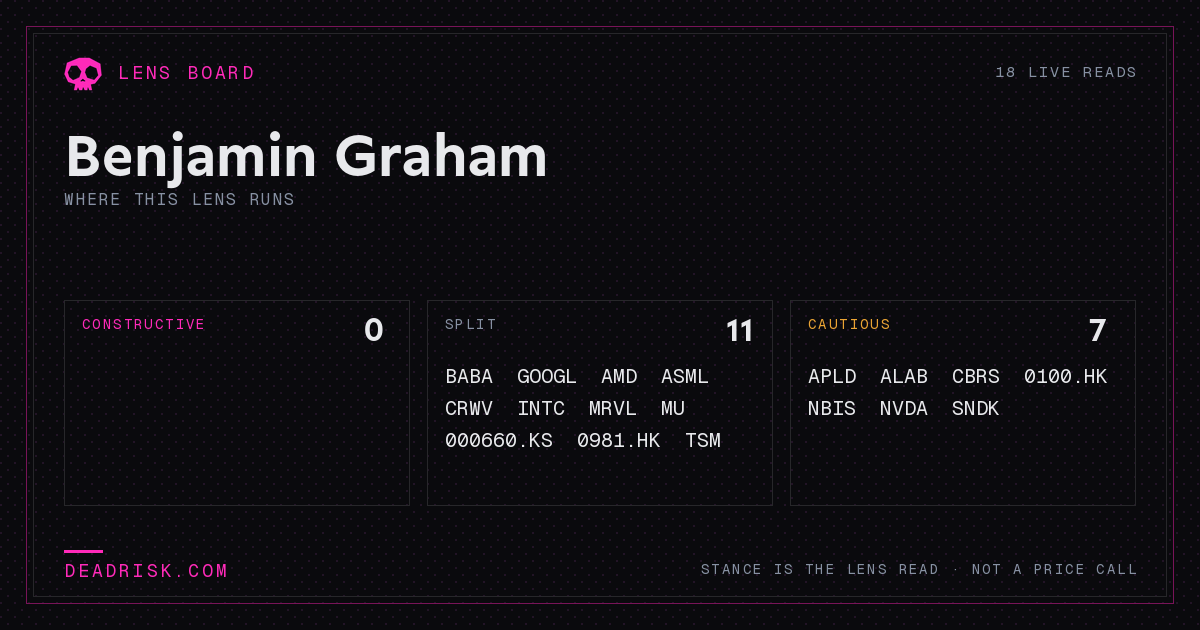
Where this lens runs
-
Alibaba Group Holding BABA
cautious
Alibaba’s revenue and Qwen downloads are measurable, but falling profit and missing long-run inputs leave Graham’s margin of safety unproved after the quote fell from $130.53 to $119.34.
-
Alphabet GOOGL
cautious
The equity stakes are the rare disclosed, quantifiable asset Graham liked hunting for — until the number attached to them turns out to be a private mark, not an earnings record.
-
AMD AMD
cautious
AMD's earnings have strengthened, but the supplied record cannot establish a Graham margin of safety at the September 4 quote.
-
ASML ASML
cautious
The financials clear Graham's bar cleanly; the variable that moves them most was set by a ministry, not a market.
-
CoreWeave CRWV
cautious
Safety of principal presumes a demonstrated earnings record — CoreWeave offers a backlog and two years of public financials instead.
-
Intel INTC
cautious
Intel’s operating record has improved, but the supplied evidence cannot establish a margin of safety at the $104.47 close on September 8, 2026.
-
Marvell Technology MRVL
cautious
Google’s warrant makes Marvell’s custom-silicon case more definite, but the supplied record cannot establish a Graham margin of safety at the August 20 close of $251.01.
-
Micron MU
cautious
Micron’s revenue supports the business case, but the record lacks the earnings, cash-flow, depreciation, and valuation inputs needed to establish a Graham margin of safety.
-
SK Hynix 000660.KS
cautious
SK Hynix’s dated HBM lead is tangible, but conflicting expansion figures and missing valuation inputs leave no demonstrable Graham margin of safety.
-
SMIC 0981.HK
cautious
SMIC’s second-quarter profit beat strengthens the earnings record, but missing asset, dividend, and valuation inputs leave its margin of safety unmeasurable.
-
TSMC TSM
cautious
The record's own hedge — a $265 billion US buildout — is a company pricing a risk Graham's arithmetic has no cell for.
-
Applied Digital APLD
averse
Sixteen billion dollars in contracted leases and two articles in the record built to check them against.
-
Astera Labs ALAB
averse
Astera’s growth validates the business, but missing cash-flow and valuation inputs leave no measurable margin of safety after the stock fell from $319.74 to $303.62.
-
Cerebras Systems CBRS
averse
Two months of public trading and one earnings print is not the thorough analysis Graham's definition of investment requires.
-
MiniMax Group 0100.HK
averse
H3 adds a product milestone, but MiniMax’s losses, proposed financing, and missing cash-flow record still leave Graham’s margin of safety unmeasurable.
-
Nebius Group NBIS
averse
A relisted spinoff, accelerating coverage momentum, and widening losses under an identity barely two years old.
-
Nvidia NVDA
averse
Nvidia’s fresh product gains strengthen the business record, but the supplied earnings record still cannot establish Graham’s margin of safety.
-
SanDisk SNDK
averse
SanDisk’s earnings growth and structural partnerships support the business story, but the supplied record cannot establish intrinsic value or a margin of safety at the current quote.