Trend pillar
The AI Capex Supercycle
Chips fund the clouds that buy the chips that train the models that raise the money — the record shows the loop tightening every quarter since 2024.
Nvidia, OpenAI, and CoreWeave Form a Financing Loop Around Nvidia Capacity
The Thesis
Nvidia sells chips to CoreWeave. CoreWeave uses a Meta services contract as collateral to borrow $8.5 billion from banks, then builds the data center that houses the chips Nvidia sold it. Nvidia separately commits $30 billion in equity to OpenAI. OpenAI, for its part, now holds roughly $2.6 billion in CoreWeave and Cerebras stock — payment in kind for committing to buy their chips and cloud time, and in Cerebras’s case, for lending it money too.
That is the AI capex supercycle: not a spending number but a financing shape. Four groups — chipmakers, hyperscalers, “neoclouds” like CoreWeave, and model labs — sell to each other, take stakes in each other, and borrow against each other’s contracts. TEXXR’s coverage record does not prove that this loop tightened every quarter. It shows that coverage of AI data-center capex rose from 85 articles in 2024 Q1 to 534 in 2026 Q2. The trade press itself also named the structure a closed loop: Bloomberg’s October 2025 chronicle of “a wave of circular deals” among Nvidia and OpenAI sat inside a TEXXR coverage cluster containing 54 archive pieces, from a Bank of England bubble warning to an outlet titled, without much subtlety, “OpenAI’s Trillion-Dollar Circle: When Vendors Finance Their Own Payday.”
Every ticker on this page sits somewhere in the loop. Nvidia is the chip. CoreWeave is the neocloud building the capacity. Salesforce is a step removed — a software incumbent whose balance sheet and pricing are now tied to the same cycle through an equity stake and a credit market that is starting to price in AI-linked risk. This page tracks what the record shows about the loop: how fast it grew, who is financing it, and where the record itself flags strain. What the loop is ultimately underwritten by — token demand, and how many years it needs to arrive — is the arithmetic on the token ceiling. This page does not forecast where any of these stocks go next.
The Evidence
The clearest number in TEXXR’s archive isn’t a dollar figure — it’s a coverage count with a baseline. Quarterly volume on AI data-center capex ran at 85 articles in 2024 Q1. By 2024 Q4 it was 132. By 2025 Q4, 304. By 2026 Q2, 534 — a 6.3x jump in nine quarters, out of 2,879 articles tagged to the topic across 45 observed quarters ending in 2026 Q2. The sharpest single-quarter shift in what that coverage was actually about, measured by semantic drift — the quarter-to-quarter change in the archive’s article-topic mix — lands earlier than the current boom’s timeline suggests: 2020 Q4, when Nvidia’s early supercomputer commitments and pandemic-era cloud spending first pulled the topic away from ordinary data-center announcements. The latest coverage increase is the second inflection, not the first.
The Stargate venture shows how unstable a single mega-deal can be even while the totals climb. OpenAI, SoftBank, and Oracle unveiled the $500 billion project in January 2025. By July, the Wall Street Journal reported it had “struggled to get off the ground” and had sharply scaled back its ambitions. By September, it had expanded again — five new US sites, pushing planned capacity toward 7 gigawatts. By February 2026, The Information was reporting that OpenAI had scrambled for compute as Stargate stalled amid clashes with SoftBank. The headline number survived; the plan under it kept changing.
The financing web is the part that repeats across every name in this cycle. Nvidia announced up to $100 billion for OpenAI in September 2025; by January 2026 that commitment had stalled and failed in its original form. CNBC then reported a $30 billion OpenAI investment in March 2026. The cited records do not establish that the March investment replaced the September plan. By May, it was one piece of more than $40 billion in equity Nvidia committed across the AI stack in 2026 alone, per its own disclosures. CoreWeave sits downstream of that money and upstream of the compute: its $11.9 billion, five-year contract with OpenAI came bundled with $350 million of CoreWeave stock issued to OpenAI at IPO — the customer as shareholder. Its Meta services contract became loan collateral the same year: reporting in February said CoreWeave was seeking bank financing backed explicitly by that Meta paper, and by March 31 the deal closed at $8.5 billion, which CoreWeave itself called “the largest chip-backed debt deal of its kind.” CoreWeave has also moved $2.6 billion of data-center construction debt off its own balance sheet using special-purpose vehicles — a capex-accounting maneuver with a direct precedent, covered below.
The money increasingly isn’t equity — it’s debt, and it’s compounding. Morgan Stanley estimated in August 2025 that hyperscalers would fund $1.4 trillion of a projected $2.9 trillion in AI infrastructure need, leaving more than half to bonds, private credit, and vehicles like CoreWeave’s. By June 2026, the same firm had raised its forecast again: global AI-tied debt issuance more than doubling to nearly $570 billion in 2026. TSMC, sitting upstream of the whole chain, keeps raising its own number too — its 2026 capex guidance moved from $52–56 billion to $60–64 billion in July, citing the “AI megatrend” directly. Even names a step removed feel it in their borrowing costs: Salesforce sold $25 billion in bonds in March 2026 at what the Financial Times called a “significant premium,” a sign, its sources said, of Wall Street jitters that have moved past the direct participants.
The record also carries the counter-evidence. The Wall Street Journal’s November 2025 accounting of the buildout put 2025’s US data-center capacity — built, underway, planned, or stalled — above 80 gigawatts, running into what it called the “ground truths of physical” limits: power, water, chips, and local opposition that don’t scale as fast as balance sheets do. One economist’s estimate, cited in a January 2026 Financial Times piece, put the whole AI investment boom at roughly 1% of US GDP — comparable in scale to prior investment booms, which is a benchmark, not a verdict on how this one ends.
The Companies
Nvidia sits at both ends of the loop. It supplies the chips every other name here is spending to acquire, and it increasingly funds the customers buying them: the OpenAI equity stake, the CoreWeave stake, the more than $40 billion in 2026 equity commitments across the stack. When Jensen Huang said an investment “might be the last time” Nvidia writes a check that size, TEXXR’s record treated the remark as news, not reassurance.
CoreWeave is the neocloud in the middle — Nvidia-backed since before its 2025 Nasdaq IPO, running 43 active data centers as of April 2026 (the same month it signed a multiyear Nvidia-chip supply deal with Anthropic), and holding a $99.4 billion revenue backlog against contracts with OpenAI, Meta, and Anthropic. It is also the clearest single case of the loop’s financial engineering: debt moved off its balance sheet through special-purpose vehicles, then more debt raised against the very hyperscaler contracts that are supposed to prove its demand is real rather than circular.
Salesforce isn’t building data centers. It’s the second-order name: a roughly $5 billion equity stake in Anthropic ties its balance sheet to the same cycle, its Agentforce pricing is shifting from flat subscriptions toward usage-based AI fees as compute costs eat into software margins, and its March 2026 bond sale — priced at a premium — is the record’s clearest sign that AI-linked credit risk has reached investment-grade enterprise software, not just the chipmakers and clouds.
The Lenses
Benjamin Graham asks whether each deal works on its own cash flows. Security Analysis rejects new-era arguments that suspend ordinary underwriting. Applied here, each contract needs a price, funding cost, useful life, and enforceable customer obligation. Revenue backlog and announced capacity cannot substitute for those inputs. The Intelligent Investor adds the margin-of-safety test: assumptions need room to fail without wiping out the capital structure.
Robert Shiller asks how the story alters the financing environment. Narratives spread through markets and feed back into behavior. Bloomberg put “circular deals” into circulation in October 2025. Banks, regulators, and investors can apply that label to separate transactions before any filing proves that cash literally completed a circle. Bloomberg’s October 2025 report does not show whether the label changed loan terms or capex plans.
What Moved
Since July 18, CNBC, Reuters, Bloomberg, and the other cited outlets have reported new evidence on supplier concentration, physical capacity, local inference, and profit quality. Four reports since September 5 add supplier-linked warrants, chip collaboration, manufacturing commitments, and resistance to data-center subsidies. CNBC’s Qualcomm report, Reuters’s OpenAI report, Bloomberg’s ASML report, and the Wall Street Journal’s subsidy report do not establish that the financing loop broke or tightened. They show how capacity plans now come bundled with equity rights, long-dated tooling changes, and political conditions.
- 2026-09-09 — Supplier-linked warrants: Qualcomm announced an AWS partnership for data-center infrastructure and issued Amazon warrants covering $4 billion of Qualcomm stock, CNBC reported. The $4 billion is warrant coverage, not recorded cash outlay by Amazon. CNBC did not report that Amazon exercised the warrants.
- 2026-09-09 — Chip collaboration: OpenAI is working with Samsung on next-generation chips, Reuters reported. OpenAI also called Samsung one of the largest-scale global deployments of ChatGPT. Reuters gave no spending figure, production capacity, or delivery schedule.
- 2026-09-09 — Manufacturing path: Samsung and TSMC committed to using ASML’s High NA EUV machines by 2028 and 2030, joining Intel, Bloomberg reported. All four companies also agreed to move from 6-inch to 12-inch photomasks. Bloomberg reported future adoption deadlines, not installed 2026 capacity.
- 2026-09-09 — Local resistance: More than 10 US states have rolled back tax breaks for tech companies, the Wall Street Journal reported. Those breaks exceed $1 billion per year in some states. The Journal documented subsidy withdrawal, not canceled data-center capex.
- 2026-09-04 — Local inference: Microsoft unveiled Project Zenith for developers to run models with more than 30 billion parameters locally on devices with at least 64GB of memory. The Verge reported a product announcement, not evidence that local inference displaced data-center workloads.
- 2026-09-02 — Sovereign funding: SemiAnalysis described South Korea’s plan for $919 billion of AI-infrastructure investment and expanded Nvidia ties with Samsung and SK Hynix. The $919 billion is planned investment, not recorded outlay.
- 2026-08-30 — Memory capacity: SK Hynix broke ground on a $4 billion advanced-memory packaging facility in Indiana. Bloomberg said next-generation HBM mass production is scheduled for the second half of 2029. The roughly three-year gap from the 2026 groundbreaking is a derived lead-time floor, not current supply.
- 2026-08-26 — Custom silicon: SemiAnalysis tested OpenAI’s Jalapeño, an ASIC developed with Broadcom. The report said it beat Nvidia, AMD, and Google chips on several top open-weight models. That establishes the result on SemiAnalysis’s benchmark set, not across all workloads.
- 2026-08-15 — Investment gains: Amazon and Alphabet’s other income, mostly investment gains, totaled about $121 billion after tax in 2026 Q2. The Wall Street Journal said that equaled 66% of Amazon’s quarterly profit and 71% of Alphabet’s.
- 2026-08-14 — Cerebras distribution: OpenAI previewed Ultrafast, an API tier powered by Cerebras. OpenAI placed a non-Nvidia supplier inside a customer-facing product.
- 2026-08-12 — Cerebras results: Cerebras reported 2026 Q2 revenue of $180 million, up 74% from 2025 Q2. Revenue missed the $194.23 million estimate cited by Reuters by $14.23 million, or 7.3%, based on subtraction and division.
- 2026-07-29 — Corning bottleneck: Corning reported 2026 Q2 sales of $4.74 billion, up 17% from 2025 Q2. Corning said production limits constrained AI-connectivity sales. Its shares closed down 12.1% from the prior close.
- 2026-07-24 — Supplier mixing: AMD and Cerebras are integrating AMD server racks with Cerebras wafer-scale chips for AI inference.
- 2026-07-18Pillar launch. TEXXR counts 534 AI data-center capex articles for 2026 Q2, compared with 85 in 2024 Q1.
- 2026-06-10Morgan Stanley forecasts nearly $570 billion of global AI-linked debt issuance in 2026, more than twice its prior forecast.
- 2026-03-05CNBC reports Nvidia’s recent $30 billion OpenAI investment. That amount is $70 billion below the September 2025 plan’s ceiling, based on subtraction; the cited reports do not call it a replacement.
Sources
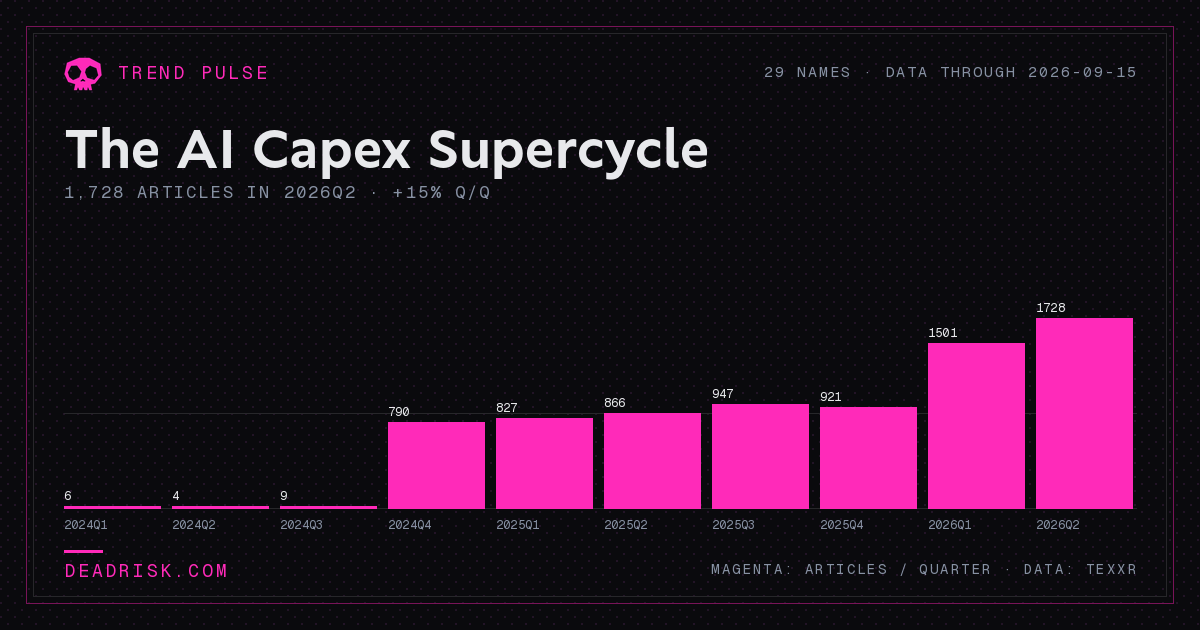
Across 29 member names, 2026Q2 drew 1,728 articles against 1,501 in 2026Q1. The largest single move was Marvell Technology, +233%.
Coverage data as of 2026-09-15 · the essay above was last revised 2026-09-12