The argument
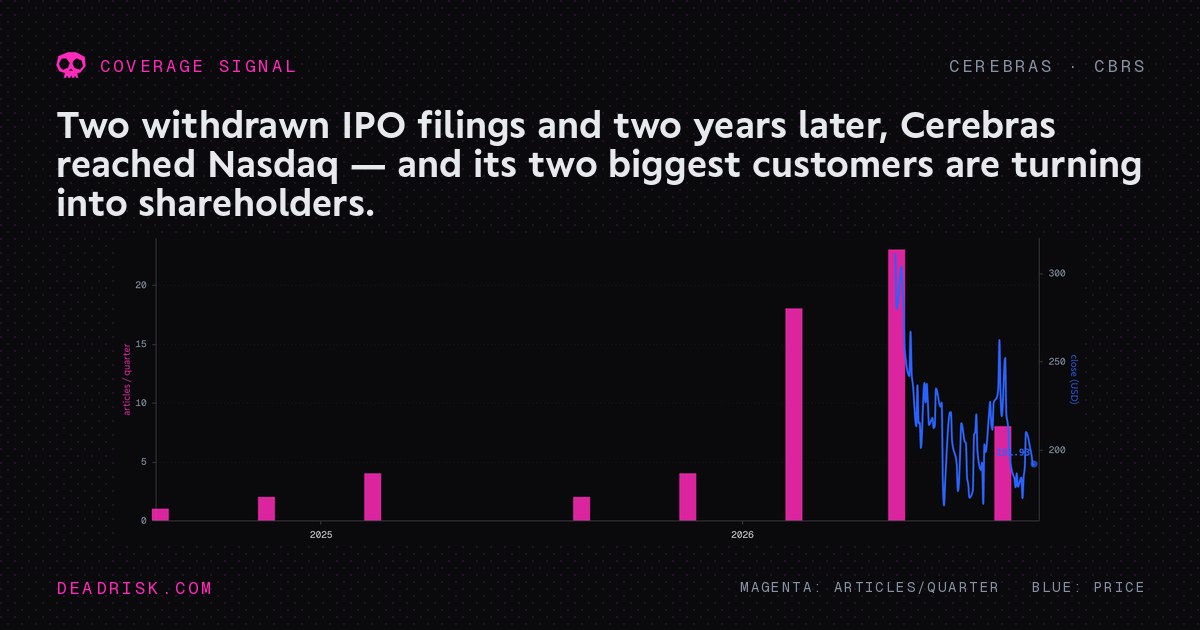
The tape · quarterly coverage amplitude · live quarter blinking
G42 accounted for 87% of Cerebras’ first-half-2024 revenue and separately committed $335 million to Cerebras stock. The supplied records do not show that the purchase closed.
Cerebras Systems (CBRS, Nasdaq) builds wafer-scale chips for training and running AI models — one large piece of silicon per chip, instead of the small dies most chipmakers cut from a wafer and wire together afterward. The company priced its IPO at $185 a share on May 13, 2026, above its raised range of $150–$160. It sold 30 million shares for $5.55 billion, derived from the price and share count. That made it the year’s largest US tech listing and the largest since Uber’s in 2019. Shares opened at $350 and closed the first trading day at $311.07, up 68% from the $185 IPO price, at roughly $67 billion in market value.
Cerebras had withdrawn its September 2024 public filing in October 2025. It filed publicly again in April 2026. That second public filing led to the May listing.

TEXXR’s corpus first tagged Cerebras on September 1, 2017: a Forbes profile of a “little known Los Altos-based” startup worth $860 million with no shipped product yet. Benchmark had led a $27 million Series A the year before. By November 2021, a $250 million Series F put the company at a $4 billion valuation and $720 million raised in total.
Coverage stayed thin for years after that. TEXXR counted one to four Cerebras-tagged corpus articles per quarter from 2023 through most of 2025. The IPO process changed that. Sources first floated a listing in January 2024. TEXXR still carries that edge as “rumored” rather than confirmed or denied. As of August 2026, it had remained unresolved for more than 900 days, among the longest-running unresolved corporate-action edges tied to Cerebras.
Cerebras filed confidentially that June, then publicly that September, reporting a $66.6 million net loss on $136.4 million in first-half-2024 sales. Reuters reported in March 2025 that CFIUS was reviewing G42’s $335 million investment commitment. Cerebras said later that month that it had resolved “all open issues.” It withdrew the public filing in October 2025, after a $1.1 billion private raise valued the company at $8.1 billion.
Four months later, a $1 billion Series H led by Tiger Global and joined by AMD valued Cerebras at $23 billion, compared with $8.1 billion after the prior raise. Cerebras filed publicly again in April 2026. CNBC’s April 18 report on that filing gave revenue of $510 million for the year ended December 31, 2025, up 76% from about $289.8 million in 2024, derived from the stated growth rate. CNBC also reported FY2025 net income of $87.9 million, against a $485 million FY2024 net loss. The DeadRisk market layer instead records FY2025 revenue of $510.0 million against $290.3 million in FY2024, and FY2025 net income of $237.8 million against a $481.6 million FY2024 net loss. The two records differ by $149.9 million on FY2025 net income, derived. No supplied reconciliation explains the difference.
For the year ended December 31, 2025, the market layer records EBITDA of negative $110.8 million, versus negative $90.1 million in FY2024; operating cash flow of negative $10.1 million, versus positive $452.0 million; capital expenditure of $382.7 million, versus $23.4 million; and free cash flow of negative $392.8 million, versus positive $428.5 million. The FY2025 net-income swing therefore did not carry through to cash flow in that record.
TEXXR counted 18 Cerebras-tagged articles in Q1 2026 and 23 in Q2, against a prior quarterly high of four from 2023 through most of 2025. The Q2 count was 5.75 times that prior high. TEXXR also counted extracted subject-predicate-object claims. In Q1 2024, financial, launch, and partnership predicates each supplied one-third of the mix. By Q2 2026, financial predicates supplied 57% and competitor predicates supplied 43%, up from 0% for competitor predicates in Q1 2024. The counterparties in those two periods did not overlap. By the IPO quarter, publishers framed Cerebras less as a chip launcher and more as Nvidia’s rival.
By September 1, 2026, the DeadRisk market layer recorded CBRS at $172.62 per share, down 6.3% from the prior close and 21.5% over the preceding 30 days. That close was $12.38, or 6.7%, below the $185 IPO price and $138.45, or 44.5%, below the $311.07 first-day close. The dollar and percentage gaps to the IPO benchmarks are derived.

The spectrogram
Signal decomposition · what the record is made of, by quarter · brightness = share of edges · drift = how far the story moved in meaning
In 2024Q1 the record was 33% launch; by 2026Q1 it is 57% financial. A price chart shows what a name did; the spectrogram shows what its story is made of.
The brains
Wafer-scale silicon reads as a genuine cornered resource — CUDA's switching costs are the wall it still has to clear.
Cerebras has delivered strong Q1 growth, but its post-IPO price reversal and abrupt coverage surge show Shiller's feedback loop shifting from recruitment to reassessment.
Two months of public trading and one earnings print is not the thorough analysis Graham's definition of investment requires.
The machine
Cerebras’ revenue has run unusually concentrated in a relationship that also showed up as a proposed shareholding. Abu Dhabi’s G42 accounted for 87% of first-half-2024 revenue, by Cerebras’ own account in its IPO filing, while separately committing to buy $335 million of Cerebras stock — enough for a stake above 5%. That proposed overlap between top customer and top shareholder is what drew the CFIUS review. The supplied records do not show that the purchase closed.
The supplied source-card record does not establish that OpenAI both committed to buy Cerebras compute and became, or agreed to become, an equity holder. It therefore does not support a two-counterparty pattern. On this page’s documented record, G42 is the only customer whose purchase commitments sit beside a prospective stake. That still places Cerebras inside the broader AI capex story of labs and hyperscalers pre-funding the suppliers they depend on.
The rest of the graph adds named customers. AWS said in March 2026 that it would deploy Cerebras’ Wafer-Scale Engine for inference workloads alongside its own Trainium chips. The announcement generated 17 near-identical TEXXR corpus edges the same day. That measures duplicated same-day coverage, not deployment. Mayo Clinic and Mistral both show up as customers in 2024 and early 2025, outside the G42 relationship. AMD invested in that Series H even as Cerebras markets itself as a Nvidia alternative — a less odd pairing once you notice AMD wants that outcome too.
The money

Currency: USD. Revenue/net income/capex/FCF cross-checked against filed XBRL.

Positioning: how much of CBRS is sold short, on the record brokers file twice a month. It lags by design — read it as where the crowd stood, not where it stands.
The record
- Customer concentration after G42’s 87% share of first-half-2024 revenue. AWS, Mayo Clinic, and Mistral expand the set of named customers. The supplied records do not show what share of revenue each contributes. Watch Cerebras’ next largest-customer disclosure, not announcement counts.
- G42’s shareholder status. Reuters reported a $335 million commitment under CFIUS review in March 2025. The supplied records do not show that G42 completed the purchase. Watch for a filing that distinguishes committed, purchased, and beneficially owned shares.
- The margin line. Cerebras’ first earnings report as a public company showed Q1 2026 revenue of $193.4 million, up 94% from about $99.7 million in Q1 2025, derived from the stated growth rate. Management forecast that core gross margin would shrink in Q2 versus Q1. The market data provider’s calendar, captured August 26, schedules the next earnings report for November 10, 2026; issuers can move scheduled dates. Watch reported gross margin against that Q2 direction and any newer baseline.
- Earnings quality. CNBC’s April 18 filing report put FY2025 net income at $87.9 million, versus a $485 million FY2024 loss. The DeadRisk market layer records $237.8 million, versus a $481.6 million FY2024 loss. The FY2025 difference is $149.9 million, derived. That market record also shows FY2025 operating cash flow of negative $10.1 million versus positive $452.0 million in FY2024, and free cash flow of negative $392.8 million versus positive $428.5 million. Watch the filed statements for a net-income reconciliation and updated cash-flow baselines.
- Deployment evidence. AWS said it would deploy Cerebras chips, while Mayo Clinic and Mistral announced customer relationships. Announcements establish named counterparties, not utilization or revenue. Watch shipped systems, active capacity, and disclosed customer sales.
- The post-IPO price reset. The DeadRisk market layer recorded a September 1 close of $172.62 per share, down 6.3% from the prior close and 21.5% over 30 days. It was 6.7% below the $185 IPO price, derived. That is price evidence; it does not establish weaker demand, deployment, or margins.
- Coverage momentum itself. TEXXR’s latest complete-quarter count is 23 Cerebras-tagged corpus articles in Q2 2026, against an eight-quarter average of 5.2, or 4.4 times the average, derived. Q3 is incomplete. The full-quarter count will show whether coverage remains above its recent baseline; it will not establish demand or deployment growth.
- Whether the graph ever formally resolves that January 2024 “considering an IPO” edge, or leaves it permanently rumored — a small illustration of how an outcome can arrive through an entirely new edge cluster rather than closing the loop on the old one.
| Quarter | Articles | QoQ | Q-end price | QoQ | The record reads |
|---|---|---|---|---|---|
| 2024Q3 | 1 | — | — | — | first quarter on record |
| 2024Q4 | 2 | +100% | — | — | attention rose |
| 2025Q1 | 4 | +100% | — | — | attention rose |
| 2025Q3 | 2 | -50% | — | — | attention cooled |
| 2025Q4 | 4 | +100% | — | — | attention rose |
| 2026Q1 | 18 | +350% | — | — | attention rose |
| 2026Q2 | 23 | +28% | 221.00 USD | — | attention rose |
| 2026Q3 open | 8 | -65% | 181.21 USD | -18.0% | attention and price fell together (quarter in progress) |
The peers
Cerebras Systems lives or dies by the same constraint as these names — small equal-weighted groups, one constraint each. Not investment products: see all categories.
Sources
Edges (TEXXR knowledge graph): 96495, 303933, 14377, 66583, 67109, 95772, 399825, 233897, 283608, 92782, 390992, 404217, 404219, 52033