Thinker lens
Hamilton Helmer
Seven kinds of competitive Barrier, one test for each: does it survive someone actually trying to break it.
The Lens
Hamilton Helmer’s 7 Powers reduces “competitive advantage” to a claim that can be tested, not asserted. A business has Power only when two things hold at once: a Benefit that lowers cost or lifts price, and a Barrier that stops a rival from copying the Benefit once it’s visible. Neither half is enough alone — a Benefit with no Barrier is just a feature, and the market will copy it. Helmer’s field test for whether either half is real runs three words: Superior, Significant, Sustainable. The first two size the Benefit. The third asks whether the Barrier survives someone actually trying to break it.
Helmer’s research turned up seven mechanisms that clear that bar, not seven examples of one idea. Scale Economies: unit costs fall as volume rises, so a leader can price where a smaller rival loses money on every sale. Network Economies: the product grows more valuable as more people use it, so a bigger installed base outvalues a smaller one at equal price. Counter-Positioning: a challenger’s new model would wreck an incumbent’s existing, profitable one, so the incumbent doesn’t copy it. Switching Costs: a customer who has already paid to adopt a platform faces a second, separate cost to leave it. Branding: a price premium built by years of consistent delivery, which no rival can buy or speed up. Cornered Resource: preferential access to an asset — a patent, a supply deal, a person — that a rival can’t get at any price. Process Power: operational gains so embedded in an organization, built over so long a stretch, that they resist copying even with full access to the same playbook — the rarest of the seven, because it takes decades, not capital.
A business can hold more than one Power, or none. Helmer’s own line for what any of this is worth chasing: “a route to continuing Power in significant markets.” Not a good quarter. Not leadership alone. Continuing.
Why It Matters Now
Tech coverage reaches for “moat” every earnings season and rarely says which mechanism, if any, is doing the work. Helmer’s test closes exactly that gap: it forces a Barrier claim to name itself as one of seven falsifiable categories, then asks whether the record shows it holding under real pressure — a rival’s product, a regulator’s ruling, a customer’s defection — rather than resting on size or popularity alone.
The AI buildout running through the AI capex supercycle is a live test of that question, at a scale Helmer’s own cases — Netflix’s content spend, an SAP migration gone wrong, Toyota’s decades of process learning — never had to answer at once. Hyperscalers are committing capital that assumes a durable Barrier will justify it years out. Whether that Barrier is Scale Economies, Switching Costs, or nothing at all isn’t a matter of sentiment. It’s a claim the coverage record can be checked against, one name at a time.
Applied to Tech Markets
Nvidia’s CUDA software stack is close to a textbook Switching Costs case: the cost of leaving isn’t a license fee, it’s years of code, tooling, and trained engineers built against one company’s platform. SemiAnalysis wrote in January 2023 that “the CUDA monopoly is nowhere close to being broken,” even while detailing OpenAI’s push toward Triton, an alternative compiler. Sixteen months later, Meta, Microsoft, and Google joined that same OpenAI-led effort — a coalition of Nvidia’s own biggest customers building a way around CUDA, rather than simply switching to a rival’s chips. That a rival chip platform never displaced Nvidia over that stretch, and that Nvidia has since ported CUDA to RISC-V rather than let a new instruction set become an exit ramp, is the Barrier holding under real, well-funded pressure — Helmer’s test, not a brand claim.
ASML reads closer to Cornered Resource. It is the only company that builds the extreme ultraviolet lithography machines needed to print the smallest, densest chips, and every advanced processor from TSMC, Samsung, or Intel passes through one of its tools first. The position clears most of Helmer’s five-part test: it isn’t rented at a price that captured the rents, and it keeps compounding rather than resting on past work. ASML raised its 2026 sales forecast for the second time this year, in July, to €43B–€45B — up from €36B–€40B in January — on a quarter that beat estimates rather than merely met them. By April 2026, outside coverage was using “chokepoint” as a plain descriptor for ASML’s position, not a hedge.
The one test still open in the record is non-replicability. Reuters reported in December 2025 that a team of former ASML engineers, having reverse-engineered the company’s own machines, built a working EUV prototype in a Shenzhen lab. As of the most recent reporting, that remains a lab prototype, not a shipped, qualified production tool — the exact distinction Helmer’s framework asks you to hold onto. A prototype doesn’t clear the bar. A shipped tool, at volume, would.
Neither example is a claim about where either stock trades. It says which of seven specific mechanisms the coverage record supports, and which one is currently being tested in it.
The Library
7 Powers (2016) is the source text: a short, dense book built from years Helmer spent teaching and consulting on corporate strategy, one chapter per Power, each stating a Benefit, a Barrier, and a named company case, then handing over the test for checking whether either is real. Two closing chapters cover when each Power becomes available to build, not just how to recognize one already standing.
Helmer remains an active investor and consultant. This page applies the framework published in 7 Powers to today’s coverage record. It is not a claim about any view he holds now, or has stated about any company named on this page.
Sources
Card grid renders above when JS/templating is available. Plain-text fallback:
- Hamilton Helmer, 7 Powers: The Foundations of Business Strategy (Deep Lodge Press, 2016) — reading notes: 7 Powers.
- “An overview of the ML software development industry over the past decade: a decline of Nvidia’s CUDA monopoly, PyTorch overtaking Google’s TensorFlow, and more” — SemiAnalysis, 2023-01-17. Original: https://www.semianalysis.com/p/nvidiaopenaitritonpytorch · TEXXR: https://texxr.com/833971
- “How Meta, Microsoft, and Google are helping OpenAI develop Triton, a tool to help run code efficiently on AI chips to compete with Nvidia’s CUDA platform” — Financial Times, 2024-05-21. TEXXR: https://texxr.com/865597
- “At the 2025 RISC-V Summit in China, Nvidia says CUDA will now be compatible with RISC-V’s instruction set architecture, making RISC-V a viable x86 and Arm rival” — Tom’s Hardware, 2025-07-21. Original: https://www.tomshardware.com/pc-components/gpus/nvidias-cuda-platform-now-supports-risc-v-support-brings-open-source-instruction-set-to-ai-platforms-joining-x86-and-arm · TEXXR: https://texxr.com/888127
- “Sources: China built a working prototype of an EUV machine in early 2025 with a team of former ASML engineers who reverse-engineered the company’s EUV machines” — Reuters, 2025-12-18. Original: https://www.reuters.com/world/china/how-china-built-its-manhattan-project-rival-west-ai-chips-2025-12-17/ · TEXXR: https://texxr.com/893813
- “ASML reports Q2 net sales of €9.3B, above €8.8B est. … and raises its 2026 net sales forecast from €36B-€40B to €43B-€45B” — CNBC, 2026-07-15. Original: https://www.cnbc.com/2026/07/15/asml-2q-earnings-ai-chips-orders.html · TEXXR: https://texxr.com/1172967
- “A deep dive into how ASML became a chokepoint for making cutting-edge chips by betting on EUV, closely collaborating with TSMC and the US government, and more” — Works in Progress, 2026-04-27. Original: https://worksinprogress.co/issue/the-worlds-most-complex-machine/ · TEXXR: https://texxr.com/1167786
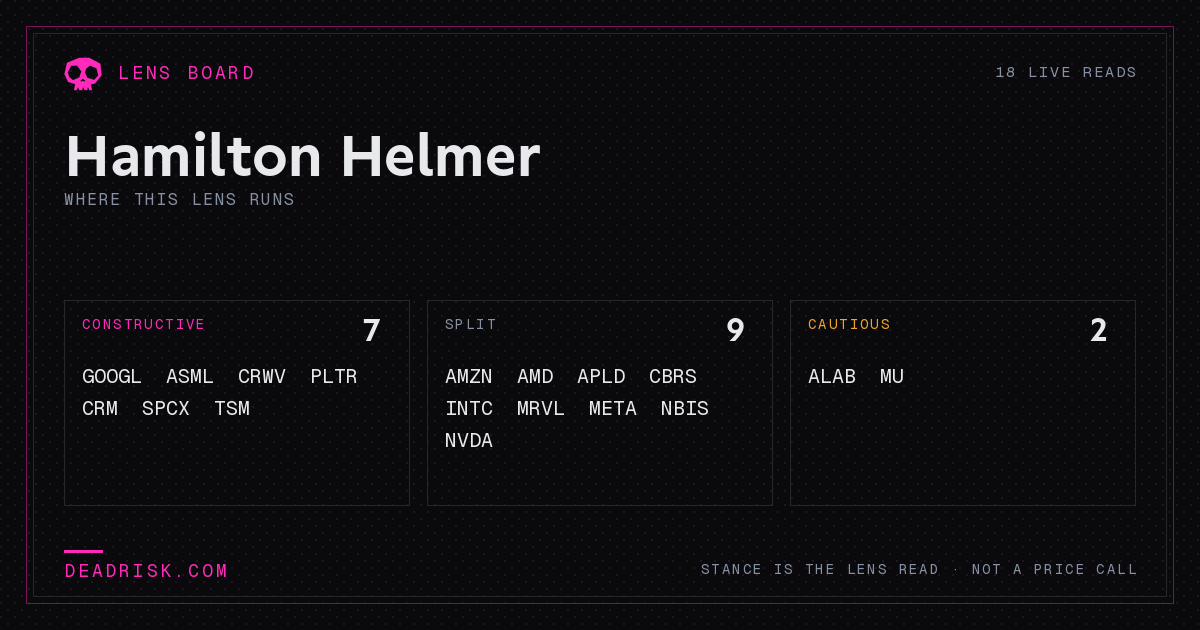
Where this lens runs
-
Alphabet GOOGL
constructive
Search and Cloud clear two of Helmer's seven cleanly; the DeepMind, Anthropic, SpaceX, and Waymo stakes sit outside all seven — priced by no framework in particular.
-
ASML ASML
constructive
ASML clears Helmer's five-part Cornered Resource test cleanly — except the one a Chinese lab is now trying to fail it on.
-
CoreWeave CRWV
constructive
Counter-positioning explains why hyperscalers let a neocloud take share — the open question is whether that barrier survives a chip supplier acting as landlord too.
-
Palantir PLTR
constructive
A cornered set of government relationships, won in court once and consolidated since — Helmer's test applied to the record.
-
Salesforce CRM
constructive
Salesforce's per-seat pricing is under real pressure; whether the switching-cost Power under it is too is a different question.
-
SpaceX SPCX
constructive
Reusable launch and a subscriber base no rival matches are real Power — in the two segments of the business that actually have it.
-
TSMC TSM
constructive
Two of Helmer's rarest Powers, scale and process, compounding on the same balance sheet at once.
-
Amazon AMZN
cautious
Amazon’s Q2 AWS profit growth shows a Benefit, but 2026 capex raised to $220B from $200B still lacks a proven Barrier.
-
AMD AMD
cautious
AMD shows demand and cash-flow growth, but the record has not proved a barrier that turns either into continuing Power.
-
Applied Digital APLD
cautious
Grid interconnection secured ahead of tenants at three straight campuses — a real Cornered Resource pattern, entangled with a tenant's own credit.
-
Cerebras Systems CBRS
cautious
Wafer-scale silicon reads as a genuine cornered resource — CUDA's switching costs are the wall it still has to clear.
-
Intel INTC
cautious
Intel’s 18A recovery shows a product benefit, but the record has not shown a barrier that rivals cannot copy or outscale.
-
Marvell Technology MRVL
cautious
Google’s expanded chip deal converts reported talks into a customer relationship, but the record still shows no durable barrier around the work.
-
Meta META
cautious
Muse turns Meta’s AI spending into a consumer service, but the launch discloses no cost gap or exit barrier that would add a second Power.
-
Nebius Group NBIS
cautious
Nvidia holds equity in Nebius and CoreWeave and supplies chips to both — one supplier's allocation can't be a Cornered Resource for either.
-
Nvidia NVDA
cautious
OpenAI’s Jalapeño benchmarks attack Nvidia’s performance edge, but they do not yet show that a customer has copied Nvidia’s scale economics or paid the full cost of leaving its platform.
-
Astera Labs ALAB
averse
Astera’s rack-connectivity wins show customer value, but the record supports no durable barrier beyond unquantified switching friction.
-
Micron MU
averse
Micron’s revenue surge establishes demand, while peer capacity and missing free-cash-flow evidence leave continuing Power unproved.