Trend pillar
The Inference Layer
Ramp's card data says Anthropic passed OpenAI in July. TEXXR's own coverage record says OpenAI is still ahead and pulling away. Both are true, and the layer underneath both of them is growing faster than either.
The Thesis
Anthropic Beat OpenAI on Ramp, Not in Coverage
In July 2026, Ramp showed Anthropic ahead of OpenAI in paid corporate-card adoption, 43.5% versus 39.7%. TEXXR’s archive for 2025Q2–2026Q3 showed the opposite attention ranking: 3,086 OpenAI articles versus 1,381 for Anthropic.
Ramp measures paid subscription activity among US businesses using its corporate cards. In April 2025, Ramp had OpenAI at 32.4% adoption, up from 28% in March. By January 2026, spending by first-time AI-tool buyers was split roughly 50/50 between Anthropic and OpenAI. In March, Anthropic took about 73% of first-time buyer spend, compared with that January split. Its adoption among all US businesses in Ramp’s sample reached 30.6%, up from 24.4% in February, but still trailed OpenAI’s roughly 35%. By July, Anthropic’s overall adoption reached 43.5%, 3.8 percentage points above OpenAI’s 39.7%.
TEXXR measures coverage, not payments. Its archive contains 3,086 articles tagged to OpenAI and 1,381 tagged to Anthropic from 2025Q2 through 2026Q3. OpenAI therefore drew 2.23 times as many articles, a derived ratio. That count says nothing by itself about customers, usage, or revenue.
The proved finding stops at the divergence. Ramp shows Anthropic leading paid-card adoption in July 2026. TEXXR shows OpenAI leading coverage across 2025Q2–2026Q3. Ramp does not measure media attention, and TEXXR does not measure payments.
The inference layer remains a watchlist, not the explanation. Fireworks, Baseten, SambaNova, and OpenRouter route, host, or run models. A routing explanation would need cohort evidence showing the same businesses switching between Anthropic and OpenAI through these providers, plus comparable revenue, margin, retention, and capital-burden data. The cited records do not provide it. Volume remains testable through the token ceiling, which tracks how much work users hand to machines rather than how many people sign up.
The Evidence
Start with the coverage record. TEXXR’s archive count is the number of indexed articles tagged to each company across 2025Q2–2026Q3: 3,086 for OpenAI and 1,381 for Anthropic. It measures attention, not adoption, spend, usage, or event frequency. The component’s coverage-momentum label refers only to the direction of quarterly article volume.
Bloomberg reported Anthropic’s annualized revenue run rate at $4B in July 2025, $9B in December, $19B by early March 2026, $47B by May, and $65B by the end of July. The July-to-July increase was 16.25 times over 12 months, derived from Bloomberg’s $4B and $65B figures. In February, the Financial Times reported that Anthropic’s investor guidance put annualized revenue above $30B by year-end 2026. Bloomberg’s reported $65B run rate at the end of July was $35B, or 117%, above that threshold, both derived. These are run-rate figures, not recognized annual revenue.
Private valuations moved too. Anthropic’s $65B Series H in May valued the company at $965B. OpenAI’s valuation in the same report was $852B, or $113B lower.
The corporate records count different things. The Wall Street Journal reported in October 2025 that corporate accounts made up roughly 80% of Anthropic’s revenue. It also cited a July estimate of 32% enterprise API share for Anthropic versus 25% for OpenAI. In February 2026, an a16z survey of 100 CIOs found 78% running OpenAI models in production versus 44% running Anthropic models. Ramp then recorded 43.5% paid-card adoption for Anthropic versus 39.7% for OpenAI in July 2026. API revenue share, production deployment breadth, and card adoption have different denominators. None supplies a universal market-share figure.
Ramp’s March records also use two denominators. Anthropic took 73% of first-time AI buyers’ spend, compared with a roughly 50/50 split with OpenAI in January. In the same month, 30.6% of all US businesses in Ramp’s sample paid for Anthropic, up 6.2 percentage points from 24.4% in February but still 4.4 points below OpenAI’s roughly 35%. Four months later, Ramp’s July adoption count put Anthropic at 43.5% versus OpenAI at 39.7%.
What would prove routing mattered. OpenRouter increased weekly token volume from 5 trillion to 25 trillion in six months, a derived fivefold increase, and raised at a $1.3B valuation in May. By July, The Information reported about $140M in annualized revenue, nearly three times its April level. Fireworks reported more than $1B in annualized revenue in July. Baseten’s valuation rose from $5B in February to $11B–$13B in June. SambaNova raised $1B at an $11B valuation. These are volume, run-rate, and financing records, not evidence that routing caused the Ramp-TEXXR divergence.
One portability signal comes from OpenRouter’s own usage logs. The Financial Times reported in March that lower-cost Chinese models from DeepSeek and MiniMax had overtaken their US rivals in token consumption since February. The logs show that routing volume can move between model families. They do not identify every buyer as an enterprise, connect those buyers to Ramp’s sample, explain why the volume moved, or disclose OpenRouter’s margin. The supply-side condition is what The China AI Stack tracks.
The Companies
Salesforce carries financial exposure to Anthropic through a stake reported at roughly $5B that started as a $50 million bet in an early 2023 round. It is not a pure Anthropic proxy. In September, Salesforce announced Koa, a CRM reasoning model built on Nvidia’s Nemotron architecture for Agentforce. CoreWeave signed a multiyear deal to supply Anthropic with Nvidia-chip data-center capacity in April, tying the same buildout this page’s AI capex supercycle already tracks to Anthropic’s specific growth curve, not the industry’s in general.
SpaceX carries the other side. Its xAI secondary, rebranded SpaceXAI in July after SpaceX absorbed xAI in an all-stock deal valuing the combined company at $1.25T, showed up on Ramp’s August ranking of the fastest-growing vendors by market share — a name that isn’t new capital reaching the AI trade so much as an existing capital base changing its label and getting counted again. TEXXR’s own record shows the xAI-SpaceX relationship logged first as rumored partnership talk in January 2026, then rumored acquisition, then completed acquisition, then merger — a company’s status in the graph moving through four labels in five weeks before the market and the coverage record agreed on what to call it. Fresh coverage makes the product contest more direct: The Information reported that OpenAI is developing counter-features for Grok Bot “teammates,” while Bloomberg reported, citing sources, that SpaceX discussed buying startup data for AI training. Neither report measures paid adoption or inference economics.
Nvidia sits underneath the inference-serving layer as its chip supplier, and its own relationship with one member of that layer shows what happens when the incumbent decides not to compete for a company, but to hollow it out instead. TEXXR’s record has Nvidia rumored to be acquiring Groq from December 2025 through March 2026, then that acquisition denied, then, by June, a different shape: Nvidia licensed Groq’s technology and hired much of its talent. Groq’s next funding round, in August, priced the company at $3.5B — down from $6.9B eleven months earlier. Not every name in the inference layer is compounding. The one that got closest to Nvidia’s own turf lost half its value to the deal that was supposed to save it. Since the prior refresh, Nvidia launched Open Agent Safety, a reference design spanning CPU sandboxes and Nvidia DPUs. CNBC also reported a Hugging Face deal, citing sources, at roughly $13B after OpenAI’s proposed investment of about $100M fell apart. Those are different transaction types, not competing valuations, and CNBC’s report did not include a company announcement confirming the acquisition.
The Lenses
Hamilton Helmer asks whether a Barrier survives an attack. Multi-model routing could weaken a model lab’s Switching Costs. OpenRouter’s increase from 5 trillion to 25 trillion weekly tokens across more than 400 models is consistent with demand for routing. It does not measure enterprise spend or show that switching costs approach zero after prompts, workflows, security reviews, and compliance controls are counted. Ramp’s July record establishes a current adoption lead for Anthropic, 43.5% versus 39.7%. It does not establish a durable Barrier such as a Cornered Resource or Process Power.
Groq tests supplier bargaining from another angle. Bloomberg’s cited source card places Groq’s $350M round at a $3.5B valuation before Nvidia later licensed Groq’s technology and hired much of its talent. The $3.5B valuation was 49% below the $6.9B September 2025 mark, derived. The disclosed record does not state the license price or show that Nvidia caused the valuation decline. It shows that technology, talent, financing, and corporate value can separate.
Richard Thaler’s mental accounting offers one hypothesis for Ramp’s March records. Anthropic took 73% of first-time AI-buyer spend, compared with a roughly 50/50 split with OpenAI in January. Yet 30.6% of all US businesses in Ramp’s sample paid Anthropic in March, versus roughly 35% for OpenAI. The denominators differ, so the figures cannot be subtracted into one market-share gap. A first purchase may open a new budget line while an installed account retains an existing contract, procurement path, and reference price. That pattern is consistent with Thaler’s inertia finding. Ramp’s records do not isolate inertia from product capability, price, or contract timing. TEXXR’s article counts likewise do not establish why newsrooms covered OpenAI more often.
What Moved
Since the September 7 refresh, no newer Ramp adoption reading or matching OpenAI-Anthropic coverage window has entered the record. The documented divergence therefore remains unchanged: Anthropic led Ramp’s July paid-card adoption by 3.8 percentage points, while OpenAI led TEXXR article volume by 2.23 times across 2025Q2–2026Q3.
Before that refresh, Nvidia’s role in the stack had widened from chip supply toward balance-sheet backing. CNBC reported on September 5 that Nvidia’s equity investments were worth $99B, 10 times their value a year earlier. Bloomberg reported the same day, citing sources, that Nscale’s financing talks covered as much as $3.5B, including $2B from Nvidia, ahead of a planned IPO. Those are talks, not closed financing.
What moved was the supplier map. Salesforce announced Koa, a CRM reasoning model built on Nvidia’s Nemotron architecture for Agentforce. CNBC then reported, citing sources, that Salesforce had held talks concerning Hugging Face. The same report said OpenAI proposed an investment of about $100M before those talks fell apart and Nvidia agreed to acquire Hugging Face for roughly $13B. CNBC did not report comparable terms for Salesforce, and the report did not include a company announcement confirming Nvidia’s acquisition. The fresh record makes Salesforce’s exposure more mixed: an Anthropic stake, an Nvidia-based internal model, and reported interest in a model platform.
Nvidia also moved above chip supply. On September 28, Nvidia launched Open Agent Safety, a reference design intended to keep agents inside sandboxes, with OpenShell for CPUs and Sentry for Nvidia DPUs. That extends Nvidia’s product surface into agent runtime and security. It does not disclose revenue, margin, or adoption for the platform.
The DeadRisk market layer records Nvidia’s FY2026 revenue at $215.9B for the year ended January 31, 2026, up 65% from $130.5B in FY2025. Free cash flow was $96.7B, up 59% from $60.9B. Bloomberg reported on September 28 that Nvidia increased its buyback authorization by $150B, from a derived $85B to $235B remaining, with completion planned through FY2028. Those figures establish financing capacity and capital allocation. They do not establish routing economics.
The SpaceX record moved at the product and data layers, not in Ramp’s adoption measure. The Information reported that OpenAI is developing counter-features for Grok Bot “teammates.” Bloomberg reported, citing sources, that SpaceX discussed buying startup data for AI training. Neither report links the OpenAI-Anthropic coverage gap to inference routing.
- 2026-08-14Ramp's July AI Index puts Anthropic's overall adoption share at 43.5% against OpenAI's 39.7% — the first month the crossover shows in the headline adoption number, not just the new-buyer marginal share.
- 2026-08-17Anthropic's revenue run rate reaches $65B, up from $47B in May. Bloomberg also reports Groq's $350M round at a $3.5B valuation, down from $6.9B in September 2025; the cited source card places the round before Nvidia's later licensing deal and talent hires.
- 2026-07-16Fireworks raises $1.5B at a $17.5B valuation and says it has passed $1B in annualized revenue.
- 2026-07-08SambaNova raises a $1B Series F at an $11B valuation and signs JPMorgan to deploy its chips for in-house AI.
- 2026-06-18Baseten raises $1.5B in a dual-tiered deal at an $11B–$13B valuation, more than double its $5B mark from February.
- 2026-05-28Anthropic's $65B Series H prices the company at $965B, overtaking OpenAI's $852B valuation from the same window.
- 2026-03-18Ramp data shows Anthropic capturing roughly 73% of first-time AI-buyer spend, up from a 50/50 split with OpenAI in January, while its share of the existing business base still trails at 30.6%.
Sources
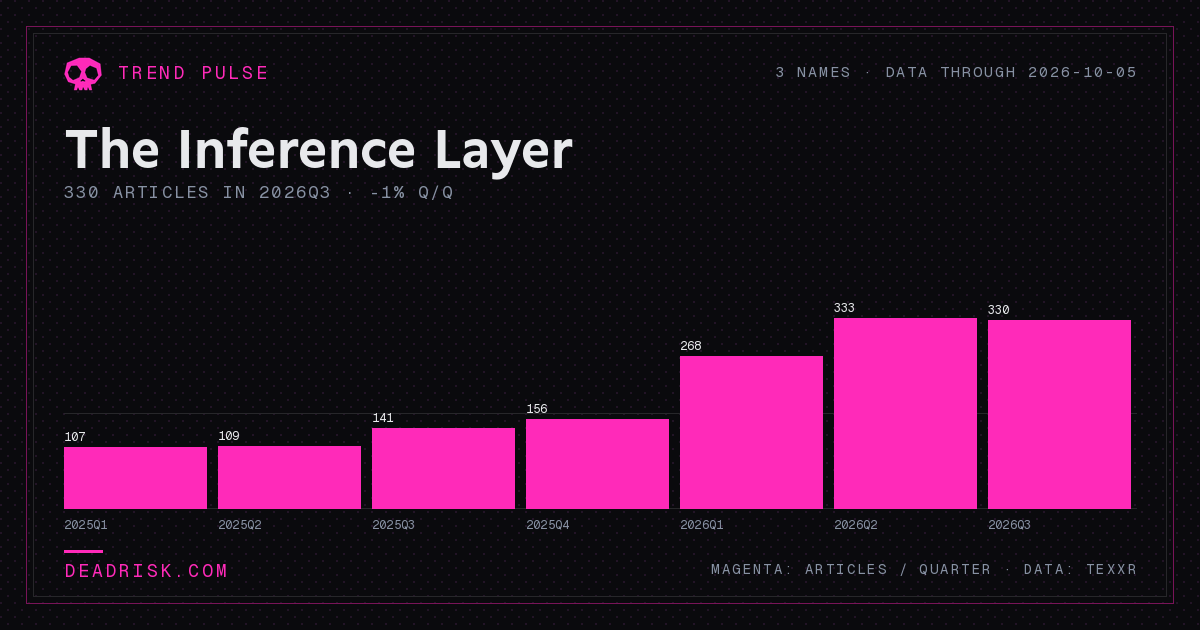
Across 3 member names, 2026Q3 drew 330 articles against 333 in 2026Q2. The largest single move was SpaceX, -52%.
Coverage data as of 2026-10-05 · the essay above was last revised 2026-09-29