Thinker lens
Richard Thaler
A number that should stop a buyer often doesn't, and the reason is which account they filed it under. Thaler's mechanisms, read against the coverage record.
The Lens
Richard Thaler spent forty years arguing that the things economic models call irrelevant are the things that decide what people actually do. Misbehaving is the history of that argument, told by the man who made it, and its usefulness here is that it never treats “irrational” as an insult. It treats it as a pattern — one regular enough that a good record can catch it happening.
Three of his mechanisms do most of the work on a markets page.
Mental accounting: a dollar is never just a dollar to the person holding it. The account it gets filed under changes how much risk feels acceptable inside it. Thaler’s own finding that gamblers take larger risks with the house’s money than with their original stake is the cleanest version — and it applies as well to an investor sitting on a three-year run-up as to anyone at a table.
Reference prices and anchoring: a price built around a particular unit becomes a number people defend long after the reason for the unit has faded. The anchor is not a belief about value. It is a starting point that everything else gets measured from.
Inertia: people stay in the arrangement they are already in, past the point it serves them, because leaving requires a decision and staying does not. This is the finding behind automatic enrolment in retirement plans, and it is the same force behind a procurement team that keeps renewing a contract priced the way it was priced in 2009.
Why It Matters Now
None of these mechanisms can be measured in a price. They can be measured in language — and language is what this site keeps.
When a stock gets filed under “the AI story” rather than “a 450x multiple,” the filing happens somewhere, in words, on a date. When a reference price comes under pressure, the defence of it gets said out loud, usually by an executive, usually to a reporter. A long coverage record is the closest thing there is to a log of which accounts a market is using. That is why Thaler belongs on a site built on the coverage record rather than on the tape.
The caution matters as much as the lens. Behavioural analysis explains why a participant is doing what they are doing. It does not establish that they are wrong, and it never establishes what happens next. Read alongside Graham, who asks what the business is worth, and Shiller, who asks how the justifying story spreads.
Applied to Tech Markets
Palantir holds both halves of the same loop at once, in the same window, pointing opposite directions.
The demand half: by late December 2025, CNBC reported that retail traders had poured billions of dollars into a stock up roughly 3,000% over three years and trading near 450 times trailing earnings — with those investors describing their position in narrative terms rather than valuation ones. Mental accounting is why a multiple that size does not function as a stop sign. A buyer who has already filed the position under the story is not running the valuation calculation the number is asking them to run, and a buyer already sitting on a large paper gain is playing, in Thaler’s terms, with the house’s money.
The insider half, inside the same window: the Financial Times reported that Alex Karp sold $1.9 billion of Palantir shares from January 2024 onward, after the stock jumped more than 350% in 2024. An insider realising gains while public enthusiasm accelerates proves nothing on its own — plenty of founders sell into strength for ordinary reasons. What it does is mark an asymmetry the framework predicts: the party with the most information about the business is locking a reference point in, while the party with the most exposure to the story is extending one.
The record does not resolve which reading wins, and that is the honest result rather than a hedge. Read the full take at Palantir through the Thaler lens, and the same mechanisms applied to a reference price under pressure at Salesforce, where a two-decade-old per-seat anchor is being renegotiated in public.
The Library
The lens comes from Misbehaving: The Making of Behavioral Economics (2015), Thaler’s account of the field’s founding, organised as a chronology of fights rather than a taxonomy of biases. The chapter notes on the shelf follow that order — the early years, mental accounting, self-control, fairness, and the move into finance.
Nudge (2008), written with Cass Sunstein, is the applied policy book and is not separately on the shelf; its choice-architecture argument grows out of the self-control and inertia work covered here. The nearest neighbour on the shelf is Shiller’s Irrational Exuberance, which takes the same starting point — that participants are not the agents the models assume — and follows it into how a story spreads rather than into how an individual files it.
Sources
- Thaler, Richard H. Misbehaving: The Making of Behavioral Economics (W. W. Norton, 2015) — mental accounting, house money, reference prices, and the inertia findings behind automatic enrolment.
- “Despite Palantir’s high trailing P/E ratio of ~450, retail traders have poured billions of dollars into the stock, which is up ~3,000% in the past three years” — CNBC, Dec 27, 2025. https://www.cnbc.com/2025/12/25/palantir-retail-investors-valuation-karp.html · TEXXR record: https://texxr.com/1154173
- “After Palantir’s stock jumped 350%+ in 2024, founder Alex Karp has sold $1.9B in shares since January 2024; VerityData says his PLTR holdings are worth $12.8B” — Financial Times, Mar 12, 2025. TEXXR record: https://texxr.com/883414
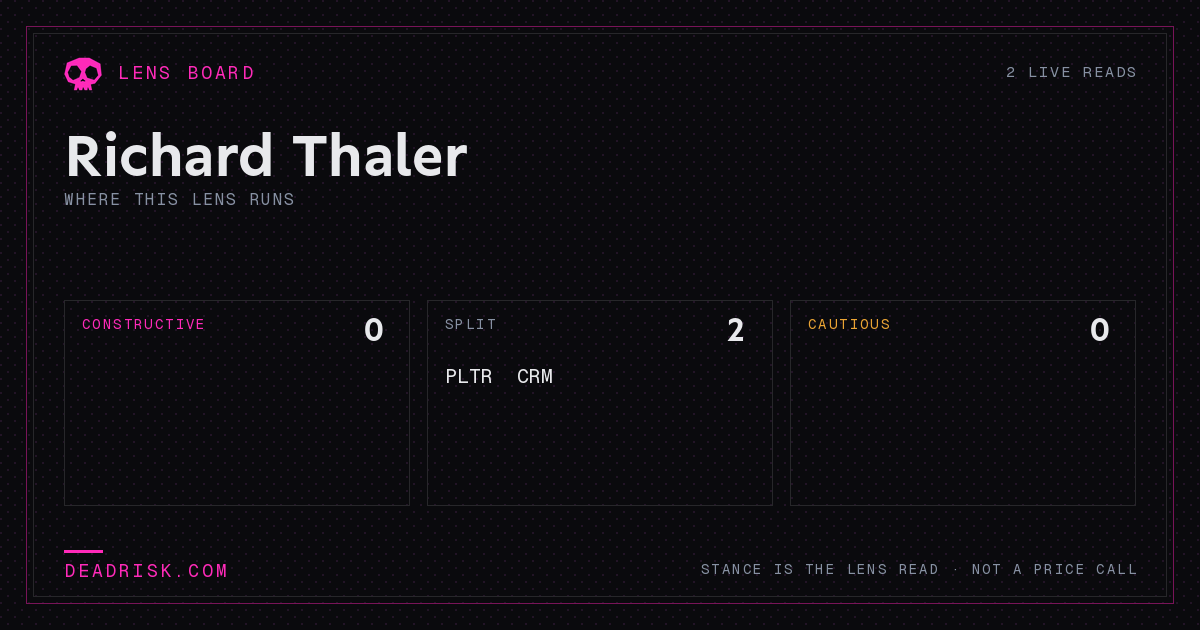
Where this lens runs
-
Palantir PLTR
cautious
Retail poured in at 450x trailing earnings while the founder sold — the record holds both halves of the same behavioral loop.
-
Salesforce CRM
cautious
The seat was never just a pricing unit — it was Salesforce's reference price, and the record shows that anchor being renegotiated in real time.