The argument
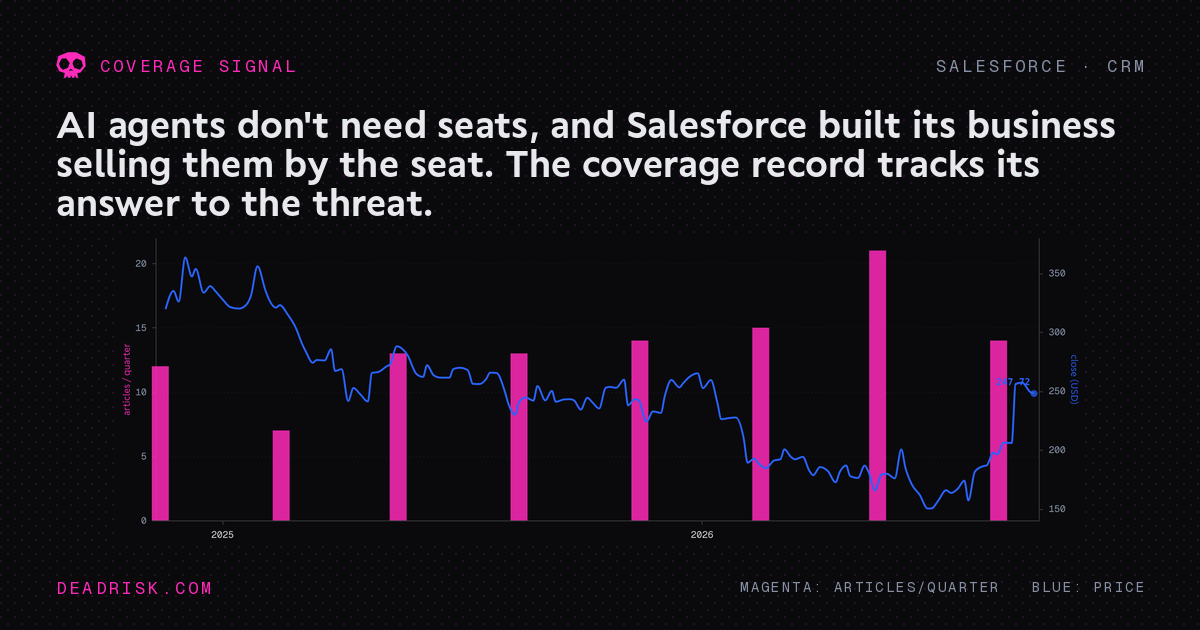
The tape · quarterly coverage amplitude · live quarter blinking
Salesforce sells software by the seat. One person, one login, one line on a finance team’s budget — that unit built the company into enterprise software’s biggest per-seat vendor and made “software as a service” the default way companies buy code. In the first quarter of its fiscal 2027, Salesforce reported $11.13 billion in revenue, up 13% year over year. The AI wave doesn’t compete with that business from outside. It goes after the unit of sale itself: an AI agent does a job, not a seat.
Marc Benioff has demonstrated the mechanism inside his own company. In June 2025 he said AI was already doing 30% to 50% of the work at Salesforce, in engineering and customer service alike. By September he had the headcount to match: support staff cut from about 9,000 to roughly 5,000 after Salesforce deployed AI agents to handle the work instead. An agent that can replace four of every nine support employees doesn’t need a Salesforce license to do it. That’s the story this report tracks — not whether Salesforce can build competitive AI products, but what an agent-native world does to a business built on selling seats.

Salesforce answered with speed, not caution. Agentforce launched in September 2024, a suite of AI agents built to act inside Sales and Service Cloud, not just answer questions. Microsoft matched it within weeks: ten new AI agents for Dynamics 365, announced days ahead of Agentforce’s general availability, in coverage that framed the release as reigniting the two companies’ long rivalry. By October 2025, Salesforce had stopped competing with the frontier labs outright and started embedding them, expanding partnerships with OpenAI and Anthropic to run their models inside Agentforce 360 and let customers reach Salesforce apps from within ChatGPT.
The pricing question came due through 2026. In February, Benioff told the Financial Times there was no “SaaS-pocalypse,” arguing that AI labs like Anthropic are themselves heavy SaaS buyers. In March, the bond market read it differently: investors demanded steep concessions on a $25 billion Salesforce debt sale, and coverage described the higher borrowing costs as a sign of Wall Street jitters over AI disruption to the business itself. In April, Salesforce joined the pricing shift it had just downplayed, adopting usage-based AI fees alongside Adobe and HubSpot. In May, Bloomberg reported that some of the Agentforce demo material behind the “digital labor” pitch showed mock-ups rather than shipping product, and Benioff defended the marketing as forward-looking. In June, Salesforce answered the same way it answered Agentforce’s launch two years earlier — by buying capability instead of waiting to build it, acquiring the content platform Contentful at a steep discount to its 2021 valuation, then the AI customer-service platform Fin, formerly Intercom, for about $3.6 billion.
Not every number in the record points one way. Agentforce’s own annual recurring revenue rose 205% to $1.2 billion in that same Q1 report — small next to Salesforce’s core business, but real, and growing faster than the pricing anxiety around it.
Then, in August, Salesforce stopped defending the seat and moved inside the thing threatening it. On the same day it reported Q2 revenue up 11% to $11.35 billion with net income up 87% to $3.5 billion, it announced Claudeforce with Anthropic — Salesforce data and workflows served inside Claude, opening with a plugin carrying 37 prebuilt sales skills. The stock closed up 22.6%, its second-best day on record. Two Februaries after Benioff told the Financial Times there was no SaaS-pocalypse, the market’s largest single-day endorsement of Salesforce arrived for the decision to let the work happen somewhere other than a Salesforce login. Whether that trades a per-seat line for a per-token one is the question the token ceiling frames: consumption that no longer tracks headcount is the condition the whole seat model was priced against.

The spectrogram
Signal decomposition · what the record is made of, by quarter · brightness = share of edges · drift = how far the story moved in meaning
In 2024Q1 the record was 38% financial; by 2026Q1 it is 29% launch. A price chart shows what a name did; the spectrogram shows what its story is made of.
The brains
Salesforce's per-seat pricing is under real pressure; whether the switching-cost Power under it is too is a different question.
The seat was never just a pricing unit — it was Salesforce's reference price, and the record shows that anchor being renegotiated in real time.
Salesforce’s price rebound and Agentforce growth are spreading the agent-era story faster than the supplied record can verify its cash economics.
The machine
This is where the relationship data does more than a headline can. Three structural facts sit under the narrative above.
First, Salesforce sits on both sides of the Anthropic trade. It first invested $50 million in an early-2023 round and bought into every round since; by June 2026 that stake was worth roughly $5 billion. It’s simultaneously a distribution partner, running Anthropic’s models inside Agentforce. That’s the AI capital cycle showing up on a balance sheet instead of a data center — see the capex build-out for the spending side of the same wave, and Nvidia’s report for the compute layer underneath it. Salesforce is a funder and a customer of the same labs whose products threaten its own pricing model.
Second, that position didn’t buy insulation. In June 2026, Anthropic shipped Claude Tag, an AI product built for companies that use Slack — which Salesforce owns. Sources reported that Salesforce staff were confused by the release and worried it could cannibalize Salesforce’s own Slackbot, handing a company Salesforce partly funds more leverage over the enterprise software stack. Holding equity in the disruptor didn’t protect the product Salesforce built to compete with it.
Third, the coverage record itself shows the size of the reorganization, not just its direction. Since January 2025, financial-predicate edges make up 45% of everything TEXXR’s graph has recorded about Salesforce — more than launch, acquisition, and personnel edges combined. Running a regime-break analysis on that history turns up nine distinct narrative regimes since 2024, each lasting roughly a quarter. The break into the current one, from the fourth quarter of 2025 into the first quarter of 2026, produced a semantic-drift score of 0.246 against an average of about 0.12 across the seven breaks before it — more than double, and the largest single-quarter shift in the sequence. The entity network turned over almost completely at that break: Agentforce 360, Anthropic, and OpenAI dropped out of Salesforce’s most-associated entities; the Pentagon, an outgoing Tableau executive, and Slackbot moved in. In one quarter, the graph’s read on Salesforce moved from an AI-partnership story to a personnel-and-product-tension story — a shift visible in the relationship data well before it resolved into any single headline.
The money

Currency: USD. Revenue/net income/capex/FCF cross-checked against filed XBRL.

Positioning: how much of CRM is sold short, on the record brokers file twice a month. It lags by design — read it as where the crowd stood, not where it stands.
The record
- Whether the financial-predicate share of Salesforce’s edge graph holds near 45%, or reverts toward the launch-and-acquisition mix that defined 2024. Reversion would read as pricing anxiety fading rather than compounding.
- Whether the Claude Tag/Slackbot tension moves from rumored to confirmed status in the graph. The August answer went the other way from a countermove: Claudeforce puts Salesforce’s own data inside Anthropic’s surface rather than defending its own.
- Whether Claudeforce shows up as usage rather than announcement — third-party evidence of the 37 sales skills being run, or a disclosed revenue line, rather than a launch-week coverage spike.
- Whether Headless 360 generates adoption evidence in later coverage — third parties actually building on Salesforce’s APIs — rather than remaining a single announcement-week spike.
- Whether the next quarterly regime break again exceeds the roughly 0.12 average drift of the pre-2026 regimes, which would mean the narrative is still reorganizing rather than settling.
- Whether the acquisition pace holds. Contentful and Fin were two AI-capability purchases inside three weeks in June 2026. A record that keeps showing purchases rather than product launches is a different pattern from the one Salesforce ran in 2024.
| Quarter | Articles | QoQ | Q-end price | QoQ | The record reads |
|---|---|---|---|---|---|
| 2024Q4 | 12 | — | 330.48 USD | — | first quarter on record |
| 2025Q1 | 7 | -42% | 265.27 USD | -19.7% | attention and price fell together |
| 2025Q2 | 13 | +86% | 270.40 USD | +1.9% | attention rose, price flat |
| 2025Q3 | 13 | +0% | 235.42 USD | -12.9% | price fell, attention steady |
| 2025Q4 | 14 | +8% | 263.57 USD | +12.0% | price rose, attention steady |
| 2026Q1 | 15 | +7% | 185.72 USD | -29.5% | price fell, attention steady |
| 2026Q2 | 21 | +40% | 156.66 USD | -15.6% | attention rose as price fell |
| 2026Q3 open | 15 | -29% | 259.43 USD | +65.6% | attention cooled as price rose (quarter in progress) |
The peers
Salesforce lives or dies by the same constraint as these names — small equal-weighted groups, one constraint each. Not investment products: see all categories.
Sources
Edges (TEXXR knowledge graph): 401194, 80098, 53659, 83787, 98834, 223297, 389321, 401195, 401704, 403358, 401693, 404786, 292926