The argument
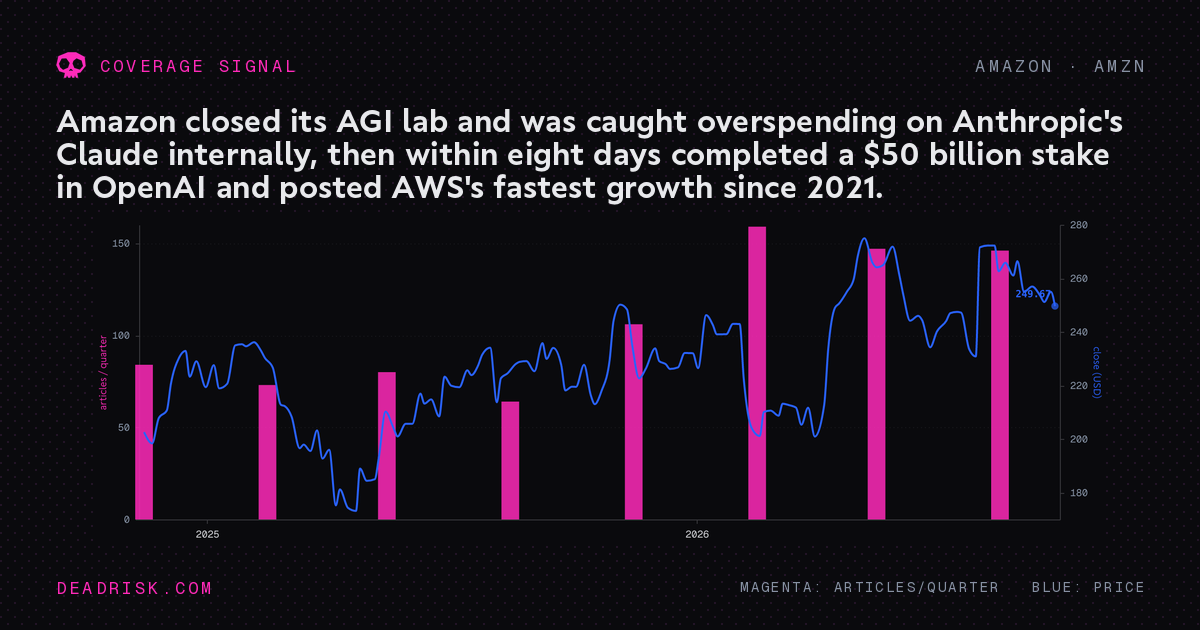
The tape · quarterly coverage amplitude · live quarter blinking
Every other name in DeadRisk’s mag7 tier is answering one question: build the frontier model, or rent someone else’s. Amazon’s answer was both, priced as an investment rather than a strategy. In a seven-week stretch this spring, Amazon committed up to $75 billion in equity to the two labs that also buy its cloud capacity: up to $50 billion into OpenAI, up to $25 billion more into Anthropic on top of $8 billion already there. Each check came bundled with a chip order — OpenAI for roughly 2 gigawatts of Amazon’s own Trainium silicon, Anthropic for up to 5. Meanwhile, the unit built to develop a rival model was cut back on three fronts: its AGI Lab’s head left in February, the lab closed in July, and Amazon was reported to be deprecating its flagship models the same month.
A SemiAnalysis report from September 2025 named this shape before it fully arrived: AWS was losing share to Microsoft Azure and Google Cloud, and the fix on the table was Anthropic as an “anchor customer” for Trainium — Amazon’s silicon, running someone else’s models. DeadRisk carries Amazon inside The AI Capex Supercycle as the counterparty that makes the neocloud trade legible from the other side: CoreWeave, Nebius, and Applied Digital sell raw compute to the same labs. Amazon does too — but it also buys equity in the customer.

The relationship started as a compute sale, not an investment. In November 2025, OpenAI signed a seven-year, $38 billion deal to buy AWS capacity — its first contract with the cloud leader, running on Nvidia GB200 and GB300 chips, not Trainium. About six weeks later, Amazon was in talks to invest $10B-plus in OpenAI, this time with Trainium attached. The figure climbed to up to $50 billion by late February, $35 billion contingent on an IPO or an AGI milestone, and by March 1 Amazon formalized $15B upfront, $35B more, with OpenAI committing to roughly 2 gigawatts of Trainium capacity through AWS.
Three weeks before that formal deal, Amazon’s Q4 earnings had already shown the cost: a $200 billion 2026 capex guide, above the Street’s $146.6 billion estimate, and AMZN fell more than 10% after hours. Four days before the deal was formalized, David Luan, Amazon’s AGI lab head, left less than two years after joining through an acqui-hire — an exit the market shrugged off, and one the graph would later read as the first domino.
Amazon didn’t stop at OpenAI. On April 21, Amazon agreed to invest up to $25B more in Anthropic, on top of $8 billion already committed, securing up to 5 gigawatts of Trainium against Anthropic’s pledge to spend $100 billion-plus on AWS over ten years. Eleven days earlier, Anthropic had shown it wasn’t relying on Amazon alone: CoreWeave announced its own multiyear deal to supply it with Nvidia chips. By June 30, Amazon was weighing OpenAI’s models alongside Nova to cut costs, after Anthropic raised the price of the models running inside Amazon’s own products — a cost tension between Amazon’s role as customer and its role as investor.
Then, across eight days in late July, four separate reports landed in quick succession. On July 24, Amazon closed its San Francisco AGI Lab, part of layoffs in the unit Luan had led. On July 28, Business Insider reported the Nova deprecation, Amazon shifting resources to something it called Frontier Model Research. On July 30, the Financial Times reported one instance of runaway AI spending: $1.8 million spent on Claude for a menial cataloging task, an overrun that took months to detect. On July 31, Amazon reported AWS revenue up 37% to $42.2 billion, its fastest growth since 2021, raised capex guidance to $220 billion, and AMZN closed up 15.32% — $235.50 to $271.58 — its largest one-day gain since April 2012. On August 1, the Financial Times reported the completed $50 billion OpenAI investment, taking Amazon’s stake to roughly 5%.

The spectrogram
Signal decomposition · what the record is made of, by quarter · brightness = share of edges · drift = how far the story moved in meaning
In 2024Q1 the record was 32% financial; by 2026Q1 it is 39% financial. A price chart shows what a name did; the spectrogram shows what its story is made of.
The brains
The machine
TEXXR’s regime-break detector marks 2026Q1 — the quarter Amazon formalized the OpenAI investment — as a structural break in how Amazon’s coverage gets classified, not just how much exists. Across the eight quarters from 2024Q1 through 2025Q4, Amazon’s predicate mix held near a stable average: roughly 31% launch-type edges, 23% financial, competitor share near zero. In 2026Q1, across 960 edges — six times the prior quarter’s 153 — the mix flipped: financial rose to 39%, competitor reached 12% from near nothing, and OpenAI entered Amazon’s most-connected-entity list for the first time, displacing Luna and Perplexity AI. Semantic drift measured 0.105, roughly triple the prior eight-quarter average. The record isn’t only saying Amazon spent more; it shows coverage shifting from products it launched to money it moved and rivals it named.
Amazon’s chips business tracks a related but separate trend — the commercial scale of its own silicon, not the funding shift above. In Andy Jassy’s April 2026 shareholder letter, Amazon’s chips business was generating over $20 billion a year. By the Q2 release, just under four months later, Amazon disclosed a run rate exceeding $25 billion — both figures stated as floors, not precise levels, so only the direction is a fact: up. The record also shows Amazon isn’t content keeping Trainium captive: in June, AI chief Peter DeSantis said Amazon is in talks to sell Trainium externally — competing with Nvidia for capacity it now reserves for its own equity partners.
The money

Currency: USD. Revenue/net income/capex/FCF cross-checked against filed XBRL.

Positioning: how much of AMZN is sold short, on the record brokers file twice a month. It lags by design — read it as where the crowd stood, not where it stands.
Order flow is signed before it becomes revenue — the earliest of the three views. From the capital-flow ledger.
| Announced | From | To | Deal | Value | In guidance |
|---|---|---|---|---|---|
| Amazon | Astera Labs | warrant switches, retimers and optical, against a share warrant ↗ | $6.5B | not stated |
The record
Signals in the record, not trade ideas:
- Whether “Frontier Model Research” becomes a real model-building push or a smaller group. Named the week Nova’s deprecation was confirmed; whether it ships anything is checkable.
- Whether OpenAI and Anthropic models keep displacing Nova inside Amazon’s own products, after Amazon weighed an OpenAI-for-Nova swap in June over Anthropic’s pricing.
- The chips run rate’s next data point. It moved from over $20B in April to over $25B in July; the next earnings report, due 2026-10-29, will show whether that pace held.
- Whether Amazon begins selling Trainium to outside data centers, the move DeSantis floated in June — a shift from captive demand toward open competition with Nvidia.
- Internal AI-spend controls, after the FT’s report of a $1.8M Claude overrun that took months to catch — an anomaly, or a pattern the next report repeats.
| Quarter | Articles | QoQ | Q-end price | QoQ | The record reads |
|---|---|---|---|---|---|
| 2024Q4 | 84 | — | 219.39 USD | — | first quarter on record |
| 2025Q1 | 73 | -13% | 190.26 USD | -13.3% | attention and price fell together |
| 2025Q2 | 80 | +10% | 219.39 USD | +15.3% | attention and price rose together |
| 2025Q3 | 64 | -20% | 219.57 USD | +0.1% | attention cooled, price flat |
| 2025Q4 | 106 | +66% | 230.82 USD | +5.1% | attention and price rose together |
| 2026Q1 | 159 | +50% | 208.27 USD | -9.8% | attention rose as price fell |
| 2026Q2 | 147 | -8% | 238.34 USD | +14.4% | price rose, attention steady |
| 2026Q3 open | 146 | -1% | 249.67 USD | +4.8% | price rose, attention steady (quarter in progress) |
The peers
Amazon lives or dies by the same constraint as these names — small equal-weighted groups, one constraint each. Not investment products: see all categories.
Sources
Edges (TEXXR knowledge graph) - #85573 — partnership: OpenAI and AWS sign a seven-year deal in which OpenAI will pay $38B for AI compute. - #99215 — financial: Amazon commits $15B initially and up to $35B more in OpenAI, contingent on conditions. - #99216 — partnership: OpenAI agrees to consume roughly 2 gigawatts of Trainium silicon capacity from AWS. - #259839 — financial: Amazon’s internal chips business generates over $20B/year, per Jassy’s April 2026 letter. - #261942 — partnership: CoreWeave signs a multiyear deal with Anthropic for Nvidia chips across US data centers. - #302800 — financial: Anthropic secures up to $25B in additional investment from Amazon, on top of $8B previously invested. - #302801 — partnership: Anthropic commits to spend over $100B on AWS over the next 10 years. - #408838 — personnel: Amazon closes its San Francisco-based AGI Lab. - #409219 — launch: Amazon is deprecating several flagship Nova AI models. - #409569 — financial: Amazon staff identify uncontrolled AI spending, including $1.8M on Claude usage. - #409745 — financial: Amazon reports an annual revenue run rate exceeding $25B for chips. - #409872 — financial: Amazon completes a $50B investment in OpenAI, taking an approximately 5% stake.
Prices: Amazon’s own reported figures (revenue, net income, capex, AWS segment results) are from Amazon’s quarterly disclosures, cited by period. Stock price levels are as-traded closes from DeadRisk’s point-in-time price archive (data/prices/amzn.json), not split-adjusted: $235.50 close on 2026-07-30, $271.58 close on 2026-07-31 — a one-day change of +15.32%.