The argument
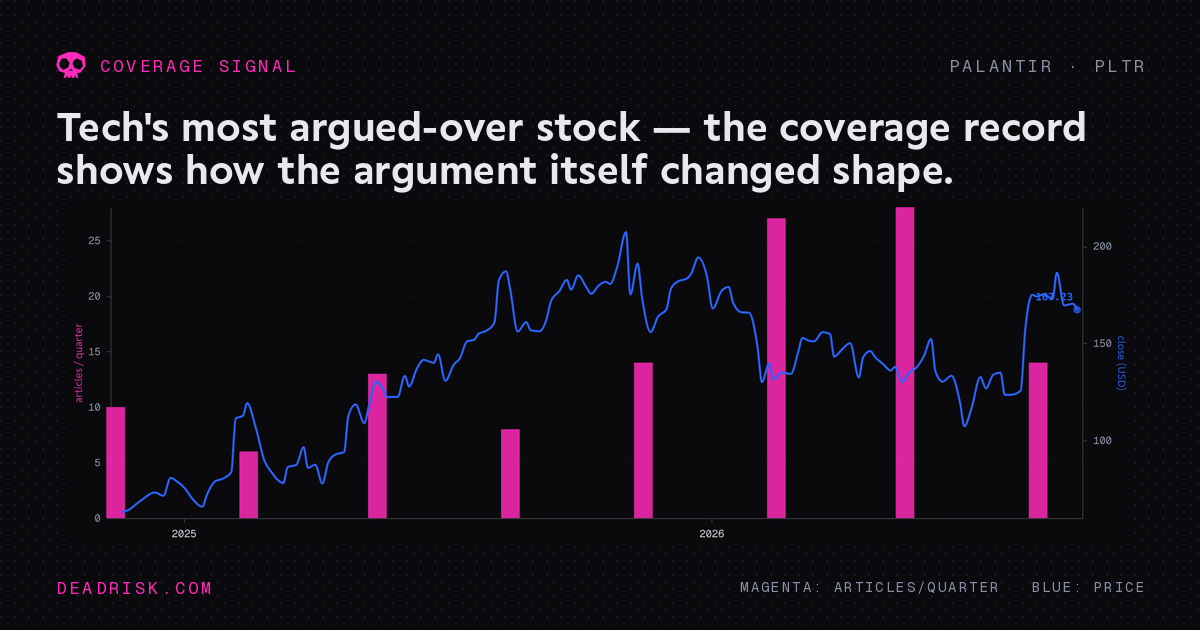
The tape · quarterly coverage amplitude · live quarter blinking
Palantir Technologies sells software that fuses scattered data into one operating picture — for governments first, for companies later. Peter Thiel and Alex Karp, among others, founded it in 2003 to build case-management tools for post-9/11 intelligence work. It stayed private for 17 years, raising money at a $15B valuation in 2015, per a Wall Street Journal report at the time, then went public through a direct listing on the New York Stock Exchange on September 30, 2020; CNBC put its first-day close at $9.50 a share. It moved its listing to Nasdaq in November 2024, the same year it joined the S&P 500. By July 2025, CNBC ranked it the 20th most valuable company in the US.
That path — spy-tech contractor to Nasdaq mainstay — is why Palantir carries more argument per dollar of revenue than almost any other large-cap name. It has no clean peer. It sells to the same government agencies that critics accuse it of arming and to pharmaceutical companies from the same platform. Its CEO writes books and picks public fights instead of avoiding them. Sell-side analysts, national-security reporters, and retail forums all cover the same four letters with almost nothing else in common. The result is a stock discussed in several unrelated vocabularies at once, each certain the others are missing the point.
This report doesn’t add a fourth vocabulary or a verdict. It measures the three that already exist, using twelve years of coverage TEXXR holds in full.

Three periods show up cleanly in the record.
Govtech and the surveillance question (2015–2020). Coverage of this period ran two threads in parallel: financing news, and accountability reporting on what the software did. Wired described Palantir building “an opaque surveillance network” from police-department data; separate reporting documented that ICE used Palantir’s case-management tools to locate and arrest people. Palantir carried that combination — quiet funding rounds, loud scrutiny — into its 2020 direct listing, which CNBC greeted by calling it “Big Data’s scariest, most secretive unicorn.”
The AIP re-rating (2023–present). Palantir shipped its Artificial Intelligence Platform in 2023, and TEXXR’s hyperedge record shows the effect with more precision than a headline can. Comparing the quarter of AIP’s debut against two years later: financial-predicate edges — revenue, contract value, share price — rose from 42% of Palantir’s edge record in 2024 Q1 to 73% in 2026 Q1, a 32-percentage-point jump, while partnership edges fell from 25% to 7%, an 18-point drop (TEXXR edge-arc analysis, 2024Q1→2026Q1; network Jaccard 1.00 and semantic drift of 0.780 mark a near-total turnover in what entities and framing attach to the name). Revenue growth accelerated alongside it: 18% year-over-year in Q1 2023, 70% in Q4 2025, then 85% in Q1 2026, with US commercial revenue up 133%, per Palantir’s own quarterly reports as covered by CNBC and Reuters.
That predicate shift is the corpus-only fact this report is built to surface: coverage after AIP didn’t just turn more favorable. It turned more financial. The instrument being described in print changed — from a contested government contractor to a stock, narrated in the vocabulary of a stock.
Same contract, three vocabularies. Palantir’s UK National Health Service relationship shows the mechanism up close, inside a single, mostly unchanged deal. In 2022, Bloomberg described “a secret plan to deepen its ties” to the NHS. By late 2023 that same relationship was a signed £480M contract, reported plainly. By mid-2026, with the underlying arrangement barely altered, Reuters reported a government review of the contract and the Financial Times ran a piece on “Palantir’s fight to save” it — while London’s mayor separately blocked a related £50M Palantir deal with the Metropolitan Police over civil-liberties concerns, per the Guardian. One relationship, three vocabularies, four years.

The spectrogram
Signal decomposition · what the record is made of, by quarter · brightness = share of edges · drift = how far the story moved in meaning
In 2024Q1 the record was 42% financial; by 2026Q1 it is 73% financial. A price chart shows what a name did; the spectrogram shows what its story is made of.
The brains
A cornered set of government relationships, won in court once and consolidated since — Helmer's test applied to the record.
Retail poured in at 450x trailing earnings while the founder sold — the record holds both halves of the same behavioral loop.
Palantir's own predicate shift is the epidemic curve Shiller describes, measured instead of asserted.
The machine
Since 2020, Palantir’s hyperedge record splits almost evenly three ways: partnership (26%), controversy (26%), and financial (25%). Partnership and controversy together account for 52% of every recorded edge — the two threads TEXXR’s edge-profile tool flags as the entity’s dominant, persistent narrative, underneath whatever the quarter’s financial edges say.
A predicate that barely existed before 2025 has since become one of the largest: competitor. Edges now describe “frontier AI labs” — the model builders, not the systems integrators Palantir used to be grouped with — pressing on its position, the same month CEO Alex Karp told CNBC that Palantir’s enterprise customers were “unhappy” with how those labs operate, and weeks later called US military reliance on AI labs “effing insane” in Forbes. Palantir sits downstream of the AI capex buildout rather than inside it — it doesn’t build chips or foundation models — but the graph shows it increasingly narrated alongside the companies that do, including a July 2026 deal to deploy Nvidia’s Nemotron models for US agencies, a thread that ties Palantir’s edge record directly to Nvidia’s own coverage arc.
The controversy edges haven’t receded under the financial re-rating. They’ve moved location. Internal Slack logs showing Palantir staff debating the company’s ICE and Department of Defense work became coverage in April 2026, per Ars Technica; by July, the Financial Times quoted insiders and investors worrying that the company’s alignment with the Trump administration could cost it corporate clients and engineering talent.
The money

Currency: USD. Revenue/net income/capex/FCF cross-checked against filed XBRL.

Positioning: how much of PLTR is sold short, on the record brokers file twice a month. It lags by design — read it as where the crowd stood, not where it stands.
The record
Signals in the record worth tracking, not trade ideas:
- Whether the “competitor” predicate keeps growing. It went from effectively absent to double digits inside the window measured above. Frontier labs appearing as rivals rather than customers or partners is a measurable shift in the graph, independent of any single quarter’s revenue.
- The outcome of the NHS contract review and the Met Police block. Both are open as this is written. A contract termination or reversal would register as a hard status change in the edge record, not a shift in tone.
- Whether the financial-predicate share keeps climbing past 73%, or gives ground back to controversy — the two have traded places before in this same graph, and the re-rating is not the only pattern TEXXR has recorded here.
- Karp’s public commentary volume. His remarks generate a disproportionate share of Palantir’s controversy and personnel edges; a change in his public posture tends to show up in the predicate mix before it shows up in a press release.
| Quarter | Articles | QoQ | Q-end price | QoQ | The record reads |
|---|---|---|---|---|---|
| 2024Q4 | 10 | — | 75.63 USD | — | first quarter on record |
| 2025Q1 | 6 | -40% | 84.40 USD | +11.6% | attention cooled as price rose |
| 2025Q2 | 13 | +117% | 136.32 USD | +61.5% | attention and price rose together |
| 2025Q3 | 8 | -38% | 182.42 USD | +33.8% | attention cooled as price rose |
| 2025Q4 | 14 | +75% | 177.75 USD | -2.6% | attention rose, price flat |
| 2026Q1 | 27 | +93% | 146.28 USD | -17.7% | attention rose as price fell |
| 2026Q2 | 28 | +4% | 116.67 USD | -20.2% | price fell, attention steady |
| 2026Q3 open | 15 | -46% | 173.31 USD | +48.5% | attention cooled as price rose (quarter in progress) |
The peers
Palantir lives or dies by the same constraint as these names — small equal-weighted groups, one constraint each. Not investment products: see all categories.
Sources
Edges (TEXXR knowledge graph): edge-arc analysis, Palantir hyperedge predicate distribution, 2024Q1–2026Q1 (aggregate; texxr.com/entity/Palantir); hyperedges #390094–390096 (Q1 2026 revenue detail), #390756 (frontier-lab competitor framing), #405996 (Nvidia Nemotron deal), #389265 (ICE/DOD internal debate), #406906 (Trump-alignment client risk).