The argument
The tape · quarterly coverage amplitude · live quarter blinking
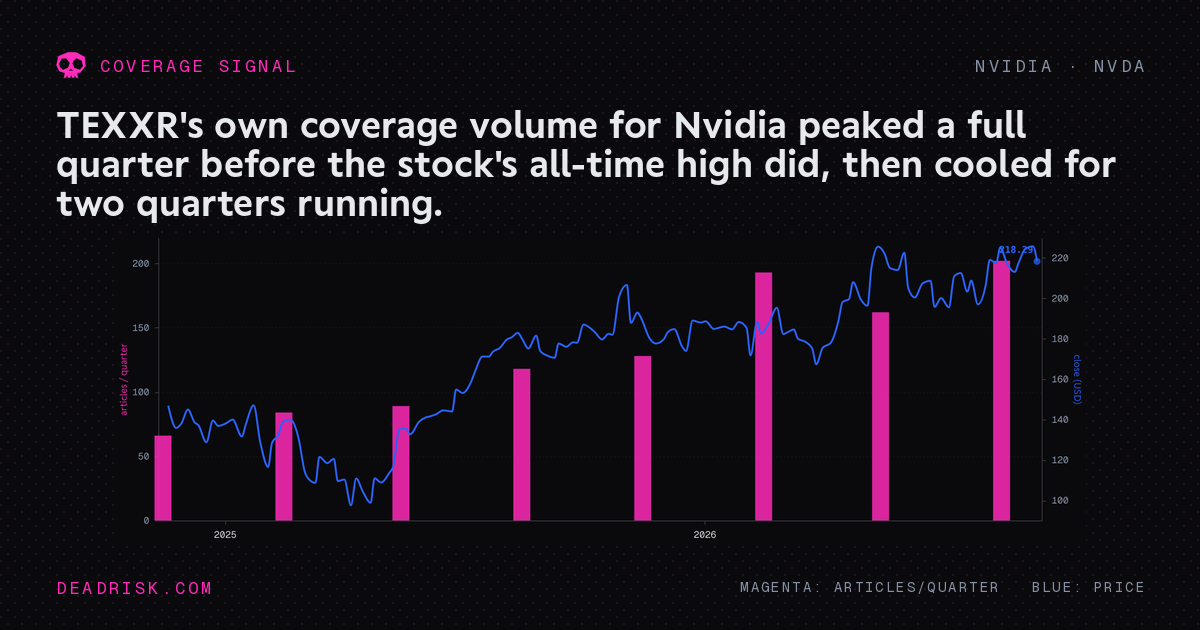
Nvidia Corporation (NASDAQ: NVDA) designs graphics processors and sells the chips, networking, and software that tie AI data centers together. Before Nvidia’s stock set its May 14, 2026 closing high, TEXXR logged 193 archive articles tagged to the company in 2026Q1, versus 85 a quarter across the prior eight quarters. The count then fell to 162 in 2026Q2 even as the price record arrived. That sequence does not establish causation.
TEXXR’s Nvidia archive runs back to the final quarter of 2014 — one of the deepest single-entity records in the corpus. Quarterly volume here counts archived articles tagged to Nvidia. Coverage ran from single digits to the high teens per quarter through most of the 2010s, broke 30 for the first time in 2022, broke 50 for the first time in the third quarter of 2023, broke 100 in the third quarter of 2025, and peaked at 193 articles in the first quarter of 2026 — 2.3 times the prior eight-quarter average of 85 articles a quarter. The 162 articles in complete 2026Q2 were 16% below that peak, derived, but 43% above the updated eight-quarter average of 113, also derived. Adding the eight fresh records since July 18 to the previously logged 143 puts the open 2026Q3 count at a derived 151 through August 23. An open quarter is not comparable to a complete one.
The DeadRisk market layer recorded an August 21, 2026 close of $214.72 per share, down 1.0% for the day, up 1.3% over 30 days, and up 22.9% over one year.
This is DeadRisk’s mag7 tier: the deepest corpus we hold on any single name, and explicitly not a stock-picking exercise. Robert Shiller’s case, laid out in Irrational Exuberance, was that narratives move markets on their own terms, apart from fundamentals. Nvidia’s coverage record is a twelve-year test of that case. This page tracks the record, not the trade.

The coverage mix changed from product cycles to capital flows. The early record follows GPUs and devices. The latest records follow system pricing, model development, and investments across the infrastructure that consumes Nvidia hardware.
The earliest coverage in TEXXR’s record is a niche chip company defending its turf: an ITC patent complaint from Samsung over GPU technology in the last quarter of 2014, GeForce card launches, the Shield Android TV set-top box announced in 2015, a 2018 Spectre disclosure alongside the rest of the chip industry. Through 2019 the record shows a graphics-card and workstation vendor with an autonomous-driving side bet — the Drive PX self-driving platform, announced in 2015 — layered on top.
Two crypto cycles interrupt that story before the AI one starts. SoftBank took a $4 billion stake in Nvidia in 2017, on the strength of gaming and early data-center demand. By 2018 Nvidia was disclosing $289 million in chip sales specifically to cryptocurrency miners, and a mining-driven GPU shortage was national tech-news copy. The pattern repeated in 2021 — Nvidia shipped mining-limited GeForce cards to keep gamers supplied — and broke in 2022: crypto demand collapsed, Nvidia disclosed excess RTX 3000-series inventory, longtime board partner EVGA quit the graphics-card business entirely citing conflicts with Nvidia, and the SEC fined Nvidia $5.5 million for failing to adequately disclose how much of its earlier gaming revenue had actually come from miners.
The Arm acquisition brackets the same stretch and tells a similar story of ambition meeting friction: announced at more than $40 billion in September 2020, the same year Nvidia’s A100 chip opened its data-center era and the company passed Intel as the most valuable US chipmaker, then abandoned in February 2022 after regulators refused to clear it and SoftBank took Arm public instead.
What follows is the AI-datacenter turn most readers already know in outline, but the coverage record gives it a shape: a $1 trillion market cap in May 2023, the week Nvidia raised its revenue forecast on AI demand; $2 trillion nine months later; $3 trillion four months after that, passing Apple, then Microsoft two weeks after that to take the title of world’s most valuable public company. Nvidia reached $4 trillion in July 2025 and $5 trillion that October. An export-control subplot runs through those numbers and never fully resolves: the H800, a cut-down H100 built for China in 2023; the H20 licensing back-and-forth of 2025; and a China-only RTX 6000D that Reuters reported met “lukewarm demand” that September. By May 2026 the record had Nvidia positioned as an AI investor in its own right, with more than $40 billion in equity commitments across the industry — before a Bloomberg-reported $1 trillion pullback in July 2026 put the stock back at an 18-times forward-earnings multiple, its lowest since 2019.
The latest records extend that turn from equity stakes into models and pricing. Wall Street Journal sources say Nvidia plans to use a reported $6 billion Poolside agreement to build an open-weight AI model positioned against Chinese models including DeepSeek and Kimi. TEXXR’s graph logs the agreement as rumored. Bloomberg sources separately say some top customers were told system prices may rise 15%+ starting in early 2027, including Vera Rubin and Grace Blackwell systems. Nvidia has not confirmed that increase in the fresh record.
The software claim is also moving up the stack. Nvidia’s technical blog says AVO scored 100% across all 25 environments and all 183 levels in the ARC-AGI-3 public set. That is Nvidia’s benchmark report on a public set, not independent validation.
The infrastructure investments keep spreading beyond compute hosts. Reuters reports Nvidia invested in Cloverleaf through a minority stake in a company working with utilities and energy providers on data-center sites. A TechCrunch source says Nvidia invested $25 million in Starcloud as the space-data-center startup raised a $250 million extension at a $2.3 billion valuation, compared with its $170 million Series A in March 2026. Reuters establishes the Cloverleaf investment; TechCrunch attributes the Starcloud amount to a source.

The spectrogram
Signal decomposition · what the record is made of, by quarter · brightness = share of edges · drift = how far the story moved in meaning
In 2024Q1 the record was 49% launch; by 2026Q1 it is 30% financial. A price chart shows what a name did; the spectrogram shows what its story is made of.
The brains
OpenAI’s Jalapeño benchmarks attack Nvidia’s performance edge, but they do not yet show that a customer has copied Nvidia’s scale economics or paid the full cost of leaving its platform.
The coverage record hit its own high before the stock did — and then it cooled first too.
Nvidia’s fresh product gains strengthen the business record, but the supplied earnings record still cannot establish Graham’s margin of safety.
The machine
In the 500-edge TEXXR graph cut underlying this page, each edge is one recorded relationship or event attached to Nvidia. The mix runs launch (26.8%), financial (24.8%), and partnership (24.4%) — three-quarters of everything that cut records about the company, with regulatory (6.2%), controversy (4.6%), and competitor (4.2%) edges making up a thin remainder. That is the record of a company still mostly building rather than mostly defending.
Grouping those records by event label, Nvidia’s edge-arc between the first quarter of 2024 and the first quarter of 2026 shows launch-predicate edges falling from 49% to 29% of the total, while competitor-predicate edges rose from zero to 23% over the same stretch. AMD, Qualcomm, and MediaTek all now show up contesting Nvidia’s data-center CPU position, and Nvidia’s own edges name Intel’s foundry, not just its chips, as a competitive front: Nvidia tested Intel’s 18A process and quietly walked away from it in mid-2026, the same season it bought $5 billion of Intel stock — 214.7 million shares at $23.28 — as part of the two companies’ x86 partnership.
The clearest illustration of where Nvidia’s own balance sheet now runs is CoreWeave. Nvidia owns a 5.96% stake as of March 2025, anchored CoreWeave’s IPO that month with a roughly $250 million order, and added another $2 billion in January 2026 to help CoreWeave deploy Nvidia’s new Vera CPUs and add gigawatts of AI computing capacity. The same investor role shows up at industry scale: more than $40 billion in equity commitments by May 2026, with $30 billion of that in OpenAI alone.
Nvidia’s other recent edges read like a map of the AI-capex supply chain itself: Cadence named Nvidia, TSMC, and Schneider Electric as early users of its AuraStack design tool; Nokia built an AI radio-access-network platform with Nvidia; and Nvidia’s own regulatory edges show it cutting authorized AI-chip customers in Singapore, Malaysia, and Japan by more than half, to close off routes for chips to reach China.
One edge pair is worth reading side by side. In the same week of December 2025, Nvidia’s $20 billion Groq licensing deal appears in the record both as a confirmed acquisition and — after a leaked internal email from Jensen Huang — as a denied one. Nvidia ended up with Groq’s CEO, Jonathan Ross, and roughly 90% of Groq’s staff, without buying the company outright. The graph logged the contradiction honestly; the contradiction is the story.
The money

Currency: USD. Revenue/net income/capex/FCF cross-checked against filed XBRL.

Positioning: how much of NVDA is sold short, on the record brokers file twice a month. It lags by design — read it as where the crowd stood, not where it stands.
Order flow is signed before it becomes revenue — the earliest of the three views. From the capital-flow ledger.
| Announced | From | To | Deal | Value | In guidance |
|---|---|---|---|---|---|
| SpaceX | Foxconn (Hon Hai) | supply next-generation AI servers on Nvidia GB300 unverified | $52.0B | outside guidance | |
| Nvidia | CoreWeave | investment equity investment to deploy Vera CPUs and add capacity ↗ | $2.0B | not stated | |
| Nvidia | Intel | investment equity stake alongside an x86 partnership ↗ | $5.0B | not stated |
The record
Signals in the coverage record worth tracking, not trade ideas:
- Quarterly article volume. Complete-quarter coverage fell from 193 Nvidia-tagged articles in 2026Q1 to 162 in 2026Q2, a derived decline of 16%. The open 2026Q3 count is a derived 151 through August 23, versus the complete-quarter baseline of 162 and the updated eight-quarter average of 113. Wait for the quarter to close before calling the direction.
- The earnings release, now filed. The deceleration did not persist. Nvidia reported Q2 revenue up 106% to $96.22 billion on August 27, with data center up 117% to $89 billion and net income up 126% to $59.7 billion, then guided to $108 billion for the current quarter and said it expects FY2028 revenue to grow about 70%. For context on the prior trend the record already held: FY2026 revenue of $215.9 billion was up 65% from FY2025’s $130.5 billion, when annual growth was 114%. The stock closed up 8.74%, adding roughly $440 billion in market value. What to watch now is whether the eight-quarter coverage average follows the revenue line back up, or whether the divergence this report opens with — coverage peaking a quarter before price — repeats in reverse.
- Supplier commitments as the demand tell. Nvidia disclosed $279 billion of supplier commitments in the quarter, against $119 billion the quarter before, $95.2 billion in 2025Q4 and $50.3 billion in 2025Q3 — a 5.5x rise in nine months. That is not a sales figure; it is a purchase obligation placed years ahead of the token demand meant to justify it, which is the arithmetic the token ceiling sets out. Watch whether the number keeps compounding, flattens, or gets revised.
- The Hugging Face acquisition. Nvidia agreed to buy Hugging Face for $12.9 billion on August 27, seven months after the record shows Hugging Face declining a $500 million Nvidia investment. Buying the open-model repository is consistent with the position the open-weight trade describes — every open model that runs well on Nvidia hardware widens the market for the hardware — but it is the first time Nvidia has paid repository prices for it. Watch for regulatory review, and for whether the open camp’s release cadence changes hands with the ownership.
- The reported 2027 price increase. Bloomberg’s sources put the increase at 15% or more for systems including Vera Rubin and Grace Blackwell. Watch for Nvidia confirmation, customer disclosures, or a change in timing from the reported early-2027 start.
- The Poolside model relationship. The Wall Street Journal’s sources describe a $6 billion agreement and an open-weight model. TEXXR logs it as rumored. A company confirmation, model release, or disclosed economics would change the status.
- The AVO benchmark boundary. Nvidia reports 100% across 25 environments and 183 levels in the public ARC-AGI-3 set. Independent replication or performance on a held-out set would carry more weight than Nvidia’s own technical-blog result.
- The competitor-edge share. It went from zero to 23% of Nvidia’s edges between 2024Q1 and 2026Q1. Does it keep climbing as AMD, Qualcomm, and MediaTek edges accumulate, or has the rivalry framing already peaked with the CPU story?
- The Singapore/Malaysia/Japan customer cuts. Still logged as rumored. A status flip to confirmed, or a new regulatory or legal edge attached to it, is the thing to watch for.
- The Groq relationship’s status. A confirmed partnership edge and a denied acquisition edge sit side by side. Whether that resolves cleanly, or produces a new controversy edge, says something about how much of Nvidia’s talent strategy the company will call by its name.
- Second-order financial edges of the CoreWeave kind — equity stakes in the companies buying Nvidia’s chips. Fresh records add the confirmed minority Cloverleaf investment and a source-reported $25 million Starcloud investment to that list. More of them, or fewer, is the clearest register the graph offers of how far Nvidia’s balance sheet is stretching into the AI-capex chain it supplies.
| Quarter | Articles | QoQ | Q-end price | QoQ | The record reads |
|---|---|---|---|---|---|
| 2024Q4 | 66 | — | 134.09 USD | — | first quarter on record |
| 2025Q1 | 84 | +27% | 108.23 USD | -19.3% | attention rose as price fell |
| 2025Q2 | 89 | +6% | 157.78 USD | +45.8% | price rose, attention steady |
| 2025Q3 | 118 | +33% | 186.34 USD | +18.1% | attention and price rose together |
| 2025Q4 | 128 | +8% | 186.27 USD | +0.0% | both steady |
| 2026Q1 | 193 | +51% | 174.20 USD | -6.5% | attention rose as price fell |
| 2026Q2 | 162 | -16% | 200.09 USD | +14.9% | attention cooled as price rose |
| 2026Q3 open | 206 | +27% | 210.96 USD | +5.4% | attention and price rose together (quarter in progress) |
The peers
Nvidia lives or dies by the same constraint as these names — small equal-weighted groups, one constraint each. Not investment products: see all categories.
Sources
Edges (TEXXR knowledge graph) - #90154 — financial: Apple, Microsoft, and Nvidia each reach a $4 trillion market valuation. - #90393 — financial: Nvidia purchased 214.7 million Intel shares at $23.28 each, about $5 billion. - #90453 — launch/failed: Nvidia tested Intel’s 18A process and did not proceed to production. - #90497 — personnel: The Groq deal secures Jonathan Ross, Groq’s CEO, for Nvidia. - #90431 — acquisition/confirmed: Nvidia and Groq have a $20B non-exclusive licensing agreement. - #90207 — acquisition/denied: A leaked email from Jensen Huang states Nvidia is not acquiring Groq. - #90449 — launch/rumored: Nvidia has approached TSMC requesting a ramp-up in H200 chip production. - #407708 — partnership: Cadence’s AuraStack names Nvidia, TSMC, and Schneider Electric as early users. - #407593 — partnership: Nokia developed an AI radio-access-network platform with Nvidia. - #407443 — regulatory/rumored: Nvidia intensified due diligence on authorized AI chip customers to prevent diversion to China. - #406922 — competitor: Nvidia, Qualcomm, and MediaTek challenge Intel and AMD in the AI data-center CPU market. - #66142 — financial: Nvidia owns a 5.96% stake in CoreWeave. - #66982 — financial: Nvidia anchored CoreWeave’s IPO with an approximately $250 million order. - #94290 — financial: Nvidia invests an additional $2 billion in CoreWeave. - #407045 — financial: Nvidia loses about $1 trillion in market value in under two months, trading at 18x forward earnings, its lowest multiple since 2019.