Trend pillar
The Credit Wall
Money got dearer this year and risk got cheaper. The AI buildout is being financed into that gap — and the record shows the index and the actual lenders disagreeing about what it is worth.
The Thesis
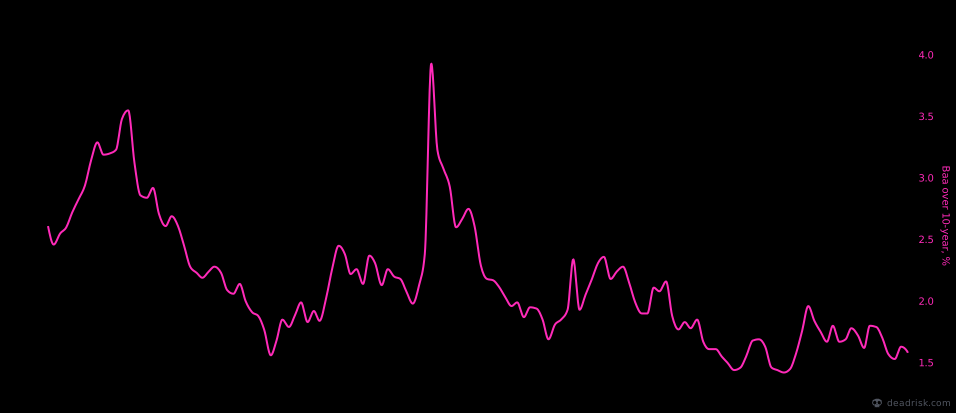
Public credit spreads and private loan distribution tell different stories. FRED’s BAA10Y series, which measures the yield on seasoned Baa corporate bonds over the ten-year Treasury, closed at 1.54 percentage points on 31 August 2026. That was 11 basis points below its 1.65-point average from 1 January through 31 August 2026. Meanwhile, banks were trying to distribute or sell Oracle-linked construction loans. The records price different instruments. A traded-bond spread is not a quote for a loan on an unfinished data centre.
The US Treasury par yield curve shows what happened to the base rate. From 2 January to 31 August 2026, the ten-year yield rose from 4.19% to 4.75%, a derived 56-basis-point increase. The two-year yield rose 87 basis points over the same dates; the thirty-year yield rose 39.
The question is not whether all AI borrowers face the same price. They do not. It is which claim the lender holds, what secures it, and who must take it when construction lending leaves the originating bank. Nothing here forecasts a credit event or expresses a view on a security.
The Evidence
Start with the market’s size. In October 2025, JPMorgan put AI-linked debt at $1.2 trillion: 14% of the US investment-grade market, against 11.7% for US banks.
The issuance records use different universes. S&P Global counted data-centre debt issuance nearly doubling from 2024 to $182 billion in 2025; it counted $62 billion raised by Meta from 2022 through 2025, about half in 2025. Across US investment-grade borrowers, companies sold $1.7 trillion of bonds in 2025, $100 billion short of 2020’s $1.8 trillion record. Goldman attributed roughly 30% of that 2025 issuance to AI. By May 2026, hyperscaler unsecured supply had reached $155 billion for the year, more than 45% above full-year 2025 supply. Morgan Stanley forecast nearly $570 billion of global AI-tied debt issuance in 2026, more than twice its 2025 figure. Its separate estimate has hyperscalers funding $1.4 trillion of $2.9 trillion in infrastructure needed through 2028 from their own cash. The difference is a derived $1.5 trillion funding gap, not an issued-debt total.
DeadRisk queried unique publisher articles dated 1 January 2024 through 31 August 2026 for eight concepts: AI debt, AI bond issuance, hyperscaler debt, data-centre construction loans, AI private credit, GPU-backed loans, chip-backed finance and AI SPV or off-balance-sheet debt. The queries returned 389 articles. Quarterly coverage rose from 6 articles in 2024 Q1 to 78 in 2026 Q2, thirteen times the earlier count; 249 of the 389 appeared in the four quarters through 2026 Q2, a derived 64%. Those are counts of reporting, not counts of loans or defaults.
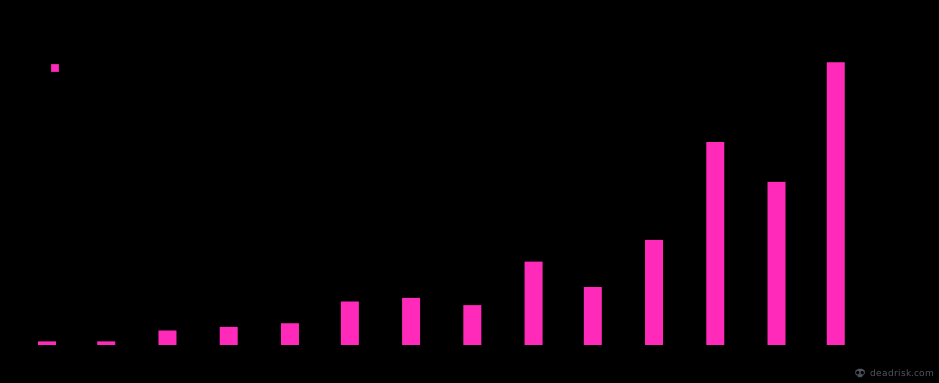
DeadRisk separately coded 36 dated financing events from June 2025 through August 2026, counting each event once regardless of article count. Twenty-five are borrower financing steps. Eleven meet a narrower lender-retrenchment rule: a lender, arranger, insurer or underwriter refused, reduced, hedged or sought to dispose of exposure. Expressions of concern alone do not qualify. The log separates unsecured bonds, project loans, SPV debt, chip-backed loans and margin loans; its issuance chart includes only events with reported amounts. The article count and event log have different denominators.
Public bond order books were deep. Meta received $96 billion of orders for $25 billion of unsecured bonds in May 2026, a derived 3.8 times the amount sold, after a $30 billion issue in October 2025. Nvidia received about $85 billion for $25 billion in June, derived coverage of 3.4 times and its first corporate sale since 2021. Alphabet received roughly $115 billion for $25 billion in August, or 4.6 times the amount sold, and said it planned to issue twice a year. Peak orders measure demand at those sales, not the ease of distributing construction loans.

A CoreWeave-tied data centre sold $900 million of five-year junk notes at par to yield 7.5% in June 2026. Bloomberg gave neither a peak order book nor a directly comparable investment-grade yield. Its demand coverage is unknown. This was debt tied to one site, not an unsecured claim on a large corporate borrower.
The construction-lending record has its own dated trail:
- November 2025. Deutsche Bank, having lent billions to hyperscalers, explored hedging its exposure, including by shorting AI stocks.
- February 2026. Trading in single-name tech credit derivatives rose amid borrowing concerns. Separately, developers sought ratings before completion of data centres.
- March 2026. KKR, Blackstone and others turned down data-centre debt over insufficient insurance against risks including natural disasters.
- April 2026. JPMorgan and other banks struggled to distribute billions in loans for Oracle-leased sites in Texas and Wisconsin. Banks had assembled a reported $38 billion financing for those sites six months earlier. Separate Oracle-linked Michigan financing closed at $16 billion in April.
- May 2026. The Financial Times reported private sale efforts, including banks seeking to offload some Oracle-linked loans at a discount. It reported attempts, not completed trades.
- August 2026. The Financial Times described the buildout as stretching major lenders across financing, insurance and underwriting.
All 11 coded retrenchment events concern loans, private-credit allocations, hedges, insurance or underwriting, rather than public unsecured corporate bonds.

Two structures matter when reading the amounts. First, the vehicle: the Financial Times’ December 2025 accounting of off-balance-sheet debt put Oracle at $66 billion, Meta at $30 billion, xAI at $20 billion and CoreWeave at $2.6 billion. Moving an obligation outside the usual balance-sheet view does not erase the creditor’s claim.
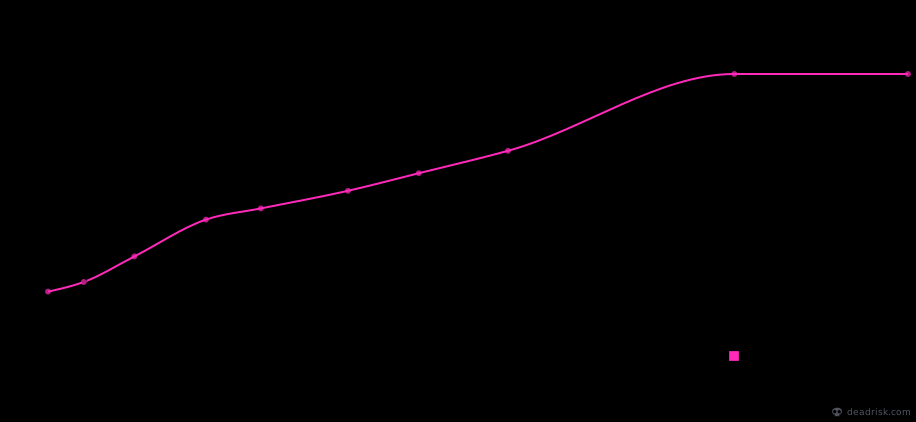
Second, the collateral: the Financial Times traced GPU-backed borrowing through vehicles to a model pioneered by CoreWeave. AMD backstopped a $300 million loan from Goldman so Crusoe could buy AMD chips. Nvidia agreed to rent back unused GPUs from young cloud providers for a share of revenue. In July 2026, a lender took inference-specific silicon as security for a $400 million loan. SoftBank sought $10 billion against OpenAI shares, a different asset valued through private funding rounds. For the chip deals, the collateral is part of the buildout the borrowing finances. The collateral ladder orders nine dated steps.
The Companies
Oracle sits at the junction of bond funding and project lending. It sought $15 billion of bonds in September 2025 and sold $25 billion in eight parts in February 2026. Its public issues and the banks’ Oracle-linked site loans are not interchangeable claims.
CoreWeave is associated with the chip-collateral structure. Its site-linked junk-bond yield cannot be read as the rate on all its borrowing. Meta also uses more than one instrument: a BlackRock-led $12 billion site sale in July 2026 sat alongside its corporate bonds and vehicle obligations.
Nvidia is both a bond issuer and a supplier supporting customers’ hardware economics. Its vendor role is examined in Nvidia financing its own demand. The Information reports that Nico Caprez, Jensen Huang’s son-in-law and an Nvidia vice-president, serves as its main neocloud contact. That identifies a reported relationship, not the terms or performance of any loan.
Salesforce is a useful control. Investors demanded steep concessions on its $25 billion March 2026 bond deal, which funded a buyback rather than a data centre. Borrower and purpose both differ from the AI issues; the deal cannot isolate an AI risk premium. Alphabet, by contrast, explored a 100-year sterling bond in February 2026. A proposed century-long maturity and an unfinished computing buildout demand different checks.
The Lenses
Dalio on what the debt produces. Big Debt Crises asks whether borrowed money generates enough income to service its cost. Its cycle template also describes vendors financing customers. The supplier-support deals above make that a useful test; the record cannot date a cycle phase or a top.
Keynes on the forecast underneath. Investment depends on the expected return on the marginal asset against the interest rate. Cheaper financing for equipment built later can make equipment built now less competitive. That is a reason to test useful life and expected receipts, not to infer either from a bond order book.
Minsky on refinancing. His cash-flow test calls a borrower speculative when receipts service interest but principal must be refinanced. A construction loan that needs refinancing at completion fits that narrow description. Difficulty distributing such loans establishes friction at that step; it does not establish a default or assign an entire industry a Minsky phase.
Mehrling on the quoted price. A spread requires a market in which dealers can quote and trade. The Baa index has one; a bespoke site loan may not. The public spread’s limit is measurable. It does not, by itself, prove what an unquoted loan is worth.
Shiller on the story. A new-era narrative can make a familiar risk premium seem unnecessary. The defence is to separate evidence of orders for one claim from evidence about another. Graham on the paperwork. Read the instrument: a claim on consolidated cash flows and a claim secured on one building do not become equivalent because both finance AI.
What Moved
The earlier risk-transfer lead remains unclosed. A DeadRisk graph update dated 29 September marked as rumored early Nvidia talks with insurers about products for lenders exposed to neocloud loan defaults. It identified no completed product, insurer, premium, covered loan or loss. That is reported discussion, not insurance capacity.
New reporting adds a physical constraint, not a new debt total. On 6 October, Reuters reported Google’s 3,590 MW power contract with Constellation Energy in the largest US power grid. New nuclear energy accounts for about 25% of the contracted supply, according to Reuters. The report’s power figure is a supply commitment; it gives no loan amount or debt-service figure. It belongs beside the financing record because funded facilities need power before they can earn from compute, not because megawatts can be converted into credit exposure.
The fiscal-year comparison shows why a single balance-sheet label is thin. DeadRisk’s market layer records CoreWeave FY2025 total debt of $29.8 billion against $10.6 billion in FY2024, up 181%; FY2025 revenue was $5.1 billion and free cash flow was negative $7.3 billion, against negative $6.0 billion in FY2024. Alphabet ended FY2025 with $59.3 billion of debt against $22.6 billion in FY2024, up 163%; free cash flow was $73.3 billion against $72.8 billion, up 1%. Meta ended FY2025 with $83.9 billion of debt against $49.1 billion in FY2024, up 71%; free cash flow fell from $54.1 billion to $46.1 billion, or 15%. Nvidia generated $96.7 billion of free cash flow in FY2026 against $60.9 billion in FY2025, up 59%, while debt rose from $10.0 billion to $11.0 billion, or 11%. Salesforce ended FY2026 with $17.2 billion of debt against $11.4 billion in FY2025, up 51%; free cash flow rose from $12.4 billion to $14.4 billion, or 16%. These are company-level fiscal-year figures, not the terms of the site loans or vehicles.
Cash conversion remains a separate check. Meta’s FY2025 capital spending was $69.7 billion against $37.3 billion in FY2024, up 87%. The Wall Street Journal reported that Mark Zuckerberg unveiled Meta Enterprise Platform on 28 September as a proposed business pillar, but supplied no bookings, revenue or cash-flow figure for it. On 6 October, The Information reported Meta’s Claude Code users had fallen to about 30,000 employees from about 60,000 earlier in 2026 as Meta and Microsoft worked to reduce internal Claude use. That is a reported tool-use change, not a measure of Meta’s platform revenue or data-centre utilization.
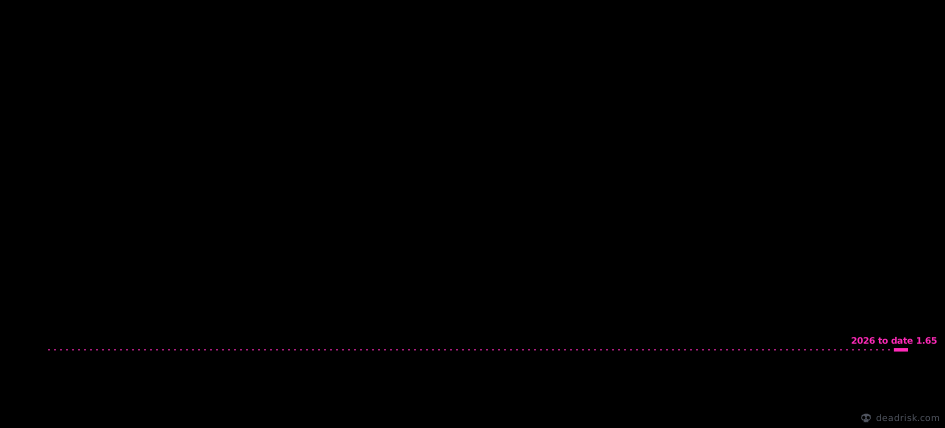
Treasury yields above use end-of-day US Treasury daily par yield-curve observations; their changes are derived. The credit spread and its derived 2026 average use FRED BAA10Y observations through 31 August 2026. Neither series quotes the private loans at issue.
Sources
Ray Dalio, Principles for Navigating Big Debt Crises — the cycle template, and the vendor-financing phase. See our reading notes.
Hyman Minsky, Stabilizing an Unstable Economy — the hedge/speculative/Ponzi classification, taken from the text rather than from the familiar summary of it.
Perry Mehrling, The New Lombard Street — the money view: a price is a matter of market liquidity, and the dealer system …[clipped 57 chars]
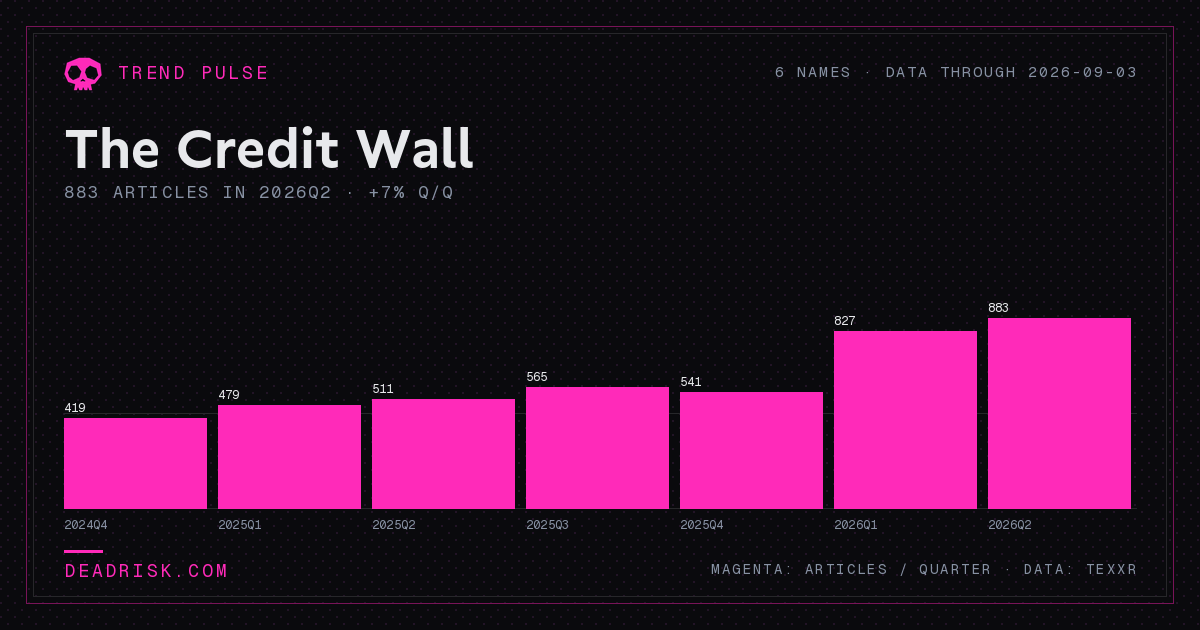
Across 6 member names, 2026Q3 drew 1,012 articles against 883 in 2026Q2. The largest single move was CoreWeave, -69%.
Coverage data as of 2026-10-18 · the essay above was last revised 2026-10-06