Trend pillar
The Memory Wall
A third of this year's big-tech capex now goes to memory alone — the input almost nobody priced. Why HBM turned a boom-bust commodity scarce, and the listed names on the short side of it.
The Thesis
The AI buildout has four walls, and this is the one the market saw last. The money loop never binds for long — the labs keep raising. Power binds now, and painfully. The chips themselves are a wall, gated by a single lithography monopoly. And then there is memory: the input that Dylan Patel of SemiAnalysis reckons now takes about a third of 2026 big-tech capex, and that almost nobody had priced a year ago.
Memory was supposed to be the opposite of scarce. DRAM and NAND are the textbook boom-bust commodity — makers flood capacity into every upcycle, prices collapse, and the record fills with glut stories. What AI did was pull the scarce part, high-bandwidth memory, out of that cycle. An accelerator cannot fall back to the cheap commodity part, the fabs that make the expensive part take two years to build, and none were started in the 2023–25 stretch when the makers were losing money. So the crunch arrived with no supply behind it, and the pricing power flipped to the three companies that make the stuff — one of which is finally listed where a US reader can reach it.
That flip is what this page tracks: how fast memory went from commodity to constraint, which numbers are the makers’ own claims rather than settled facts, and which listed names sit on the short side of the wall. What it costs the rest of the chain — and who is now raising prices on whom because of it — is the chokepoint rotation. It does not forecast where any of these stocks go — memory has broken every writer who called the top or the bottom, and the honest position is to watch the record, not predict it.
The Evidence
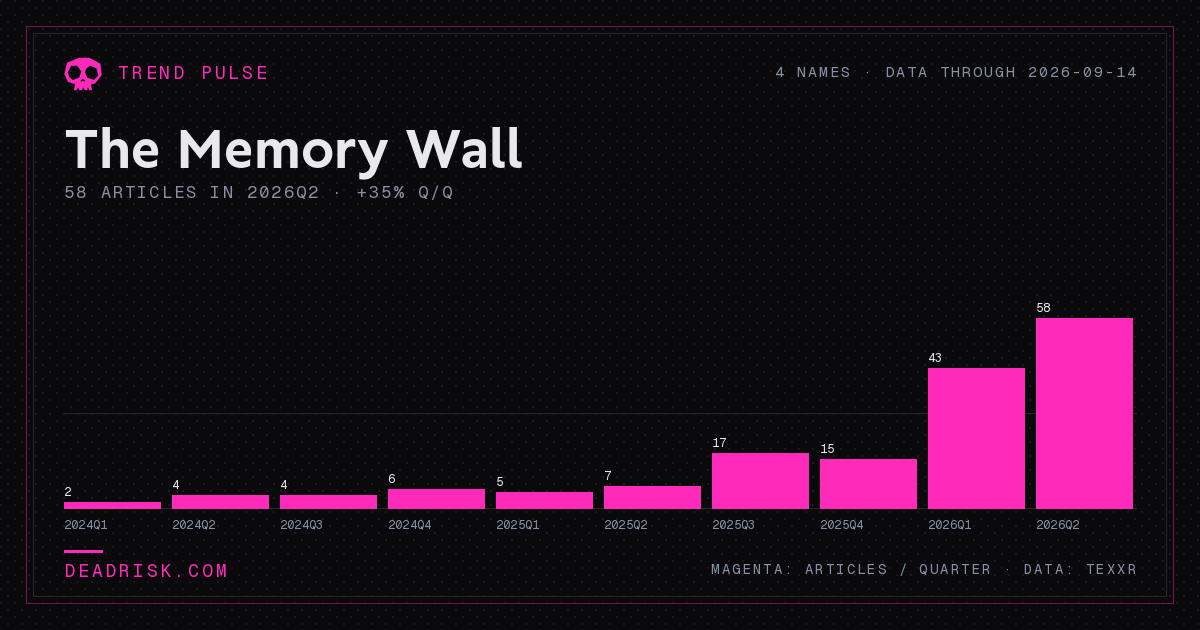
The cleanest gauge is the one name you can hold directly. Micron coverage in the TEXXR archive ran at 2 articles a quarter through early 2025. It hit 17 in 2026 Q1, 19 in Q2, and in the first weeks of Q3 is already past 40 — an eightfold jump against an eight-quarter average of under six. The record has spiked on memory before: a 2023 glut drew a burst of coverage that then collapsed as prices fell. What makes this one read differently is that the spike is arriving with pricing power, not after it.
The price flipped, hard. The Wall Street Journal ran the line that AI had made memory chips more valuable than oil, with the makers using their leverage to lock buyers into long-term agreements — a commodity behaving like a cornered resource, which commodities are not supposed to do. Micron’s fiscal Q3 revenue rose 346% to $41.46 billion, a single quarter larger than all of its fiscal 2025. In May the stock crossed $1 trillion in market value for the first time, weeks after it had passed $700 billion.
Why the cheap part cannot rescue the buyer. Patel’s mechanism is physical, not financial: an HBM stack moves on the order of 2.5 terabytes a second against 64–128 gigabytes for equivalent commodity DDR. That gap is why an accelerator cannot fall back to the cheap memory even on a workload that would tolerate the latency — the bandwidth is the product. And because HBM steals wafer starts from ordinary DRAM, the scarcity spreads: the same math has DRAM in a phone roughly tripling from ~$50 to ~$150, adding perhaps $250 to the sticker, with low-to-mid-range smartphone volumes possibly falling from ~1.4 billion toward 500–600 million within two years. Those are his figures, walked from the transcript, not filed facts — but they are checkable against the record as it lands.
The supply that would break it is years out, or contested. Micron itself does not expect to ship HBM until summer 2028 from its new capacity, and has raised its US capital commitment to $250 billion through 2035 plus a ~$9.3 billion Hiroshima expansion. New supply is coming from the side, too: SK Hynix is seeking ~$29.4 billion in a US listing, and China’s CXMT is in the frame — though memory vendors pushed back on the cheap-DDR5 claim, saying its prices match theirs rather than undercut them.
The record carries its own check. Memory is still memory. Micron and Sandisk led a sharp selloff on June 23, each down more than 13% in a single session, and memory and storage names fell sharply again in July. A stock that drops 13% in a day is one the market cannot decide is a supercycle or a top. And policy is now inside the price: the chip group SEMI, Micron and Samsung among its members, warned Washington against moves that would distort the memory market. New capacity and political intervention are the two things that have ended every memory cycle before this one — anyone reading the wall as a guaranteed shortage should read those three paragraphs first.
The record then wrote the check twice in one week. On July 28, South Korea’s KOSPI fell more than 11%, led by chip stocks, on concerns over China’s chipmaking progress and “AI fatigue” — Samsung and SK Hynix both fell 11-12%. The next day SK Hynix reported Q2 revenue up 257% to roughly $54.34 billion and operating profit up 557% to about $41.48 billion — both below estimates, and the selloff continued through July 30, dragging Sandisk down more than 7.5%, Arm 6.5% and AMD 6.5%. Samsung’s own Q2 print landed the same day the selloff continued: revenue up 130% to about $118.1 billion, operating profit up 1,814% to roughly $61.46 billion, on AI memory demand — a beat that did nothing to stop the sector-wide decline. Then, with no new information about either company, Samsung and SK Hynix shares surged more than 20% in Seoul on July 31. A miss, a beat, an 11% fall and a 20% rally inside four sessions — the wall’s own volatility, not a story about it.
The squeeze reached the buyer’s own flagship. Nvidia is reportedly weighing lower-memory versions of its Rubin Ultra GPU because it may not secure enough HBM, and has tested at least three configurations — the company at the top of the demand stack, constrained by the same input this page tracks. SK Hynix answered its own miss with capacity and cash, not caution: a $38 billion expansion across new DRAM and NAND facilities in South Korea, and, two weeks later, a ~$29 billion share buyback explicitly framed as an answer to “worries about the durability of AI spending” — new fabs and a buyback in the same month is the capacity-plus-confidence signal Dalio’s lens, below, reads as the harder half of a boom to interpret.
The Companies
The names on the short side of this wall are the three that make the memory, plus the equipment makers who tool the fabs. Only one of the three trades where a US reader can hold it directly.
Micron is that one — the only US-listed pure-play on the memory wall, and DeadRisk’s second-order archetype: a name the AI trade does not create, but reaches for when the input it depends on turns scarce. Its dossier tracks whether the long-term contracts hold or the cycle wins, quarter by quarter.
The other two scale makers are Korean, and between them they hold most of the world’s HBM. SK Hynix is the one Patel singles out: Nvidia is already its largest customer, alongside being TSMC’s — there is no adjacent phone-and-PC capacity to borrow from, which is the whole reason the wall holds. Its own dossier is still being checked before publication. Samsung is the third, and the widest — memory plus a foundry business that puts it on more than one wall at once, and the record now traces its HBM qualification fight against SK Hynix in full. Both sit in the memory basket, the equal-weighted category page that reports how few independent bets a group of names that move together really holds.
Around the makers sits the supply chain that tools them. The HBM-equipment basket holds the back-end specialists that grind, stack, bond and test the memory dies — the steps that turn ordinary DRAM into an HBM cube, and a different set of names from the ones who make logic chips. On Patel’s read, lithography is only in the teens as a share of a DRAM wafer’s cost against ~30% for logic, so the memory crunch runs through deposition, etch and die-stacking far more than through ASML; the wall here is not the one EUV builds. Treat every basket as one bet wearing several tickers — each page reports its own internal correlation for exactly that reason.
The demand side needs no introduction. Nvidia is negotiating three-year memory deals and carrying roughly $90 billion of long-term supply contracts — the clearest sign that the buyer, not the seller, is the one afraid of being caught short.
The Lenses
The Helmer lens reads HBM as a candidate cornered resource — one of the seven powers, preferential access to a coveted asset on terms rivals cannot match. Three makers, a two-year lead time on new fabs, and a buyer who cannot substitute the cheap part: on paper that is the textbook case. But the honest version states what breaks it, and here the thing that breaks it is memory’s own history. A cornered resource is supposed to be durable; a commodity that has mean-reverted every cycle for thirty years is not. The pricing power is real today and contested by construction — the tell will be whether the makers’ long-term contracts survive the supply that Micron, SK Hynix and Samsung are all now building toward, or melt the way memory prices always have.
The Dalio lens asks the question the cycle forces. His debt-cycle template separates a buildout funded out of cash flow from one funded on debt, because they fail differently — and it asks, when the revenue inflection comes late, who is forced to sell. Memory is the most cyclical link in the whole chain, the one with the longest record of boom turning to glut. If any part of the AI trade is going to test Dalio’s question first, it is this one. For now the makers are printing cash and the contracts are holding. The record’s job is to notice the quarter that stops being true.
What Moved
- 2026-08-19SK Hynix announces a ~$29B share buyback, framed as calming worries about the durability of AI spending; Samsung raises 4nm/5nm foundry prices up to 15%.
- 2026-08-07SK Hynix commits $38B to new DRAM and NAND facilities in South Korea.
- 2026-08-06Nvidia is reported to be weighing lower-memory Rubin Ultra GPU configurations over HBM supply.
- 2026-07-31Samsung and SK Hynix shares surge more than 20% in Seoul, reversing the week's selloff with no new information about either company.
- 2026-07-30Samsung reports Q2 revenue up 130% to ~$118.1B and operating profit up 1,814% to ~$61.46B; the sector selloff continues the same day.
- 2026-07-29SK Hynix reports Q2 revenue up 257% to ~$54.34B and operating profit up 557% to ~$41.48B, both below estimates; Sandisk, Arm and AMD fall 6.5%+ in the spillover.
- 2026-07-28South Korea's KOSPI falls more than 11%, led by chip stocks, on China chipmaking-progress concerns and "AI fatigue"; Samsung and SK Hynix each fall 11-12%.
- 2026-07-26Pillar launch. Micron coverage stands at 19 articles for 2026 Q2, up from 2 a quarter through early 2025, with more than 40 already logged in Q3.
- 2026-07-17Memory and storage makers fall sharply again in a broad chip selloff.
- 2026-07-09Micron raises its US capital commitment to $250 billion through 2035.
- 2026-07-04Micron breaks ground on a ~$9.3 billion Hiroshima plant expansion.
- 2026-07-02SEMI, with Micron and Samsung, warns Washington against moves that would distort the memory market.
- 2026-06-24Micron reports fiscal Q3 revenue up 346% to $41.46B; SK Hynix files to raise ~$29.4B in a US listing.
- 2026-06-23Micron and Sandisk lead a sharp tech selloff, each down more than 13% in a session.
- 2026-05-26Micron crosses a $1 trillion market value for the first time.
Sources
- Micron reports fiscal Q3 revenue up 346% YoY to $41.46B, above estimates; HBM shipments from summer 2028 — CNBC, 2026-06-24. Original · texxr.com/1171494
- Micron hits a $1T market value for the first time — CNBC, 2026-05-27. Original · texxr.com/1169645
- AI has made memory chips more valuable than oil; makers lock in long-term deals — Wall Street Journal, 2026-05-30. Original · texxr.com/1169894
- Micron zooms past $700B market cap in a memory-stock rally — CNBC, 2026-05-06. Original · texxr.com/1168379
- Micron boosts US spending to $250B through 2035 amid memory demand — Bloomberg, 2026-07-10. Original · texxr.com/1172317
- Micron breaks ground on a ~$9.3B Hiroshima plant expansion — Bloomberg, 2026-07-05. Original · texxr.com/1172040
- Chip group SEMI, incl. Micron and Samsung, warns the US against distorting the memory market — Bloomberg, 2026-07-04. Original · texxr.com/1171994
- SK Hynix looks to raise ~$29.4B in a US listing — Bloomberg, 2026-06-24. Original · texxr.com/1171465
- Micron and Sandisk lead a sharp tech selloff, down 13%+ — MarketWatch, 2026-06-24. Original · texxr.com/1171425
- Memory vendors say CXMT’s DDR5 prices match Samsung, SK Hynix and Micron — Wccftech, 2026-06-08. Original · texxr.com/1170429
- US chip, memory and storage stocks fell sharply — Financial Times, 2026-07-17. Original · texxr.com/1173141
- South Korea’s KOSPI drops 11%+, led by chip stocks; Samsung falls 11%+, SK Hynix 12%, on China chipmaking-progress concerns — Bloomberg, 2026-07-28. Original · texxr.com/1173805
- SK Hynix reports Q2 revenue up 257% YoY to ~$54.34B, below ~$57.56B est., and operating profit up 557% YoY to ~$41.48B, below ~$43.85B est. — CNBC, 2026-07-29. Original · texxr.com/1173885
- Investors continue to dump chipmaker stocks following SK Hynix’s results; Sandisk down 7.5%+, Arm 6.5%+, AMD 6.5%+ — Financial Times, 2026-07-30. Original · texxr.com/1173988
- Samsung reports Q2 revenue up 130% YoY to ~$118.1B, operating profit up 1,814% to ~$61.46B, on AI demand — CNBC, 2026-07-30. Original · texxr.com/1173970
- SK Hynix and Samsung shares surge 20%+ in Seoul, a sharp reversal from the week’s selloff — CNBC, 2026-07-31. Original · texxr.com/1174063
- Nvidia is considering lower-memory versions of its Rubin Ultra GPU due to potential issues securing enough HBM, and has tested at least three versions — The Information, 2026-08-06. Original · texxr.com/1174494
- SK Hynix plans a $38B chipmaking expansion in South Korea, including a ~$24.7B DRAM facility in Yongin and a ~$13.3B NAND plant in Cheongju — Bloomberg, 2026-08-07. Original · texxr.com/1174562
- SK Hynix plans a ~$29B share buyback, repurchasing and canceling up to 24M treasury shares, to calm worries about the durability of AI spending — Bloomberg, 2026-08-19. Original · texxr.com/1175245
Across 4 member names, 2026Q2 drew 58 articles against 43 in 2026Q1. The largest single move was SK Hynix, +114%.
Coverage data as of 2026-09-15 · the essay above was last revised 2026-08-28