The argument
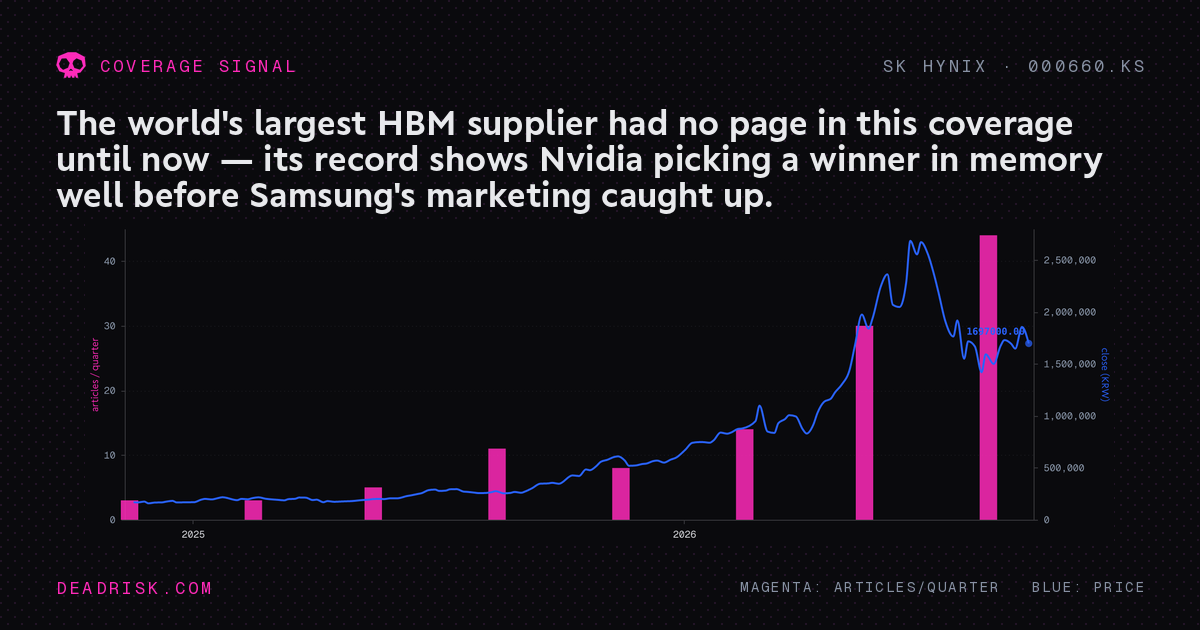
The tape · quarterly coverage amplitude · live quarter blinking
SK Hynix (KRX: 000660) makes HBM — the stacked memory that sits next to an Nvidia GPU die and feeds it fast enough to keep the chip busy. It is the supplier at the center of the memory wall, the constraint the AI-capex buildout runs into once money, power and the accelerators themselves stop being the bottleneck. Until this page, the memory-wall trend carried only Micron and SanDisk, the two US-listed names — the Korean company that actually leads HBM supply had no dossier at all.
That gap wasn’t a judgment call. SK Hynix carries 249 hyperedges in TEXXR’s graph, queried August 3, 2026 — comparable in depth to Micron’s 326, far ahead of SanDisk’s 37, and more than thirty times Constellation Energy’s 7-edge record on the same day. Reading those edges in order answers a question the memory-wall story usually skips: whether SK Hynix’s lead over Samsung is a real, dated sequence in the coverage, or a story told backward once the outcome was known.

The record runs in order, and the order matters. On 24 May 2024, Reuters reported that Samsung’s HBM3 and HBM3E chips had not passed Nvidia’s tests, citing heat and power problems. Two months later, Nvidia cleared Samsung’s older HBM3 — but only for the H20, the cut-down chip built for the Chinese market, with HBM3E still in testing. SK Hynix spent that same window pulling ahead: it started mass-producing 12-layer HBM3E chips in September 2024, the product Samsung was still trying to qualify. By January 2025, Samsung’s HBM3E clearance had widened only to an 8-layer part for Nvidia’s less powerful, China-tailored processors — still short of the flagship line SK Hynix was already shipping.
The next-generation chip repeated the pattern on a faster clock. Samsung entered final qualification for HBM4 on 26 January 2026, targeting mass production in February. Two days later, Yonhap reported that Nvidia had already allocated roughly 70% of its 2026 HBM4 demand to SK Hynix, with Counterpoint estimating SK Hynix would hold about 54% of the global HBM4 market for the year — an allocation call made while Samsung’s qualification was still in progress, not after. Samsung’s answer came on 12 February 2026, when it said it had sent the first commercial HBM4 shipments to customers, framed in the coverage as a race to reclaim the AI lead. The “first” is real. The demand share was already spoken for.
That sequence is the finding: SK Hynix’s qualification lead is not a story assembled after the fact from a winner’s press releases. It is dated, month by month, in a public record that ran the same way each cycle — SK Hynix qualifies and ships first; Samsung follows, months to years later, on a narrower version of the same part.
The company staked its own valuation on the idea that this cycle finally breaks the industry’s boom-and-bust pattern. Its Nasdaq debut, raising $26.5 billion in the largest-ever foreign US listing, was covered as a bet AI breaks the cycle. Days later its CEO warned of a worst-ever shortage coming in 2027, with demand outrunning supply past 2030 — a supplier, not a bottleneck, in his own telling. Two weeks after that, Anthropic asked SK Hynix for chips for its own silicon effort, and Nvidia and SK Group unveiled a $500 billion AI initiative built partly around locking in SK Hynix’s HBM supply.
The tape did not agree the cycle was broken. This page’s price data comes from data/market/000660-ks.json, a provider-current end-of-day series for the Seoul-listed common shares — not the Nasdaq ADR, which trades separately in US dollars — and not a point-in-time archive of what a price was believed to be on a past date, only what it shows today. In won, the stock ran from a 52-week high of KRW 2,919,000 on 22 June 2026 down to KRW 1,322,000 by 30 July 2026, a 54.7% drawdown across five weeks that included a reported 15%-plus single-day plunge on 13 July, its largest ever, days after its own Nasdaq debut. Then it moved the other way: KRW 1,322,000 to KRW 1,718,000 the next session, 31 July 2026, a one-day gain of 29.95%. A stock that swings that hard in a week is a stock the market has not decided is a permanent structural break or another turn of a cycle that has broken every supplier’s confidence before.

The spectrogram
Signal decomposition · what the record is made of, by quarter · brightness = share of edges · drift = how far the story moved in meaning
In 2024Q1 the record was 69% financial; by 2026Q1 it is 71% financial. A price chart shows what a name did; the spectrogram shows what its story is made of.
The brains
The machine
SK Hynix’s 249 edges skew financial — 146 of them, 58.6% — a narrower share than Micron’s 227 of 326 (69.6%), because launch and partnership edges carry more of SK Hynix’s record: 21 launch edges and 21 partnership edges, 16.8% combined, against 8.9% for Micron over the same two predicates. Samsung’s own 500-edge record looks nothing like either: 33.4% launch, driven by phones and consumer electronics that have nothing to do with memory. SK Hynix’s graph reads as what it is — a single-product financial story, not a product-launch calendar, which is exactly what a company selling one input into one demand curve should look like.
Ninety-six percent of SK Hynix’s edges — 240 of 249 — date from 2024 onward, matching the HBM boom rather than the company’s decade-plus listing history. The regulatory share tells the supplier-or-bottleneck question a different way: 27 edges, 10.8% of the total, cover US export licensing on China-based fabs, a live constraint since at least 2022 and still unresolved as of the most recent annual license renewals reported in the record.
The money

Currency: USD.

The record
Signals in the coverage and filing record, not trade ideas:
- HBM4E samples, targeted for the second half of 2026. SK Hynix said in April it aimed to ship them in H2 2026 — a dateable checkpoint on whether the qualification lead over Samsung persists into the next node.
- Whether Samsung’s “first commercial shipment” converts to share. Nvidia’s reported 70% HBM4 allocation to SK Hynix predates Samsung’s February shipment claim; watch whether later coverage revises that split.
- Next earnings, 27 October 2026, against a quarter that already produced a 9% one-day drop on disappointing results and a 54.7% five-week drawdown.
- The annual China export license. SK Hynix’s Dalian NAND plant has run on renewable, revocable US exemptions since 2022; a non-renewal would hit capacity the coverage treats as central to its HBM ramp.
- Whether the Anthropic supply request becomes a contract. A chip developer asking a memory maker for supply is a different relationship than a GPU maker doing the same — worth tracking whether it appears again with terms attached.
| Quarter | Articles | QoQ | Q-end price | QoQ | The record reads |
|---|---|---|---|---|---|
| 2024Q4 | 3 | — | 171716.47 KRW | — | first quarter on record |
| 2025Q1 | 3 | +0% | 189522.95 KRW | +10.4% | price rose, attention steady |
| 2025Q2 | 5 | +67% | 290721.84 KRW | +53.4% | attention and price rose together |
| 2025Q3 | 11 | +120% | 346478.66 KRW | +19.2% | attention and price rose together |
| 2025Q4 | 8 | -27% | 649551.50 KRW | +87.5% | attention cooled as price rose |
| 2026Q1 | 14 | +75% | 806690.19 KRW | +24.2% | attention and price rose together |
| 2026Q2 | 30 | +114% | 2649425.50 KRW | +228.4% | attention and price rose together |
| 2026Q3 open | 43 | +43% | 1690000.00 KRW | -36.2% | attention rose as price fell (quarter in progress) |
The peers
SK Hynix lives or dies by the same constraint as these names — small equal-weighted groups, one constraint each. Not investment products: see all categories.
The newest constraint — the memory constraint, 1.9 independent bets across 7 names
Sources
Edges: TEXXR knowledge graph, SK Hynix edge profile (249 edges, queried 2026-08-03): Nvidia’s HBM4 supply allocation to SK hynix (94446), Samsung’s final-phase HBM4 qualification (94096), Samsung’s first commercial HBM4 shipment (97192), Samsung’s failed HBM3/HBM3E tests (42039), Anthropic’s supply request (408998), and the Nvidia-SK Hynix memory partnership (408959). Price data: data/market/000660-ks.json, KRW-denominated end-of-day series for the KRX common shares, generated 2026-08-03 — provider-current, not a point-in-time archive.