The argument
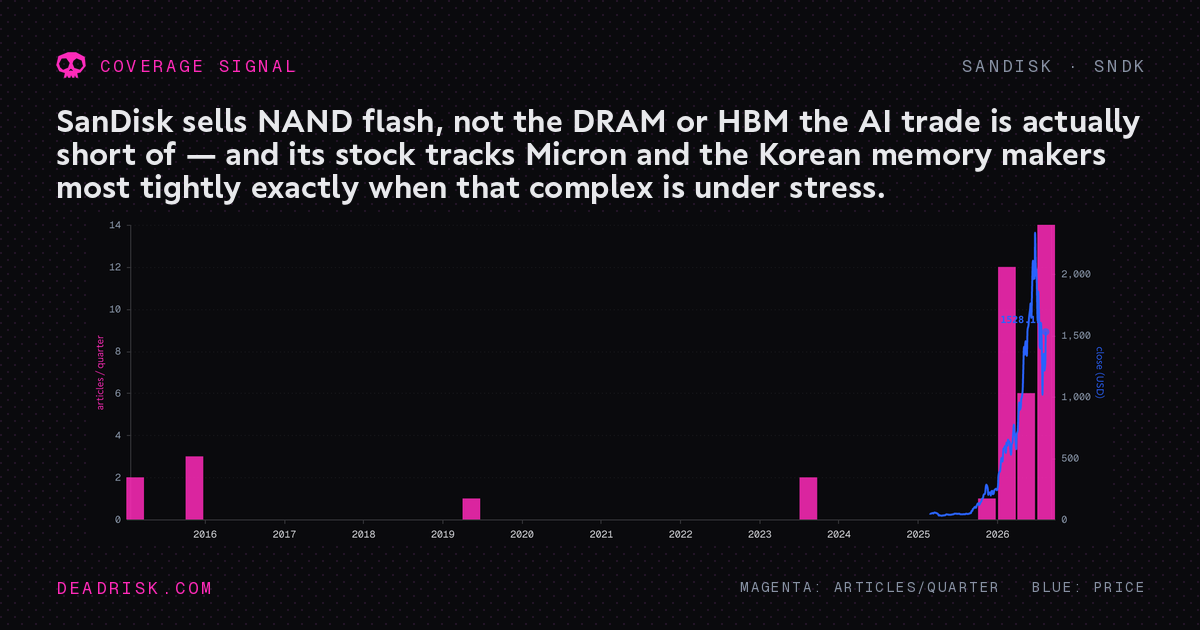
The tape · quarterly coverage amplitude · live quarter blinking
SanDisk (NASDAQ: SNDK) makes NAND flash — not the DRAM or HBM that Micron and the Korean makers sell into the AI crunch — and has been an independent stock for eighteen months. Western Digital split into two companies in October 2023 after a planned merger with its Kioxia joint-venture partner collapsed; the flash half re-listed as SanDisk Corp on 2025-02-24, closing its first session at $48.60. The registry lists it second-order, in chips, on the memory-wall and AI-capex trends — the same tier and sector as Micron, selling a different product into the same story.
Situational Awareness LP’s 13F, filed 2026-05-18 for the quarter ended 2026-03-31, reported 1,140,119 SanDisk shares worth $724.36 million — its second-largest long stock position, 18.8% of a $3.86 billion long book, behind only Bloom Energy. The same filing’s $583.7 million Micron line is a Put, not a comparable long bet — its value is the underlying’s notional, and the filing cannot say if it is a bearish bet or a hedge.

SanDisk does not make the memory the AI trade is short of, and it trades as if it does. Across SanDisk’s full trading history — 360 sessions, 2025-02-24 through 2026-07-31 — the Pearson correlation between its daily returns and Micron’s is 0.75. Across the 28 sessions of the Korean memory selloff and reversal alone, 2026-06-22 through 2026-07-31, it rises to 0.92. A 28-session window is short enough that this shows the relationship tightening under stress, not that it changed for good — but the number is real, computed from TEXXR’s own as-traded price data, and it is the most interesting thing in this record.
The setup for that stress: SanDisk priced its spinoff low, bottomed at $29.62 on 2025-04-22, then closed 2025 up more than 560%, the S&P 500’s top performer. It kept running — $41.33 on 2025-08-01 to $470.80 on 2026-01-26, a 1,039% move — which Sherwood News credited to SanDisk’s cost advantage from its Kioxia joint venture, the two companies extending that JV by five years, to 2034, on 2026-02-01 — a structural relationship Micron’s dossier has no equivalent for. Earnings kept beating: Q2 revenue up 61% to $3.03 billion, net income up 672% to $803 million (2026-01-30), then Q3 revenue up 251% to $5.95 billion, net income $3.62 billion (2026-05-01) — though that report flagged a consumer-revenue miss and a shift to “multiyear customer engagements,” the same contracted-demand language Micron was using.
SanDisk closed the second quarter at $2,273.73 (2026-06-30), up 257.9% from $635.34 (2026-03-31) — a figure that hides a violent week. Micron and SanDisk led a selloff on 2026-06-23, each down 13%+, SanDisk closing at $1,963.60; it fell to $1,914.46 the next day, spiked 22.0% to an all-time closing high of $2,335.00 on 2026-06-25, then drifted back to the quarter-end close. The real break came in July: a broad selloff on 2026-07-17 left SNDK down 12.63%, worse than Micron, Western Digital, Seagate or Intel that day, and the close kept falling to $1,015.89 by 2026-07-29 — down 56.5% from the 2026-06-25 high, five weeks earlier.
That low landed inside a densely covered Korean selloff: SK Hynix fell 15%+ on 2026-07-13, its largest-ever single-day decline, days after its own Nasdaq debut; then SK Hynix and Samsung both surged 20%+ in Seoul on 2026-07-31 — the same session SanDisk itself rallied 26.0%, from $1,015.89 to $1,279.96, in US trading on 2026-07-30.
Short interest tracks the same volatility with a lag. FINRA’s 34 settlements (2025-02-28 through 2026-07-15) show shares short peaking at 10,911,306 on 2026-06-15, the series high, then falling 34.0% to 7,197,631 by 2026-06-30 — right as the stock topped — before rising to 7,857,690 by 2026-07-15. Settlements publish roughly eight business days later, so that reading is already three weeks stale: it cannot say whether shorts kept covering into the 2026-07-30 rally or were rebuilding into the next leg down. The 2026-07-31 settlement is not yet published.

The spectrogram
Signal decomposition · what the record is made of, by quarter · brightness = share of edges · drift = how far the story moved in meaning
In 2025Q4 the record was 100% financial; by 2026Q1 it is 38% financial. A price chart shows what a name did; the spectrogram shows what its story is made of.
The brains
The machine
37 hyperedges touch SanDisk in TEXXR’s corpus, against Micron’s 323 — a gap about continuity, not scale. The earliest edge is Western Digital’s 2015 acquisition of SanDisk; two more follow by 2019; then nothing until 2025-12-31. The graph’s SanDisk clock tracks its corporate status, not its operations — dark for six years while SanDisk was a subsidiary, not an independent subject.
Once the clock restarts, half the 37 edges are bare financial predicates — a price move, no object, day after day — where Micron’s 2026 edges cluster on capex and policy. The edges that aren’t price are structural: the Kioxia JV extension, and a January 2026 pledge with Micron, Western Digital and Seagate to keep undershooting demand rather than repeat the 2023 glut — the promise the July selloff is the first real test of.
The money

Currency: USD. Revenue/net income/capex/FCF cross-checked against filed XBRL.

Positioning: how much of SNDK is sold short, on the record brokers file twice a month. It lags by design — read it as where the crowd stood, not where it stands.
The record
- Q4 earnings, 2026-08-05. Does “multiyear customer engagements” become contracted revenue, or stay a hedge against a demand question nobody has answered.
- Whether the correlation holds. 0.92 over the 28-session Korean window against 0.75 over the full history is a tightening under stress, not proof the relationship changed — watch whether it reverts once the Korean episode ages out of both windows.
- The 2026-07-31 FINRA settlement, not yet published. The only way to know whether the mid-July uptick in short interest continued into the late-month rally or reversed with it.
- The four-company capacity pledge. A 56.5% five-week drawdown is the kind of move that tests whether Micron, SanDisk, Western Digital and Seagate actually hold their own discipline.
| Quarter | Articles | QoQ | Q-end price | QoQ | The record reads |
|---|---|---|---|---|---|
| 2015Q1 | 2 | — | — | — | first quarter on record |
| 2015Q4 | 3 | +50% | — | — | attention rose |
| 2019Q2 | 1 | -67% | — | — | attention cooled |
| 2023Q3 | 2 | +100% | — | — | attention rose |
| 2025Q4 | 1 | -50% | 237.38 USD | — | attention cooled |
| 2026Q1 | 12 | +1100% | 635.34 USD | +167.6% | attention and price rose together |
| 2026Q2 | 6 | -50% | 2273.73 USD | +257.9% | attention cooled as price rose |
| 2026Q3 open | 9 | +50% | 1712.89 USD | -24.7% | attention rose as price fell (quarter in progress) |
The peers
SanDisk lives or dies by the same constraint as these names — small equal-weighted groups, one constraint each. Not investment products: see all categories.
The newest constraint — the memory constraint, 1.9 independent bets across 7 names
Sources
Edges: TEXXR knowledge graph, SanDisk edge profile (37 edges, 2015-2026, queried 2026-08-02): the 2015 Western Digital acquisition (397008), the January 2026 capacity-discipline pledge (92261), the Kioxia JV extension (95034), the June selloff shared with Micron (404185), and the July 17 storage-sector selloff (407927). Correlation figures: Pearson coefficients on daily close-to-close returns, data/prices/sndk.json vs. data/prices/mu.json, 360 common sessions (full history) and 28 common sessions, 2026-06-22 to 2026-07-31 (Korean-selloff window).