The argument
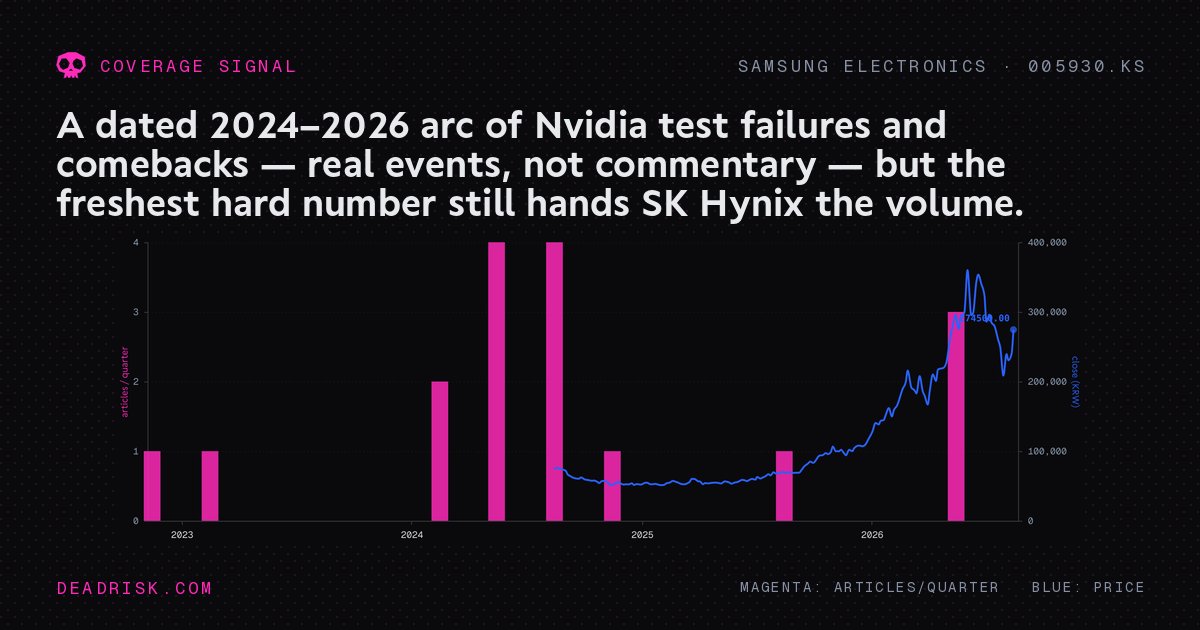
The tape · quarterly coverage amplitude · live quarter blinking
Samsung Electronics is three companies wearing one ticker: the world’s largest maker of memory chips, a foundry that manufactures other firms’ designs, and the maker of the Galaxy phone in most non-American pockets. DeadRisk files it under memory-wall and ai-capex for one reason only — the fight over qualifying its high-bandwidth memory, the stacked DRAM that feeds Nvidia’s AI accelerators, against SK Hynix. Everything else about Samsung — the foldables, the watches, the credit card it launched in the US in July 2026 — sits outside that argument, however much of the record it fills. Micron is the one US-listed pure play on the same memory wall; Samsung and SK Hynix are the two Korean names that actually set the pace.
The scale is worth a number with its baseline. Samsung’s Q2 2026 operating profit rose 1,814% year over year to roughly $61.46 billion, on revenue up 130% to about $118.1 billion — both credited in the report to AI-driven memory demand, not phones.

The record holds a genuine failure-and-recovery arc, not retrospective spin dressed as history. In May 2024, Reuters reported Samsung’s HBM3 and HBM3E chips had not passed Nvidia’s tests, citing heat and power problems — a public stumble for a company used to leading. Two months later, Nvidia cleared Samsung’s HBM3 chips, but only for the H20, the cut-down accelerator built for China; the more advanced HBM3E stayed in testing. Days after that, Samsung told the record it was narrowing the gap with SK Hynix and expected full HBM3E approval by November. When that approval landed, in December 2024, it again came capped: Bloomberg reported Nvidia cleared the 8-layer HBM3E only for Nvidia’s lesser China-market processors.
The pattern breaks in 2026. On January 26, Samsung said it had entered the final qualification phase for HBM4, targeting mass production in February — no China-only caveat this time. Two days later a separate report undercut the win: Nvidia had reportedly allocated about 70% of its 2026 HBM4 demand to SK Hynix, with Counterpoint projecting SK Hynix at 54% of the global HBM4 market for the year — qualification and share are not the same fight, and the corpus has them landing two days apart. Samsung answered with speed rather than share: claiming on February 12 to have sent the first commercial HBM4 shipments to customers, ahead of SK Hynix, and again in May with the first 12-layer HBM4E samples — a generation SK Hynix had said in April it wouldn’t ship until the second half of 2026.
So the qualification arc tested true: a dated failure in May 2024, a China-only clearance that July, a full clearance capped the same way in December, a “final phase” claim in January 2026, and two “first” claims since. What the record does not show is Samsung winning the volume fight. The 70/30 split toward SK Hynix, dated January 28, 2026, is the newest hard allocation number in the graph, and nothing since has revised it — Samsung’s “firsts” are announcement dates, not share data.
The market read that tension in late July. After Samsung reported Q2 revenue up 130% year over year, shares fell more than 11% on July 28 in a broader chip selloff tied to worries over China’s chipmaking progress; tens of millions of South Korean retail investors, the market’s largest 2026 buyers, were caught in the same selloff through July 30 as Samsung and SK Hynix both tumbled. Then it reversed: Samsung and SK Hynix shares surged more than 20% in Seoul the next session. Provider end-of-day data (not a point-in-time archive — see Sources) puts Samsung’s close at 207,000 won on July 30 and 262,500 won on July 31, 2026, a one-day gain of 26.8%. Over the trailing year the same series runs from 70,515 won (July 31, 2025) to 262,500 won (July 31, 2026), up about 272% — a re-rating with a 52-week range of 66,762 to 362,101 won along the way, not a straight line.

The spectrogram
Signal decomposition · what the record is made of, by quarter · brightness = share of edges · drift = how far the story moved in meaning
In 2024Q1 the record was 100% financial; by 2026Q1 it is 38% launch. A price chart shows what a name did; the spectrogram shows what its story is made of.
The brains
Samsung’s record lacks the per-share earnings, book value, debt, and dividend history needed to show a margin of safety against the September 21 close of 274,000 won.
A 1,814% profit surge and a fresh round of capacity spending look identical at the top of a cycle and the start of one — the record can date the surge, not which it is.
Samsung's own record beat estimates on the day the sector was still selling it off, and the reversal two days later carried no new information about Samsung at all.
The machine
Samsung’s most recent 500-edge batch in TEXXR’s graph runs mostly consumer. Of the 497 edges dated since 2024, roughly 179 — the largest single bucket, more than a third — touch Galaxy phones, watches, foldables, or smartphone-market share, not memory or foundry. Edges keyed to memory, HBM, DRAM, foundry, or Nvidia/SK Hynix/Micron run to about 108, but that count overstates the depth of the record: 61 of those 108, more than half, are the same Bloomberg report of a preliminary March 18, 2026 HBM4 deal with AMD, refracted by extraction into 61 near-identical rows — Samsung to AMD, HBM4, DDR5, MI455X, Helios, recombined every way five nouns allow. Strip that single story out and the distinct memory record runs closer to 47 edges: a genuine deep record on the qualification fight, but a fifth of consumer volume, not a fifth of the total. SK Hynix, a pure memory play with no phones to dilute it, carries 249 edges in the same graph — almost all financial — a useful comparator for how much of Samsung’s count is noise from a name that also sells watches.
Foundry, Samsung’s third leg, shows the same direction with less volume. TEXXR’s earliest foundry edge on the rivalry, from August 2022, records Samsung losing Qualcomm and Nvidia as customers to TSMC; more recently, Samsung’s Taylor, Texas plant pushed its mass-production timeline from the second half of 2026 to early 2027, per sourced Korea JoongAng Daily reporting on a pattern of repeated delays. Memory is where Samsung is contesting and gaining ground on a dated, checkable arc; foundry is where it is still losing it — the split this page exists to keep separate.
The money

Currency: USD.

The record
Signals in the coverage record, not trade ideas:
- The allocation split, not another “first.” Nvidia’s reported 70/30 tilt toward SK Hynix for 2026 HBM4 demand is the newest hard share number in the graph. Watch for a revised allocation report now that Samsung has shipped commercial volume — that would move the actual fight, an announcement date would not.
- Whether the HBM4 supply edge to Nvidia confirms. It is still tagged rumored in the corpus, dated to the January 2026 qualification claim. A status flip to confirmed is the cleanest signal of the qualification fight actually closing.
- SK Hynix’s HBM4E samples. It said in April it would ship 12-layer HBM4E samples in the second half of 2026, after Samsung’s May shipment. Whether it lands on that schedule closes or reopens the gap Samsung opened.
- The Taylor, Texas timeline. Already pushed from H2 2026 to early 2027 on a pattern the record calls frequent. Another slip would say foundry recovery is not happening on the same clock as memory.
- The predicate mix. Launch — mostly Galaxy — runs a third of Samsung’s recent edges. Whether that ratio holds as HBM4 volumes ramp, or the memory share of the record grows to match the memory share of the earnings, is a read on whether coverage is catching up to the business.
| Quarter | Articles | QoQ | Q-end price | QoQ | The record reads |
|---|---|---|---|---|---|
| 2022Q4 | 1 | — | — | — | first quarter on record |
| 2023Q1 | 1 | +0% | — | — | attention held |
| 2024Q1 | 2 | +100% | — | — | attention rose |
| 2024Q2 | 4 | +100% | — | — | attention rose |
| 2024Q3 | 4 | +0% | 59604.56 KRW | — | attention held |
| 2024Q4 | 1 | -75% | 51911.93 KRW | -12.9% | attention and price fell together |
| 2025Q3 | 1 | +0% | 83229.88 KRW | +60.3% | price rose, attention steady |
| 2026Q2 | 3 | +200% | 334000.00 KRW | +301.3% | attention and price rose together |
The peers
Samsung Electronics lives or dies by the same constraint as these names — small equal-weighted groups, one constraint each. Not investment products: see all categories.
The newest constraint — the memory constraint, 1.9 independent bets across 7 names
Sources
Edges: TEXXR knowledge graph, Samsung edge profile (500-edge batch, queried 2026-08-03) and entity-edge query since 2024-01-01 (497 edges). Edges cited: 42039, 46645, 46646, 47081, 47082, 62075, 94096, 94097, 94098, 94446, 94447, 97192, 97193, 97194, 401338, 401339, 231659 (one of 61 near-identical March 18, 2026 edges), 409185, 409511, 409552, 409553, 409733, 99434.
Price basis: data/market/005930-ks.json, provider end-of-day series in KRW, generated 2026-08-03. This is provider-current data, not a point-in-time archive of what a price was believed to be on a past date — Massive’s point-in-time archive is US-only, so non-US names including Samsung reconcile against this series instead (per docs/CONTENT-CONTRACT.md).