The argument
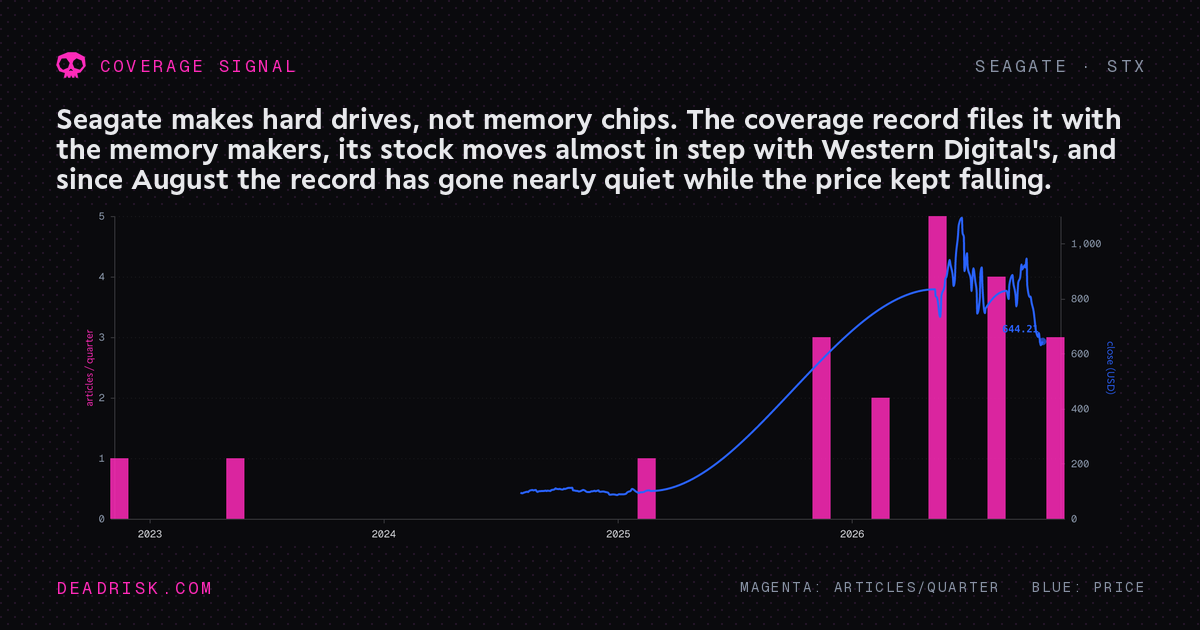
The tape · quarterly coverage amplitude · live quarter blinking
Seagate makes hard disk drives. Its 10-K for the year ended 3 July 2026, filed 4 August, reports revenue of $12.2 billion, up 34% from $9.1 billion. It shipped 789 exabytes of drive capacity, against 595 a year earlier. Nearline drives, the high-capacity disks that data centres buy, made up 695 of those exabytes, up from 497. Data centres took 80% of revenue, against 75%, and one customer took about 14%, against 10%.
The filing credits two things: more nearline exabytes and “favorable pricing actions”. Cost of revenue rose 13% while exabytes rose 33%. Per exabyte shipped, revenue was about flat and cost fell about 15%, and gross margin rose 11 points to 46%. Capital spending more than doubled, to $569 million from $265 million, and Seagate cut its debt by $1.4 billion, to $3.6 billion.
DeadRisk has held Seagate as data in the memory basket since August. A review on 3 August found a step change in its coverage, but also a finding against it: bulk storage is not a constraint arriving on its own clock. Seagate’s coverage turned in the same quarter as Micron’s, and the record treats the two as one story. This page keeps that finding. Seagate sits under the memory wall as a name that rides that story, not as a wall of its own.
Large AI funds bought in the second quarter. In 13F filings for the quarter ended 30 June, filed 14 to 17 August, the 18 AI-heavy funds DeadRisk tracks added about $1.28 billion of Seagate net of sales, valued at the 30 June close. Lone Pine Capital opened a line of 1,000,109 shares worth $965.1 million. Tiger Global, Whale Rock and D1 opened smaller ones. Value Aligned Research Advisors, which held Seagate in March, cut from 914,657 shares to 709,357. A 13F shows what a fund held on the last day of the quarter, not when it bought or whether it still holds. Seagate closed at $965.00 on 30 June and $630.49 on 23 October, down 34.7%.

For twenty years the record held a consumer-hardware company: drive launches, a failure epidemic in 2009, the Maxtor purchase, chief executives coming and going. From 2021 to 2023 the main thread was an export case. A Senate report found Seagate kept selling drives to Huawei after the rules tightened, and in April 2023 Seagate agreed to pay $300 million to settle. The 10-K still lists the payments, $15 million a quarter.
The turn came in late 2025, and it came as a price story. On 31 October Reuters reported that Seagate and Western Digital were up about 200% on AI demand for hard drives. Seagate joined the Nasdaq 100 in December and finished 2025 fourth in the S&P 500.
In January the WSJ grouped Seagate with Micron, SanDisk and Western Digital as makers that meant to keep undershooting demand rather than repeat past gluts. Three quarters of results followed: revenue up 22% to $2.83 billion in January, up 44% to $3.11 billion in April, and $3.63 billion in July against $2.44 billion a year earlier, per the results release.
The same discipline cut the other way in May. On 18 May, CNBC reported, Seagate led a group-wide sell-off after Dave Mosley’s comments raised concern it could not meet AI demand. Bloomberg’s headline had him saying new factories would take too long. CNBC called Seagate a “memory chip maker”. It closed at $740.84, down 6.87% from $795.47. It fell with the memory names again on 23 June and in the 16 July sell-off, when it closed at $745.49, down 10.0% from $828.30.
October brought a supplier that will not hold back. Nikkei reported on 5 October that Toshiba plans to double its hard-drive capacity for AI data centres from its 2025 level, aiming for a 30% share by capacity, up from about 10%. A day later Bloomberg’s sources had Seagate and Toshiba bidding against each other for TDK’s drive-head business. Seagate closed at $945.57 on 1 October and $805.63 on 6 October, down 14.8%.
The price shows the same grouping as the record. Over the 95 paired sessions we hold from 8 May to 26 October 2026, the correlation of Seagate’s daily returns with Western Digital’s is 0.93, where 1 would mean the two move as one. With SanDisk it is 0.72, with Micron 0.66 and with Nvidia 0.42. The two drive makers trade as a pair, and the pair trades with memory.

The spectrogram
Signal decomposition · what the record is made of, by quarter · brightness = share of edges · drift = how far the story moved in meaning
In 2025Q1 the record was 100% launch; by 2026Q1 it is 75% financial. A price chart shows what a name did; the spectrogram shows what its story is made of.
The brains
Panel not seated
Fewer than the full panel of lenses have read this name. The gauge shows n/3 until it fills.
The machine
TEXXR holds 104 edges for Seagate under two names, back to 2005. Twenty-eight date from October 2025 on. Twenty-three of those are financial: results, guidance, index moves, share-price falls. Two more are market moves. The rest are the January report on capacity restraint, which takes two edges, and the TDK bid. No edge in this cycle names a Seagate customer, a contract or a Seagate product line.
The product is close to absent from the record. Nearline drives were 88% of the exabytes Seagate shipped last year. The word “nearline” appears in one TEXXR article, a 2015 Google cloud launch. Mozaic, the drive platform the 10-K builds its roadmap on, appears in none about Seagate. Heat-assisted magnetic recording, the technology inside it, surfaces twice: a 2019 edge recording Seagate’s choice of it, and a March 2025 WSJ piece. The record knows Seagate as a share price inside the memory trade, which is why this page does not argue it is a separate constraint.
Since 4 August TEXXR has logged one new Seagate edge, the TDK bid. Over the same twelve weeks it logged 22 for Micron and 5 for Western Digital. SanDisk’s record has the same shape: dark for years, then mostly price.
The money

Currency: USD. Revenue/net income/capex/FCF cross-checked against filed XBRL.

Positioning: how much of STX is sold short, on the record brokers file twice a month. It lags by design — read it as where the crowd stood, not where it stands.
The record
Signals in the filings and the record, not trade ideas:
- The fiscal first quarter, ended 2 October. Seagate guided to revenue of $4.1 billion, plus or minus $100 million, about 13% above the fourth quarter. The 10-Q will show whether nearline exabytes kept rising or price did the work.
- The TDK head business. The 10-K names read/write heads among parts for which Seagate relies on few outside suppliers, though it also makes heads in Northern Ireland and Minnesota. A signed deal, and who signs it, is the first edge in this cycle about how drives get made.
- Toshiba’s doubling. If it lands, it tests from outside the restraint the WSJ described in January. Watch Seagate’s pricing language and its capital spending, which already doubled last year.
- Concentration. One customer took 14% of revenue last year. Each 10-Q and the next 10-K should say whether that grew.
- The September-quarter 13Fs, due by 16 November. They show whether Lone Pine’s line, and the other new ones, outlasted a 34.7% fall.
- Whether the record names the product. One article on nearline demand or a hyperscaler contract would be more evidence of a drive story than another price move.
| Quarter | Articles | QoQ | Q-end price | QoQ | The record reads |
|---|---|---|---|---|---|
| 2022Q4 | 1 | — | — | — | first quarter on record |
| 2023Q2 | 1 | +0% | — | — | attention held |
| 2025Q1 | 1 | +0% | 100.85 USD | — | attention held |
| 2025Q4 | 3 | +200% | 100.85 USD | +0.0% | attention rose, price flat |
| 2026Q1 | 2 | -33% | 100.85 USD | +0.0% | attention cooled, price flat |
| 2026Q2 | 5 | +150% | 965.00 USD | +856.9% | attention and price rose together |
| 2026Q3 | 4 | -20% | 922.34 USD | -4.4% | attention and price fell together |
| 2026Q4 open | 3 | -25% | 644.21 USD | -30.2% | attention and price fell together (quarter in progress) |
The peers
Seagate lives or dies by the same constraint as these names — small equal-weighted groups, one constraint each. Not investment products: see all categories.
The newest constraint — the memory constraint, 2.3 independent bets across 7 names
Sources
Edges: TEXXR knowledge graph, Seagate and Seagate Technology edge profiles (104 edges, 2005–2026, queried 2026-10-27): the 2019 choice of heat-assisted recording (325689), the 2025 AI-demand rally (85510), the January 2026 capacity restraint (92261, 92262), the May sell-off (400143), the July sell-off (407928), the fourth-quarter results (409269) and the TDK bid (521566). Article counts: TEXXR search for “Seagate”, 2021-01-01 to 2026-10-27, split at 2025-10-01 and 2026-08-04.