Company dossier

Micron

The only US-listed pure-play on the memory wall — where AI's hunger for HBM flipped a boom-bust commodity into an input Wall Street now prices like oil.

MU NASDAQ Chips
Coverage intelligence, not investment advice — the gauge is narrative balance (measured), never a call.
The Trade
short-narrativelong-narrative
narrative balance (measured) · short-narrative leaning
0/3 constructive

The short story Micron’s revenue surge establishes demand, while peer capacity and missing free-cash-flow evidence leave continuing Power unproved.

Coverage heat 5.6× the argument · mark = 1×
30-day tape -24.2% EOD delayed
Next earnings T−52d 2026-09-23
Short cover 1.0d -15% vs peak
This week 3 stories in 7d

The argument

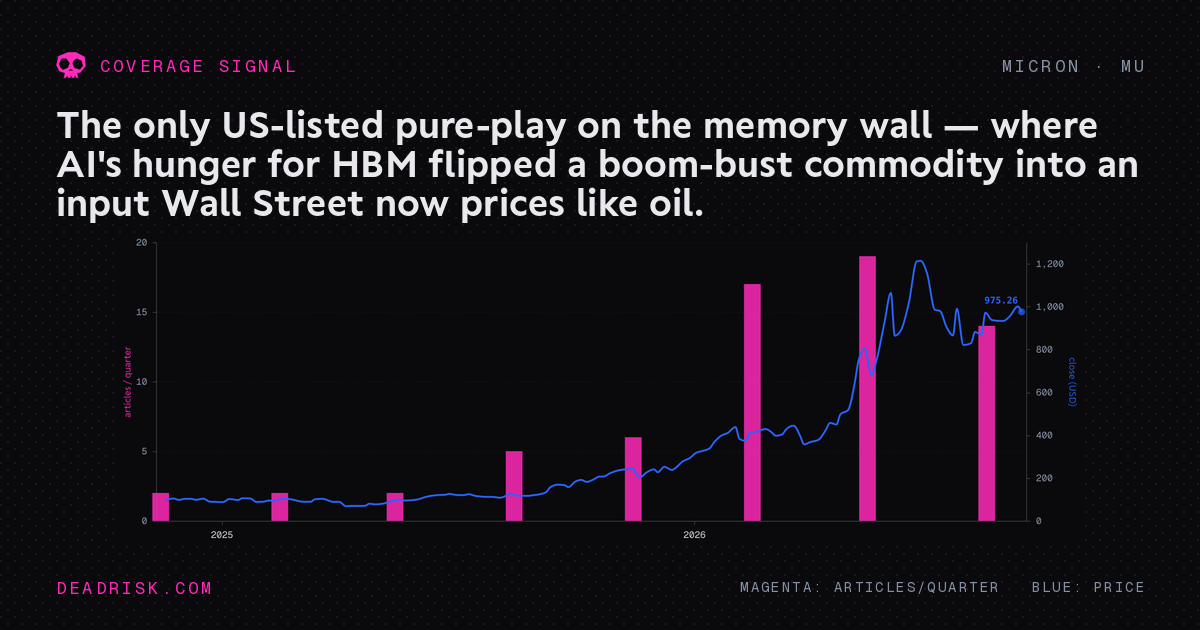
The tape · quarterly coverage amplitude · live quarter blinking

Micron (NASDAQ: MU) makes DRAM and NAND — the memory a computer holds data in — and it is the one thing its scale peers are not: American. SK Hynix and Samsung, the other two names that matter, are Korean. So Micron is the accessible way onto the fourth wall of the AI buildout: after money, after power, after the chips themselves, the binding constraint that almost nobody had priced is memory, and Micron is the only US-listed pure-play on it. See the economics of AI compute for why HBM became the crunch, and the AI-capex loop for the spending it feeds.

The number that named the moment: Micron reported third-quarter revenue up 346% to $41.46 billion, above the $35.84 billion estimate — a single quarter larger than all of fiscal 2025 ($37.38 billion). In May 2026 the stock crossed a $1 trillion market value for the first time, weeks after it had passed $700 billion. This is DeadRisk’s second-order tier: a name the AI trade does not create, but reaches for when the input it depends on turns scarce.

21
Micron articles in TEXXR's corpus, 2026 Q2
up from ~3 a quarter across 2024; the last spike this size — 17 in 2023 Q2 — was a glut, and the coverage then collapsed
Micron: coverage volume and how the record frames it

Memory is a cyclical business, and the record remembers. TEXXR’s archive carries Micron back to 2015, and its coverage runs in the sawtooth memory has always run: quiet years broken by a spike, then a collapse. The last spike before this one came in 2023 — a glut, when memory makers were losing money and coverage jumped to 17 articles in a quarter, then fell back to two or three. The corpus holds that boom-bust in the same file as what is happening now, which is the whole tension of the name.

Because what is happening now reads as a break from the cycle, not another turn of it. AI’s appetite for high-bandwidth memory made the scarce part scarce, and the pricing power flipped to the makers: the Wall Street Journal ran the line that AI had made memory chips more valuable than oil, with the makers using their newfound leverage to lock in long-term agreements. That is a commodity behaving like a cornered resource, which commodities are not supposed to do.

Micron is spending as if it believes the break. It raised its US capital commitment to $250 billion through 2035, adding $50 billion for New York, Idaho and Virginia; it broke ground on a ~$9.3 billion expansion of its Hiroshima plant. Its constraint has moved from demand to its own capacity to build — the same shape The AI Capex Supercycle tracks one layer up.

But the tape has not made up its mind. Micron and Sandisk led a sharp selloff on June 23, each down more than 13% in what one outlet called a gut-check moment for AI stocks; in July, memory and storage makers fell sharply again. A stock that swings 13% in a session is a stock the market cannot decide is a supercycle or a top.

Two more forces sit in the record. Supply is coming: SK Hynix’s US listing seeks to raise ~$29.4 billion, and China’s CXMT is in the mix — memory vendors pushed back on the cheap-DDR5 claim, saying its prices match theirs. And politics is now inside the price: the chip group SEMI, Micron and Samsung among it, warned Washington against moves that would distort the memory market. New supply and policy are exactly the two things that end a memory cycle.

The signature: Micron coverage volume against price

The spectrogram

launch financial partnership acquisition regulatory legal personnel drift 24Q124Q224Q324Q425Q125Q225Q325Q426Q1

Signal decomposition · what the record is made of, by quarter · brightness = share of edges · drift = how far the story moved in meaning

In 2024Q1 the record was 67% financial; by 2026Q1 it is 30% launch. A price chart shows what a name did; the spectrogram shows what its story is made of.

Who tells it · top-3 hold 58%
Bloomberg 46
Reuters 28
Wall Street Journal 17
CNBC 15
Financial Times 9
Nikkei Asia 7

The brains

Each take is an editorial application of a thinker's published framework — not their actual view, affiliation, or advice. methodology ↗
The powers meter — Helmer's 7 Powers · 0/7 held · dark = not argued in the record
Scale Economiescontested Micron is funding more capacity, but the record shows no cost-per-bit or volume lead and identifies expanding peer supply
Cornered Resourcecontested HBM scarcity and long-term agreements support a Benefit, but Samsung, SK Hynix, and Chinese supply prevent exclusivity

7 Powers · the Helmer lens

An editorial application of Hamilton Helmer's published framework — not their actual view, affiliation, or advice.

The machine

323 hyperedges touch Micron — a deep record for a company the tech press ignored for years, and the shape of it is the finding. The recent edges have turned. Where Micron’s older record was product — NAND densities, SSD launches — the 2026 cluster is capacity and policy: the $250 billion US capex commitment, the Hiroshima groundbreaking, a plan to ship HBM from summer 2028, and a regulatory edge for the SEMI memory-market warning. A memory company’s edges reading like a utility’s — capex, factories, policy — is the record registering the moment the commodity became strategic.

Key counterparties — top by shared coverage
Samsung 23Intel 22China 21Micron Technology 19SK Hynix 19Chinese 14NAND 10Nvidia 10HBM 10Trump 9
Key products
MicronDDR5
Micron financial stock price
Micron shares close up 18%.
confirmed #409727
Apple controversy Micron
Apple and Micron clash over blacklisted Chinese memory chips.
confirmed #409046
Micron controversy US chip industry
Micron warned that Apple's proposed use of Chinese memory chips could destroy the US chip industry.
confirmed #408957
Micron financial shares
Micron shares decline about 6% amid a broad sell-off in US memory and storage stocks.
confirmed #407931
India financial Micron
India's 2021 $10B incentive program for chipmaking attracted investments from companies including Micron.
confirmed #407604
Micron financial GlobalWafers
Micron invests $500M in GlobalWafers.
confirmed #407079
Micron financial US plants, New York, Idaho, Virginia
Micron raises its US capital expenditure commitment to $250B through 2035, including an additional $50B for projects in New York, Idaho and Virginia.
confirmed #407078
Micron launch Hiroshima factory
Micron breaks ground on a ¥1.5 trillion (~$9.3B) expansion of its Hiroshima factory as part of a global ramp-up to meet AI demand.
confirmed #406642
Micron launch HBM
Micron plans to start shipping HBM from summer 2028.
confirmed #406643
Micron launch HBM
Micron plans to start HBM shipments from summer 2028 as part of its global ramp-up to meet AI demand.
confirmed #406583
Micron launch Hiroshima factory
Micron breaks ground on a ¥1.5 trillion (~$9.3B) expansion of its Hiroshima factory.
confirmed #406582
SEMI, Micron, Samsung regulatory US policies, memory chip shortage
SEMI, including Micron and Samsung, warns that US policies affecting prices or production capacity would worsen the memory chip shortage.
confirmed #406500

The money

Micron fundamentals: revenue, free cash flow, EBITDA, capex
Revenue · FY2025
$37.4B
per filing
Free cash flow · FY2025
$1.7B
per filing
EBITDA · FY2025
$18.5B
EOD estimate
Capex · FY2025
$15.9B
per filing
Net income · FY2025
$8.5B
per filing

Currency: USD. Revenue/net income/capex/FCF cross-checked against filed XBRL.

Micron price, two years (EOD, delayed)

Positioning: how much of MU is sold short, on the record brokers file twice a month. It lags by design — read it as where the crowd stood, not where it stands.

Shares short
36.2M -0.3%
FINRA via Massive, settled 2026-07-15 · 3-month change
Days to cover
1.0
at 43.4M average daily volume
Against its own record
-15%
vs peak 42.7M, 2025-01-15

The record

Signals in the coverage and filing record, not trade ideas:

  • Whether the long-term contracts hold. The bull case is that AI turned memory from a spot commodity into a contracted input. The bear case is that memory has mean-reverted every cycle in its history. The contracts the makers are locking in now are the test — whether they survive the next wave of supply, or melt the way memory prices always have.
  • The HBM ramp lag. Micron says HBM shipments start summer 2028. The gap between demand today and supply years out is where a cycle either sustains (demand outlasts the wait) or breaks (supply floods in late).
  • The China undercut. CXMT matching DDR5 prices is the classic cycle-ender — new low-cost capacity. Whether that stays a DDR5 story or reaches HBM is the structural question.
  • Peer supply coming online. SK Hynix’s US listing and Samsung’s expansions add capacity to the same market. More supply is what has always broken memory pricing; watch whether demand absorbs it.
  • Coverage against the cycle. The corpus caught the 2023 glut spike and its collapse. Whether Micron’s coverage stays elevated or falls back the way it did in 2024 is a read on whether this time is structural, tracked quarter by quarter.
Micron coverage volume and quarter-end price, by quarter.
Quarter Articles QoQ Q-end price QoQ The record reads
2024Q4 2 83.84 USD first quarter on record
2025Q1 2 +0% 86.67 USD +3.4% price rose, attention steady
2025Q2 2 +0% 122.94 USD +41.8% price rose, attention steady
2025Q3 5 +150% 167.05 USD +35.9% attention and price rose together
2025Q4 6 +20% 285.25 USD +70.8% attention and price rose together
2026Q1 17 +183% 337.79 USD +18.4% attention and price rose together
2026Q2 19 +12% 1154.11 USD +241.7% attention and price rose together
2026Q3 open 32 +68% 874.66 USD -24.2% attention rose as price fell (quarter in progress)
SRC Coverage 8 records
  1. CNBC Chip stocks rallied Thursday after strong Microsoft and Lam Research earnings: Lam Research closed up 18%, Micron 18%, Sandisk 26%, Arm 7%, AMD 13%, Intel 11% rec #1174064
  2. Reuters Sources: CXMT expelled Huawei-linked SiCarrier staff from its R&D zone amid a pricing dispute, as Chinese memory makers flex their newfound clout to hike prices rec #1173745
  3. Wall Street Journal Sources: Apple has pitched Trump on using Chinese memory chips in its products sold outside the US; Micron warned such a plan could destroy the US chip industry rec #1173683
  4. Financial Times US stocks of chip, memory, and storage makers fell sharply on Thursday; SNDK closed down 12.63%, STX 10%, Western Digital 9.15%, Intel 5.84%, and Micron 5.65% rec #1173141
  5. Bloomberg India pledges $13.3B to boost domestic chipmaking, building on a $10B incentive program from 2021 that attracted investments from companies like Micron and Tata rec #1173008
  6. Bloomberg Micron raises its US capex commitment to $250B through 2035, adding $50B for New York, Idaho, Virginia, and other projects, and invests $500M in GlobalWafers rec #1172381
  7. Bloomberg Micron raises its US capex commitment to $250B through 2035, adding $50B for New York, Idaho, Virginia, and other projects, and invests $500M in GlobalWafers rec #1172317
  8. Bloomberg Micron breaks ground on its ~$9.3B Hiroshima factory expansion, part of its global ramp-up to meet AI demand, and plans to start HBM shipments from summer 2028 rec #1172072
VOX Voices · $MU 14 captured
  1. $MU On the back of an upgrade and Trump mention, Micron up another +17%, its best day since last April (and before that 2011), now up +215% YTD and pushing it to a $1 trillion market cap. Shares are up 13x from the April 2025 lows. [image]

  2. Micron closed with a market value of more than $1 trillion, overtaking Walmart to become the 10th largest co in the U.S. The shares rallied 19.3%, biggest one-day jump since **2011** [image]

  3. Micron's Market Cap: • May 27, 2025: $108 billion • May 26, 2026: $1.01 trillion For perspective, Spotify's current market cap is $108 billion. It's the 210th largest company in the world.

  4. Watching Micron go from $80 billion to a trillion dollar market cap within the span of a year [image]

  5. I have been writing for years that Micron Technology is one of the most valuable companies in all of semiconductors, perhaps all of tech.  The upward revisions happening for the DRAM market, and possibly NAND, are astounding, and beyond even what I expected.  But it is in line wi…

  6. Micron has entered an elite club.  —  The memory chipmaker surpassed a $1 trillion market value on Tuesday, joining megacap technology companies including Apple, Nvidia and Google. …

  7. The pace of Micron's rise to becoming a $1 trillion company is unprecedented. The dot-com boom created millionaires. The aftermath of the 2008 financial crisis minted billionaires. The AI revolution is resulting in trillionaires. https://www.wsj.com/... [image]

  8. That is an insane chart. Micron 10x to $1 trillion in one year. [image]

their words, verbatim — inclusion is not endorsement method ↗

The peers

Micron lives or dies by the same constraint as these names — small equal-weighted groups, one constraint each. Not investment products: see all categories.

The newest constraint — the memory constraint, 1.9 independent bets across 6 names

Sources

SRCSources11 records
  1. CNBCMicron reports Q3 revenue up 346% YoY to $41.46B, vs. $35.84B est., gross margin above estimates, and forecasts Q4 revenue above est.; MU jumps 14%+ after hoursrec #1171494
  2. CNBCMicron hit a $1T market value for the first time on Tuesday as its stock closed up 19.29%, after hitting $700B earlier in May, driven by high memory chip demandrec #1169645
  3. Wall Street JournalMemory chip makers are leveraging their newfound power to secure long-term agreements, a move set to reshape the industry's business model and stabilize pricesrec #1169894
  4. CNBCMicron closed up 11% on May 5 after announcing it began shipping its highest-capacity SSD, passing a $700B market cap for the first time; Sandisk closed up 12%rec #1168379
  5. BloombergMicron raises its US capex commitment to $250B through 2035, adding $50B for New York, Idaho, Virginia, and other projects, and invests $500M in GlobalWafersrec #1172317
  6. BloombergMicron breaks ground on its ~$9.3B Hiroshima factory expansion, part of its global ramp-up to meet AI demand, and plans to start HBM shipments from summer 2028rec #1172040
  7. BloombergLetter to Scott Bessent: chip group SEMI, which includes Micron and Samsung, warns that US intervention in chip pricing or capacity would worsen chip shortagesrec #1171994
  8. BloombergFiling: SK Hynix is seeking to raise ~$29.4B in a US listing, expects trading to start on July 10, and intends to use the funds to build additional capacityrec #1171465
  9. MarketWatchMicron and Sandisk led a tech selloff on June 23, falling 13%+ each; Western Digital fell 8%, Marvell 9%, Seagate 5%, Qualcomm 8%, and Applied Materials 8%rec #1171425
  10. WccftechMemory chip vendors say CXMT's DDR5 prices match Samsung's, SK Hynix's, and Micron's, and it has more supply in client markets as it is not prioritizing HBMrec #1170429
  11. Financial TimesUS stocks of chip, memory, and storage makers fell sharply on Thursday; SNDK closed down 12.63%, STX 10%, Western Digital 9.15%, Intel 5.84%, and Micron 5.65%rec #1173141

Edges: TEXXR knowledge graph, Micron edge profile (323 edges, queried 2026-07-24): the $250B US capex commitment (407078), the plan to ship HBM from 2028 (406643), the Hiroshima expansion (406642), the SEMI memory-market warning (406500), and the July memory-storage selloff (407931).