Trend pillar
The Chokepoint Rotation
A dollar of AI capex is a bill of materials, and the layers of the chain are fighting over its split. In four months, four of them raised prices on each other in public.
The Thesis
Samsung’s foundry increase is in force. ASML’s tool-price plan is contested. Nvidia’s system-price notice applies from early 2027.
Across reports published July 16–August 24, 2026, Reuters documented one completed price action: Samsung raised prices by up to 15% for new 4nm and 5nm foundry orders in July. The Information’s sources described ASML’s planned 10% DUV increase, talks on higher EUV prices and resistance from TSMC. Bloomberg reported that some Nvidia customers were told system prices would rise by at least 15% from early 2027. The cited reports document one implemented new-order increase, one contested equipment plan and one future notice. They do not document three increases already paid.
This site tracks the money loop, electricity, memory, the fabs underneath them and the demand meant to pay for the buildout. Here the question is narrower: when a supplier asks for more, who accepts the cost, who passes it on and where does it stop?
The reports do not measure incremental gross profit by layer. Samsung and SK Hynix reported faster operating-profit growth than ASML reported sales growth, but those are different measures at different companies. ASML’s tool position can remain hard to replace while TSMC resists a proposed price. Resistance is a negotiating fact, not proof that ASML withdrew the proposal.
The Evidence
The reported quarters put the growth rates in view, with each company measured against its own year-earlier quarter. Samsung’s Q2 2026 operating profit grew 1,814% from Q2 2025 on AI memory demand. SK Hynix’s Q2 2026 operating profit grew 557% from Q2 2025. Micron’s fiscal Q3 2026 revenue grew 346% from fiscal Q3 2025 to $41.46B; that quarter exceeded its full FY2025 revenue. Nvidia’s fiscal Q2 2027 revenue grew 106% from the year-earlier quarter to $96.22B, while net income grew 126% to $59.7B. TSMC’s Q2 2026 revenue grew 36% from Q2 2025 to about US$39.45B, while net income grew 77.4% to about US$21.9B. ASML’s Q2 2026 net sales were €9.3B, against €7.7B in Q2 2025: a derived increase of about 21%.
The comparison says only that reported memory-company operating-profit growth exceeded ASML’s reported revenue growth. It cannot locate the largest dollar gain in gross profit. On this site’s compute-economics read, lithography accounts for a share in the teens of a DRAM wafer’s cost, against roughly 30% for a logic wafer. Those are wafer-cost shares for different products, not the share ASML collects from an AI system. Bloomberg’s June chip-sector comparison described spending on etching, deposition and advanced packaging. Its stock comparison does not show whether ASML customers accepted a higher tool price.
Reuters’ Samsung report linked the July new-order increase to AI demand and tight TSMC capacity. It did not establish what every customer ultimately paid. Memory has another contracting record: the Wall Street Journal reported makers locking buyers into long-term deals, without identifying another dated, quantified increase. Nor does Nvidia’s customer notice establish a final invoice. The pass-through test ends at the token demand curve, after each buyer in between has had a chance to negotiate or absorb the cost.
Substitution is another test. The Information reported Nvidia was testing at least three lower-memory Rubin Ultra configurations over possible HBM supply constraints. Tested configurations are not a final design or a disclosed HBM price. The Information’s reported Hugging Face agreement and the Wall Street Journal’s Poolside plan could give Nvidia another route to open models. Neither report records a change in model prices; the open-weight trade covers that potential substitute from the model side.
Nvidia said its Groq 3 LPX inference accelerator entered full production with Nebius as its first customer. That establishes a product route, not a price comparison with Nvidia’s other systems. Bloomberg reported Groq’s later valuation at $3.5B, against $6.9B previously, after Nvidia licensed its technology and hired much of its team. Those are company valuations, not accelerator prices. Crunchbase counted chip giants’ participation in rounds collectively valued above $250B year to date as of August 17. That total values the covered rounds; it is not chip-company spending or proof that customers accepted a price increase.
The Companies
ASML has a tool customers need and a proposed increase customers can contest. Reuters reported Intel’s commitment to High NA EUV for Panther Lake and put a High NA machine at about $400M per tool. That price is for a different tool; it supplies no pre-increase DUV price against which to test ASML’s proposal. Export controls affect which customers ASML can serve. Bloomberg reported US questions about a machine allegedly reaching China; ASML called the claim inaccurate. The dispute matters to the China AI stack, but establishes no realized tool-price increase.
Customer location matters too. Tom’s Hardware reported ASML’s European revenue share at 0% in each of Q1 and Q2 2026, against 1% for full-year 2025 and 5% for full-year 2024. Those are shares over different periods, not a count of transactions. They show why local demand cannot be assumed when discussing where ASML might place more tools. In a September Financial Times interview, CEO Christophe Fouquet described a supply chain spanning 2,000 companies. Supplier breadth can affect ASML’s costs; it does not establish that TSMC accepted a higher equipment price.
TSMC is the buyer in the reported ASML negotiation and the seller in a separate wafer market. Chips at 7nm or smaller made up 77% of its Q2 2026 wafer revenue, against 74% in Q1 2026, a derived three-percentage-point shift. Reuters reported MediaTek’s 2nm phone design; TechRadar reported two Qualcomm 2nm designs; and Tom’s Hardware reported a 3nm chip for Google’s planned Googlebook line. These designs identify prospective users of TSMC capacity. None of those reports gives an accepted wafer-price increase, yield or shipped volume.
The DeadRisk market layer records TSMC FY2025 capex of 1,282.6 billion feed units against 965.0 billion in FY2024, a derived 33% rise. FY2025 revenue was 3,809.1 billion units against 2,894.3 billion in FY2024, a derived 32% rise; free cash flow was 992.4 billion units against 861.2 billion, a derived 15% rise. The feed prefixes these annual figures with “$” but supplies no currency code. They cannot be put on the same US-dollar scale as the cited quarterly revenue. Capex records spending, not capacity ready to take an order or a wafer price a designer agreed to pay.
Marvell supplies custom silicon and interconnect, giving some buyers another design route. The DeadRisk market layer records FY2026 revenue, for the year ended January 31, of $8.2B against $5.8B in FY2025, a derived 42% rise. EBITDA was $4.5B against $651.6M, a derived 597% rise, while free cash flow was $1.4B in each year. Those company measures do not show that custom chips displaced Nvidia systems or won a higher price. Marvell’s reported 32.52% one-day stock gain in June was measured against the previous close; the market layer separately records a 5.8% one-day rise at the October 6, 2026 close against a 27.3% rise over the preceding 30 days. Neither move measures chip adoption. Marvell expanded its Google development deal with a warrant covering up to $12.2B of shares, a maximum rather than a recorded chip purchase. AWS’s reported plan for 2M Nvidia GPUs across 2027–28 is future capacity planning, not current deliveries. Buyers can develop custom silicon and still plan Nvidia purchases.
Micron gives the memory layer a listed-company read. The memory wall carries the shortage case and its countercase: memory prices have a history of mean reversion. This page asks who bears the cost while the reported constraint holds.
The Lenses
Hamilton Helmer’s 7 Powers supplies the test: an invention can improve system economics without its inventor keeping every gain. Contracts and accepted prices determine the division. The reports here show a new-order foundry increase, tool-price resistance and a future system notice. Their mixed quarterly measures cannot settle the durable division of gross profit.
Robert Shiller’s narrative economics is a check on the street’s bottleneck story. Attention can outlast a constraint if engineers find a substitute. Ask which buyer signed, which product changed and which increase held. More coverage answers none of those questions.
What Moved
- 2026-01-28ASML reports Q4 bookings of €13.2B, against a €6.32B estimate. Orders show demand for tools, not acceptance of a later price proposal.
- 2026-07-15ASML gives FY2026 sales guidance of €43B–€45B. The earlier guidance figure is not supplied here, so this range cannot quantify the change.
- 2026-07-16The Information dates the ASML–TSMC equipment-pricing talks and TSMC's resistance.
- 2026-08-19Reuters reports the Samsung new-order foundry increase that took effect in July.
- 2026-08-24Bloomberg reports Nvidia's customer notice for early 2027 system prices, not a current invoice.
- 2026-08-28The Wall Street Journal reports Nvidia's Q2 supplier commitments at $279B, against $119B in Q1. Commitments are not realized supplier prices.
A September capacity report runs on a later clock. Nikkei reported that NXP and TSMC affiliate Vanguard inaugurated their Singapore fab and were considering another facility. They target mass production in early 2027. An inaugurated affiliate plant is neither current TSMC 2nm output nor evidence that another foundry can already take the same order.
The fresh ASML record concerns tools already imported, not a new equipment price. The Center for Technology & Statecraft tally, as reported by SCMP, puts Chinese fabs’ immersion DUV acquisitions at about 343 tools by early 2026, including about 270 from ASML. Tom’s Hardware’s account describes 343 as ASML scanners. Those are different ASML counts attributed to the same tally, not two counts to add. SCMP says immersion DUV can be adapted for 7nm chips and HBM. A count of acquired tools does not establish output, yield or an accepted increase in ASML’s DUV prices.
TSMC’s prospective business has a similar split between talks and commitments. Culpium reported Terafab supply discussions involving TSMC and Elon Musk’s Tesla, SpaceX and xAI, and said TSMC was considering a Texas presence; it reported no signed supply deal. Bloomberg then reported Musk ruled out a TSMC operational role in Terafab on October 7, saying his businesses would build and operate it. That rules out the reported operational possibility, not by itself a separate supply discussion. Reuters also reported AMD’s 2027 supply plan: CEO Lisa Su said AMD needs more advanced wafer capacity and plans to “substantially increase” supply in 2027 as she met TSMC and Foxconn. Against current capacity, that is a stated future need, not a disclosed wafer order, volume or price.
The next check is accepted pricing, not another design announcement. The market provider’s calendar, captured August 26, schedules ASML earnings for October 14 and TSMC earnings for October 15, 2026; either date can move. A later disclosure of equipment prices agreed with buyers, foundry prices paid on orders or realized system prices would narrow the pass-through question. Until then, the cited records place the documented actions at three different stages. They do not show where the full cost finally lands.
Sources
Growth figures compare each company’s most recently reported quarter against the same quarter a year earlier, as filed or reported: Samsung and SK Hynix on operating profit, Micron and ASML on revenue, Nvidia and TSMC on both. They are not adjusted for accounting differences between reporting regimes, and a memory maker’s operating profit is a more volatile series than an equipment maker’s revenue by construction — the ladder is a ranking of this cycle’s increment, not a valuation. Article IDs resolve at texxr.com/<id>.
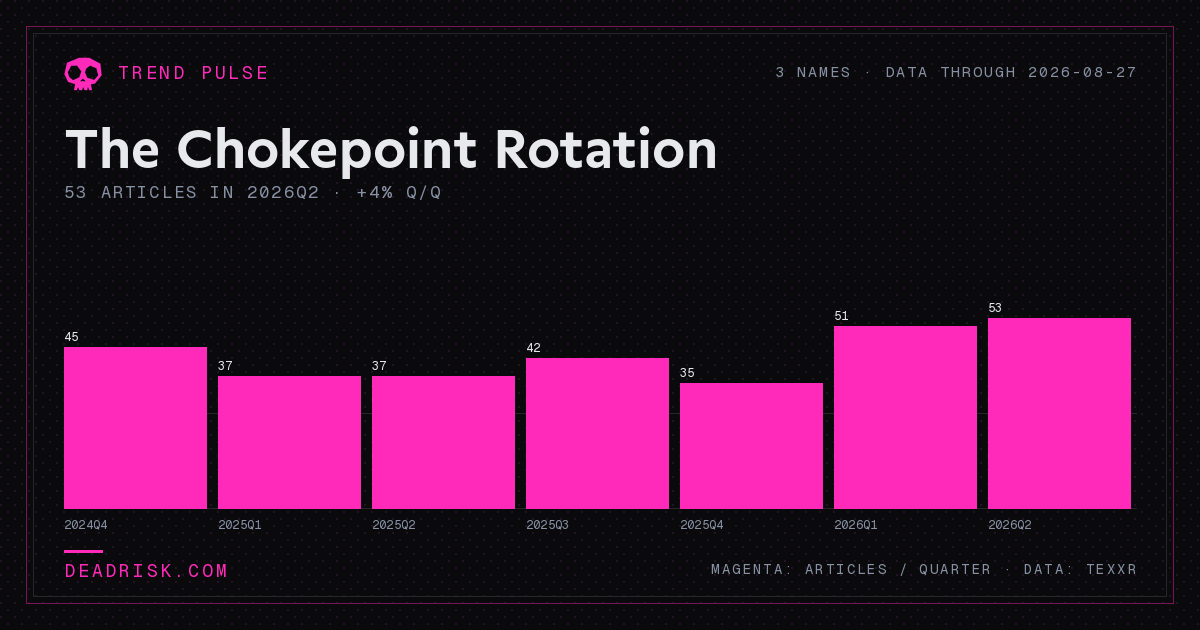
Across 3 member names, 2026Q3 drew 47 articles against 53 in 2026Q2. The largest single move was Marvell Technology, -70%.
Coverage data as of 2026-10-12 · the essay above was last revised 2026-10-07