The argument
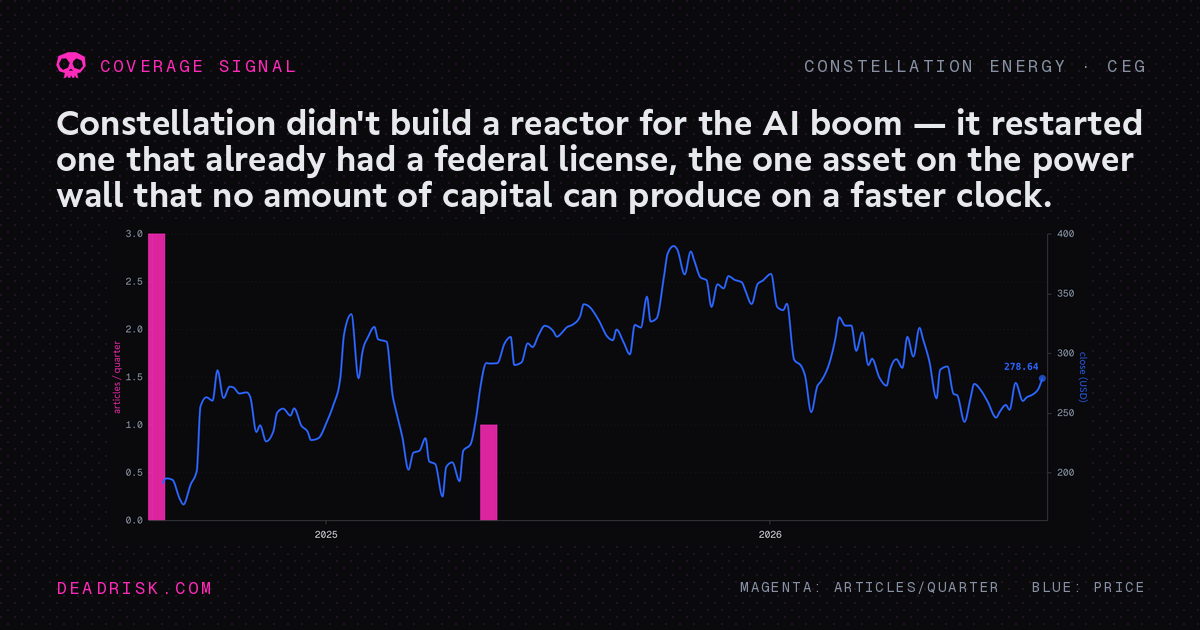
The tape · quarterly coverage amplitude · live quarter blinking
Constellation Energy runs the largest fleet of nuclear reactors in the United States, most of it built decades ago and sold for years as a commodity: megawatt-hours into wholesale power markets, priced against gas, weather, and whatever else was on the grid that hour. The Power Wall is what turned that commodity into a counterparty. As data-center operators ran into grid queues measured in years and permits measured in protests, the AI industry went looking for power it could contract directly, at scale, without waiting for anything to be built. Constellation had reactors already carrying an NRC operating license — the one document in this whole trend that cannot be issued faster no matter how much capital shows up.
That makes Constellation a different animal from its neighbors on the wall. Bloom Energy sells a fuel cell a county will permit in roughly two years. The uranium miners and small-modular-reactor developers in the nuclear-restart basket sell a plant that doesn’t exist yet, on a horizon closer to twenty. Constellation sells neither speed nor a promise — it sells a reactor that already ran, already passed inspection, and only needs turning back on. In Hamilton Helmer’s terms this is a sharper Cornered Resource than Bloom’s local permit: a zoning board can be persuaded, but an NRC operating license cannot be bought, rushed, or transferred to a plant that never held one — it exists only for reactors that already ran the decade-plus approval process once. Two hyperscalers have now paid for exactly that asset, in two separate twenty-year contracts.

The first contract landed on 20 September 2024: Constellation would spend $1.6 billion reviving Three Mile Island in Pennsylvania — the reactor, not the one that melted down in 1979 — and sell all 835 megawatts of it to Microsoft under a 20-year power purchase agreement. The stock’s reaction was immediate and large: Constellation closed at $208.50 the session before the news broke and $254.98 the day it did, a 22.3% single-day move (as-traded closes, data/prices/ceg.json). Reopening a nuclear plant to feed a data center was, at the time, a genuinely new idea.
By June 2025 it no longer was. On 3 June, Meta signed its own 20-year deal for the full output of Constellation’s Illinois plant — a contract that doesn’t actually start until mid-2027, when a separate ten-year state subsidy on that plant runs out. The market barely blinked: Constellation closed at $313.43 the day before and $313.03 the day of, essentially flat. The pattern that had been a surprise in September 2024 was priced-in strategy by June 2025.
Then the federal government joined as financier rather than customer. On 19 November 2025, the Department of Energy approved a $1 billion loan to help fund the Three Mile Island restart — the same restart whose output was already contracted to Microsoft. The stock popped 5.3% that session, from $339.35 to $357.48, then gave most of it back the next day, closing at $345.78. A public loan backstopping a deal already signed with a private hyperscaler moved the stock less than either of the original announcements.
None of it stopped the reversal. Constellation’s own as-traded closing high was $403.95, set 15 October 2025 — between the Meta deal and the DOE loan, not after either. By 31 July 2026, the last session in the price record, it closed at $262.75: a 35.0% decline from that high, with two signed reactor contracts and a federal loan sitting in between. One investor’s disclosed position traces a piece of that arc. Situational Awareness LP added Constellation common stock across three consecutive 13F filings: 96,400 shares valued at $21.6 million at period end 2024-12-31 (filed 2025-02-12), 183,400 shares at $37.0 million at period end 2025-03-31 (filed 2025-05-14), and 319,200 shares at $103.0 million at period end 2025-06-30 (filed 2025-08-14). It bought through a drop — shares up 90% between the first two filings while Constellation’s own close fell 9.9%, from $223.71 to $201.63 — and then into a 60.1% rebound by the third, when the close reached $322.76. The position is absent from the filing for period end 2025-09-30 (filed 2025-11-14) and has not reappeared through the most recent filing on record, period end 2026-03-31 (filed 2026-05-18). A 13F only shows a book up to 45 days stale by the time it’s public, so nothing here says why the fund left or exactly when in that quarter it did — only that by the next disclosed snapshot, it was gone.

The spectrogram
Signal decomposition · what the record is made of, by quarter · brightness = share of edges · drift = how far the story moved in meaning
In 2024Q3 the record was 50% financial; by 2025Q2 it is 100% acquisition. A price chart shows what a name did; the spectrogram shows what its story is made of.
The brains
Panel not seated
Fewer than the full panel of lenses have read this name. The gauge shows n/3 until it fills.
The machine
TEXXR’s knowledge graph holds eleven edges touching Constellation, and they resolve to exactly the three events above — but not evenly, and not all under the same name. The Microsoft deal alone produced six edges, because the same Bloomberg story ran through the corpus three separate times on three consecutive days (20, 21, and 22 September 2024, articles 875515, 875672, 875699) — one announcement, extracted three times. The Meta deal produced exactly one edge (886447). The DOE loan produced three more (article 892744) — but they don’t surface in a search for “Constellation Energy”: the extraction recorded the subject as “Constellation,” the short form, not the full company name a reader would search. A reader who searches the graph by the name on the ticker sees seven edges and misses the loan entirely; the eleventh edge, 51306, has Microsoft as its subject and Three Mile Island as its object, with Constellation named nowhere in the edge itself. The record supports the deals. It does not, on its own, support a clean count of them.
The money

Currency: USD. Revenue/net income/capex/FCF cross-checked against filed XBRL.

Positioning: how much of CEG is sold short, on the record brokers file twice a month. It lags by design — read it as where the crowd stood, not where it stands.
The record
- Whether the Illinois contract’s 2027 start shows up as a step change. The Meta deal is signed but its economics don’t begin until the state subsidy it replaces expires in mid-2027 — a dateable moment the filings should mark.
- Whether a third hyperscaler signs a restart or re-contract, not a new build. Two deals in nine months set a pattern; the nuclear-restart basket’s own new-build names have a much longer runway, which is exactly what makes an existing license worth watching for who else wants one.
- Whether Situational Awareness LP’s stake, or a similar one, reappears in a future 13F. The fund’s exit predates the stock’s October 2025 high and its subsequent drawdown; a re-entry would be a dateable, checkable signal either way.
- Whether the DOE loan is a template or a one-off. A federal loan financing a plant whose output is already sold to a private company is an unusual structure; whether DOE repeats it for the next restart is worth tracking against future loan announcements.
| Quarter | Articles | QoQ | Q-end price | QoQ | The record reads |
|---|---|---|---|---|---|
| 2024Q3 | 3 | — | 257.03 USD | — | first quarter on record |
| 2025Q2 | 1 | -67% | 320.58 USD | +24.7% | attention cooled as price rose |
The peers
Constellation Energy lives or dies by the same constraint as these names — small equal-weighted groups, one constraint each. Not investment products: see all categories.
Sources
Edges: TEXXR knowledge graph, Constellation Energy edge profile (11 edges touching the company across three events, queried 2026-08-02): six from the Microsoft/Three Mile Island announcement (51120, 51121, 51245, 51246, 51304, 51305), one from the Meta/Illinois deal (72554), three from the DOE loan article that don’t surface under an entity search for “Constellation Energy” (87112, 87113, 87114), and one with Microsoft as subject rather than Constellation (51306).
13F filings: Situational Awareness LP (CIK 0002045724), quarterly Form 13F-HR, SEC EDGAR. Period 2024-12-31, filed 2025-02-12: https://www.sec.gov/Archives/edgar/data/2045724/000093583625000120/0000935836-25-000120.txt. Period 2025-03-31, filed 2025-05-14: https://www.sec.gov/Archives/edgar/data/2045724/000204572425000002/0002045724-25-000002.txt. Period 2025-06-30, filed 2025-08-14: https://www.sec.gov/Archives/edgar/data/2045724/000204572425000006/0002045724-25-000006.txt. No Constellation position appears in the filings for period 2025-09-30 (filed 2025-11-14), 2025-12-31 (filed 2026-02-11), or 2026-03-31 (filed 2026-05-18).
Prices: data/prices/ceg.json, as-traded daily closes, Massive (Polygon) grouped daily.