The argument
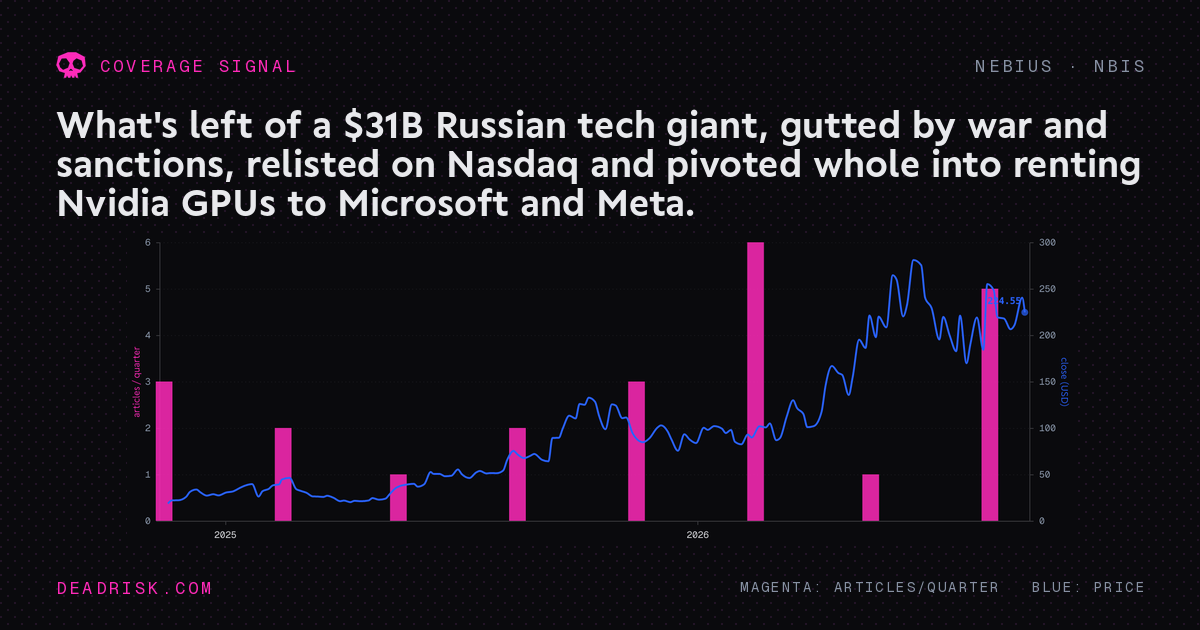
The tape · quarterly coverage amplitude · live quarter blinking
Nebius Group (NBIS) trades on the Nasdaq — the same legal entity that once traded as Yandex N.V., parent of Russia’s dominant search engine, suspended by Nasdaq days after Russia invaded Ukraine in February 2022. Trading stayed frozen for two and a half years.
What came back was not Yandex. Yandex finalized the sale of its entire Russian business — search, maps, ride-hailing, everything domestic — to a group led by its own Russian managers, and renamed the surviving Dutch entity Nebius Group, with Volozh returning as CEO. Volozh had resigned as CEO in June 2022 after the EU placed him under personal sanction — a sanction the bloc never applied to Yandex as a company. What he came back to run had no search engine and no consumer app left — only a data-center business built for the old Yandex’s own AI research, a majority stake in Avride (a self-driving spinoff), and smaller stakes in an edtech platform and a data-labeling business. The bet: sell everything else and turn the leftover infrastructure into a GPU cloud company competing for the same dollars as CoreWeave. See The AI Capex Supercycle for the spending cycle Nebius now sits inside.
Almost no independent analysis treats this as one company rather than two unrelated stories — a sanctions casualty, an AI-infrastructure startup. That gap is the assembly job below.

The decline came fast. Yandex lost more than 75% of its value in the six months after the invasion, even without being directly sanctioned, as its US partnerships with Uber, Grubhub, and DuckDuckGo all looked likely to end. By July 2022, the New York Times tracked the fall in dollar terms — from more than $31 billion in November 2021 to under $7 billion. What kept Yandex from being nationalized outright, sources told Reuters, was the Kremlin’s own fear of a brain drain — the company employed more than 20,000 people Moscow did not want fleeing the country. The same week, Volozh told Reuters that Russia’s invasion of Ukraine was “barbaric,” as he pushed for full separation.
The divestiture took two tries. In November 2023, Bloomberg reported Yandex had scrapped a plan to sell just a 51% stake and would divest the entire Russian business instead. By February 2024 the deal had a price — about $5.2 billion. It closed that July. Days later, Volozh told TechCrunch the company would triple its Nvidia GPU deployments and build toward being a European AI-compute leader — full-stack AI infrastructure, not a search-engine remnant. That December, Nvidia joined a $700 million private placement into Nebius alongside Accel and other investors — the same company that sold Yandex its chips now owned a piece of what Yandex had become. That January, Volozh gave Bloomberg the line that captures the arc: “For 30 years we were building a new country, not just a company. And then you realize it’s over.” The old Yandex, meanwhile, kept the name inside Russia and kept growing: it reported 2024 revenue up 37% to a record ~$12.3 billion — one lineage, two companies, opposite directions.
The pivot escalated fast. Nebius kept building out the self-driving unit it carried over — Avride, spun out of a Yandex-Uber joint venture in 2020 — deploying 100 driverless Ioniq 5 robotaxis with Hyundai in March 2025 and launching robotaxi service with Uber in Dallas that December. But the cloud business was the center of gravity. A September 2025 SEC filing disclosed a Microsoft deal worth up to $19.4 billion through 2031; NBIS jumped more than 50%. Bloomberg placed it inside a pattern: Microsoft had committed more than $33 billion to “neocloud” providers rather than build every data center itself, naming CoreWeave as the other half. That November, Nebius signed a roughly $3 billion, five-year deal with Meta, reporting a Q3 net loss of $100.4 million — up from $39.7 million — with NBIS up more than 250% year to date. It kept acquiring: Tavily, an AI-agent search company, for a reported $275 million that February, and Eigen AI, which speeds up AI inference chips, for roughly $643 million in May. Meta expanded again that March: up to $27 billion over five years, $12 billion starting early 2027; NBIS jumped more than 12%. Nvidia doubled down the same month, investing $2 billion as Nebius said it would deploy more than 5 gigawatts of Nvidia systems by 2030, and days later Nebius said it would raise $3.75 billion in convertible debt for the buildout — senior, unsecured notes, a different instrument from the GPU-collateralized vehicles behind CoreWeave’s own debt. Weeks later came a $10 billion, 310-megawatt data center in Finland. By July, Reflection — an AI startup that had separately signed with SpaceX — committed more than $1 billion to Nebius capacity, including Nvidia chip access.

The spectrogram
Signal decomposition · what the record is made of, by quarter · brightness = share of edges · drift = how far the story moved in meaning
In 2024Q3 the record was 50% launch; by 2025Q4 it is 67% financial. A price chart shows what a name did; the spectrogram shows what its story is made of.
The brains
Nvidia holds equity in Nebius and CoreWeave and supplies chips to both — one supplier's allocation can't be a Cornered Resource for either.
Senior unsecured convertible notes, not a GPU-collateralized vehicle — a cleaner instrument financing the same unproven income stream as its cohort.
A relisted spinoff, accelerating coverage momentum, and widening losses under an identity barely two years old.
The machine
TEXXR’s knowledge graph carries 76 hyperedges touching Nebius — against 267 for its neocloud peer CoreWeave. Financial edges dominate at 40.8%, launch at 27.6%, partnership at 23.7%; acquisition and personnel sit at 2.6% apiece, controversy and regulatory at 1.3% each — one edge each, both drawn from Volozh’s own account of the rename, not the deal headlines. Nebius, Nvidia, Microsoft, and Meta as a four-entity constellation turn up 26 edges across 21 months, fully connected — no isolated node.
The momentum tools tell a sharper story than the raw counts. Across the six quarters TEXXR’s rivalry tool tracks side by side (2025 Q2–2026 Q3), Nebius’s coverage velocity is accelerating — +4.06, acceleration +4.89 — while CoreWeave’s is decelerating, at -0.68 and -1.12. Same cohort, same backdrop, opposite direction.
The graph also holds a silence worth naming. Nebius carries stakes in Toloka (data-labeling) and TripleTen (edtech) alongside its majority stake in Avride — but neither Toloka nor TripleTen has generated a single hyperedge under its own name in TEXXR’s corpus. Avride has six. The graph’s attention runs through the compute business and the vehicle spinoff; the rest of the conglomerate is, so far, invisible to it.
The money

Currency: USD. Revenue/net income/capex/FCF cross-checked against filed XBRL.

Positioning: how much of NBIS is sold short, on the record brokers file twice a month. It lags by design — read it as where the crowd stood, not where it stands.
The record
- Customer concentration against the backlog. Two contracts — Microsoft’s up-to-$19.4B, Meta’s up-to-$27B — carry the growth story. Whether a third customer at Reflection’s scale becomes a pattern is a filing question, not a headline one.
- The convertible notes at maturity. $3.75 billion in senior unsecured debt against multi-billion-dollar committed capex. Refinancing terms will show whether credit markets price Nebius as an infrastructure company or still price in Yandex’s old risk.
- The old Yandex’s own trajectory. It grew revenue 37% inside Russia the year after the split — a separate track record, in a separate index, that the corpus keeps following under the name Nebius left behind.
- Whether Toloka or TripleTen ever generate a coverage thread of their own. Right now they are line items, not tracked entities. A change there marks a change in what the market treats as material about the conglomerate.
- The Nvidia triangle. Nvidia holds equity in both Nebius and CoreWeave and supplies chips to both. Any divergence in how it treats them should surface in the graph before a filing confirms it.
| Quarter | Articles | QoQ | Q-end price | QoQ | The record reads |
|---|---|---|---|---|---|
| 2024Q4 | 3 | — | 27.70 USD | — | first quarter on record |
| 2025Q1 | 2 | -33% | 21.11 USD | -23.8% | attention and price fell together |
| 2025Q2 | 1 | -50% | 55.33 USD | +162.1% | attention cooled as price rose |
| 2025Q3 | 2 | +100% | 112.27 USD | +102.9% | attention and price rose together |
| 2025Q4 | 3 | +50% | 83.70 USD | -25.4% | attention rose as price fell |
| 2026Q1 | 6 | +100% | 103.76 USD | +24.0% | attention and price rose together |
| 2026Q2 | 1 | -83% | 276.17 USD | +166.2% | attention cooled as price rose |
| 2026Q3 open | 5 | +400% | 212.19 USD | -23.2% | attention rose as price fell (quarter in progress) |
The peers
Nebius Group lives or dies by the same constraint as these names — small equal-weighted groups, one constraint each. Not investment products: see all categories.
Renting the compute out again — the capital constraint, 1.6 independent bets across 5 names
Sources
Edges: TEXXR knowledge graph, Nebius edge profile (76 edges, queried 2026-07-19) and four-entity constellation (Nebius, Nvidia, Microsoft, Meta; 26 edges, 21 months). TEXXR momentum data, Nebius vs. CoreWeave quarterly coverage velocity, 2025Q2–2026Q3 (queried 2026-07-19).