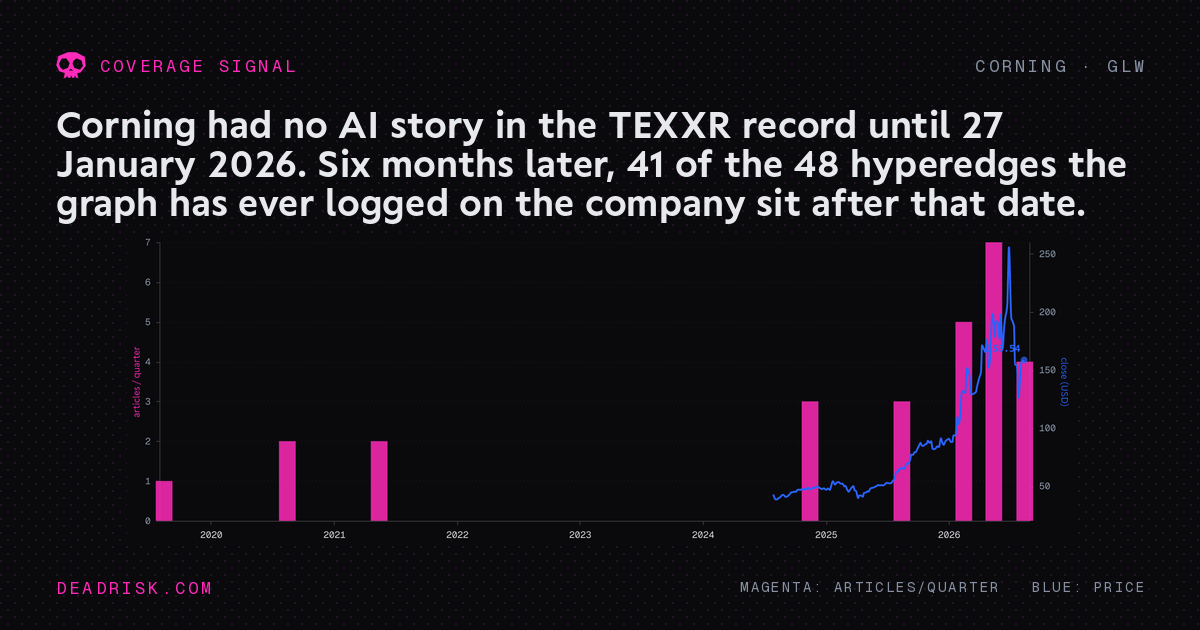
The argument
The tape · quarterly coverage amplitude · live quarter blinking
Corning makes glass and optical fiber. It does not make chips, servers, or anything that runs a model. For most of the period the ai-capex trend covers, that kept the company several steps removed from the buildout — a name that shows up in a data center only as the cable between racks. The company the TEXXR record describes through most of 2024 and 2025 is a different business entirely: a consumer-glass supplier defending Gorilla Glass exclusivity terms against an EU antitrust probe, and an Apple vendor collecting incremental checks from Apple’s Advanced Manufacturing Fund. Then, on 27 January 2026, Meta committed to paying Corning up to $6 billion through 2030 for the fiber-optic cable wiring its AI data centers, and the record’s read on the company changed inside one trading session.
That makes Corning second-order in a specific sense. Constellation Energy sells the power a data center needs to run at all. Bloom Energy sells the generator that gets around a stalled grid interconnection. Corning sells the wiring inside the building once the power and the racks are both there — the physical layer under the physical layer. It doesn’t carry the multiple a chipmaker does, but by mid-2026 it had something a chipmaker’s supplier list rarely shows: three separate hyperscalers with signed, multi-year commitments rather than purchase orders that reset every quarter.

The Meta deal moved the stock immediately: Corning closed at $94.95 on 26 January 2026 and $109.74 the next day, up 15.6% (as-traded closes, data/prices/glw.json). Two weeks later, the Wall Street Journal ran a retrospective on the reversal: the same optical-fiber division analysts had spent years telling Corning to sell — a legacy of the dot-com-era telecom buildout — was now the growth engine pushing the stock to new highs.
The second confirmation landed on 6 May 2026, when Nvidia announced a $500 million equity investment in Corning, tied to a partnership: three new US manufacturing plants, a tenfold increase in optical-connectivity capacity, and a 50%-plus expansion of fiber production, with more than 3,000 jobs attached. Corning closed at $162.10 the day before and $181.57 the day of, up 12.0% — close to the “jumps 12%” the Journal’s own headline used. Corning CEO Wendell Weeks later described the deal structure in an interview: risk-sharing provisions built into all three hyperscaler contracts to protect Corning if AI capital spending slows.
The third deal is where the record and the reaction diverge. On 8 June 2026, Amazon announced a multiyear, multibillion-dollar deal with Corning for optical fiber, and the corpus recorded the reaction as “shares jump 8%+.” The close-to-close move from Friday’s $177.58 to Monday’s $187.54 was 5.6%; Monday’s intraday high of $192.90 was the 8.6% figure the headline meant. By Tuesday’s close, Corning had fallen to $173.94 — 2.1% below where it closed the Friday before the deal was ever announced. The extracted claim was accurate to the moment it was written. It did not survive two trading sessions.
The stock kept climbing after that anyway, closing at a record $255.69 on 29 June. Then, on 28 July, Corning reported Q2 sales up 17% to $4.74 billion but weak Q3 guidance, citing production limits on its AI connectivity products — a capacity ceiling on the exact business the three deals were supposed to expand. Corning closed at $143.36 the day before and $126.01 the day of, down 12.1%. By 31 July, the last session in the price record, it closed at $138.25: 45.9% below the June peak. Measured against a year earlier — $63.24 on 31 July 2025 — that same $138.25 close is still up 118.6%. Both numbers describe the same stock.

The spectrogram
Signal decomposition · what the record is made of, by quarter · brightness = share of edges · drift = how far the story moved in meaning
In 2024Q4 the record was 75% regulatory; by 2026Q1 it is 50% financial. A price chart shows what a name did; the spectrogram shows what its story is made of.
The brains
Panel not seated
Fewer than the full panel of lenses have read this name. The gauge shows n/3 until it fills.
The machine
TEXXR’s knowledge graph has recorded 48 hyperedges on Corning across the full corpus, reaching back to 2016-era Gorilla Glass launches. Forty-one of them — 85% — are dated on or after 27 January 2026, the day of the Meta deal. Seven cover everything else: a decade of Gorilla Glass product launches, Apple manufacturing-fund grants, and the 2024–2025 EU antitrust dispute over display-glass exclusivity. The graph’s memory of Corning is, by volume, almost entirely a six-month AI story sitting on top of a mostly separate, much longer consumer-glass one.
An independent structural check agrees. TEXXR’s regime-break detection finds Corning’s predicate mix broke twice in five quarters: once in 2025Q3, as the EU case gave way to the Apple glass-supply story, and again — sharply — entering 2026Q1, with a Jensen-Shannon divergence of 0.41 and a semantic-drift score of 0.399, the largest break in the company’s record. The entity network flips in the same move: Apple, the European Commission, and Corning’s Kentucky facility drop out; Meta, Carrier Global, Comfort Systems USA, and Sterling Infrastructure — its data-center-boom peers — replace them.
Every edge tied to the three hyperscaler deals carries status confirmed. One does not. Buried in the 8 February feature on Corning’s fiber business is a separate, narrower claim: Nvidia is technology_exploration-status “exploring Corning’s co-packaged optics” for servers (edge 96456), status rumored. Co-packaged optics — fusing the fiber connection directly onto the chip package rather than routing cable to a separate transceiver — is a materially different, higher-margin bet than the capacity deals Nvidia, Meta, and Amazon have already signed. Nothing in the corpus since 8 February confirms it moved.
The money

Currency: USD. Revenue/net income/capex/FCF cross-checked against filed XBRL.

Positioning: how much of GLW is sold short, on the record brokers file twice a month. It lags by design — read it as where the crowd stood, not where it stands.
The record
- Whether edge 96456 turns confirmed. Corning’s shipped deals are fiber-supply contracts; co-packaged optics would put Corning inside the chip package itself. It has sat rumored, unconfirmed, since 8 February.
- Whether the “production limits” line recurs. The 28 July miss blamed capacity, not demand — the opposite problem from the one the three 2026 deals were built to solve. The next quarterly print will show whether that’s an isolated bottleneck or a pattern.
- Whether the 2026Q1 regime holds. The record has broken twice already in five quarters; a third break, or a reversion toward regulatory and legal edges, would be visible in the same predicate mix that flagged the last two.
- Whether a fourth hyperscaler signs. Three signed commitments in six months set a pattern rather than confirm one. A fourth would.
| Quarter | Articles | QoQ | Q-end price | QoQ | The record reads |
|---|---|---|---|---|---|
| 2019Q3 | 1 | — | — | — | first quarter on record |
| 2020Q3 | 2 | +100% | — | — | attention rose |
| 2021Q2 | 2 | +0% | — | — | attention held |
| 2024Q4 | 3 | +50% | 46.48 USD | — | attention rose |
| 2025Q3 | 3 | +0% | 81.47 USD | +75.3% | price rose, attention steady |
| 2026Q1 | 5 | +67% | 135.76 USD | +66.6% | attention and price rose together |
| 2026Q2 | 7 | +40% | 255.43 USD | +88.1% | attention and price rose together |
| 2026Q3 open | 2 | -71% | 156.74 USD | -38.6% | attention and price fell together (quarter in progress) |
The peers
Corning lives or dies by the same constraint as these names — small equal-weighted groups, one constraint each. Not investment products: see all categories.
Sources
Edges: TEXXR knowledge graph, Corning edge profile (48 edges recorded across the full corpus, queried 2026-08-03): Meta deal (94315, 94316); the 8 February feature, including the sole rumored edge (96454, 96455, 96456, 96457); Nvidia investment and plants (390349, 390359, 390360, 390361, and related); Amazon deal (402584, 402585); Weeks interview (403170); Q3 guidance miss (409315, 409316, 409317, 409318). Edge count by window: 48 all-time, 44 since 2024-01-01, 41 since 2026-01-27 (the Meta deal date) — identical to the count since 2026-01-01, meaning no edges were recorded in the first 27 days of the year.
Regime detection: TEXXR regime-break analysis for Corning (queried 2026-08-03): break at 2025Q3 (JSD 0.20, semantic drift 0.150) and a sharper break at 2026Q1 (JSD 0.41, semantic drift 0.399) — the largest in the record — coinciding with the Meta deal.
Prices: data/prices/glw.json, as-traded daily closes, Massive (Polygon) grouped daily, computed 2026-08-03. Key closes: $94.95 (2026-01-26) to $109.74 (2026-01-27), +15.6%; $162.10 (2026-05-05) to $181.57 (2026-05-06), +12.0%; $177.58 (2026-06-05) to $187.54 (2026-06-08), +5.6%, intraday high $192.90 same day (+8.6% vs. prior close); $187.54 (2026-06-08) to $173.94 (2026-06-09), -7.3%; peak close $255.69 (2026-06-29); $143.36 (2026-07-27) to $126.01 (2026-07-28), -12.1%; $63.24 (2025-07-31) to $138.25 (2026-07-31), +118.6%; drawdown from peak close to 2026-07-31 close, -45.9%.
Financials (verified externally, for context, not cited inline above): Corning full-company revenue $13.118B (2024) to $15.629B (2025), +19.1% — data/market/glw.json, SEC EDGAR XBRL companyfacts, accessed 2026-08-03.