The argument
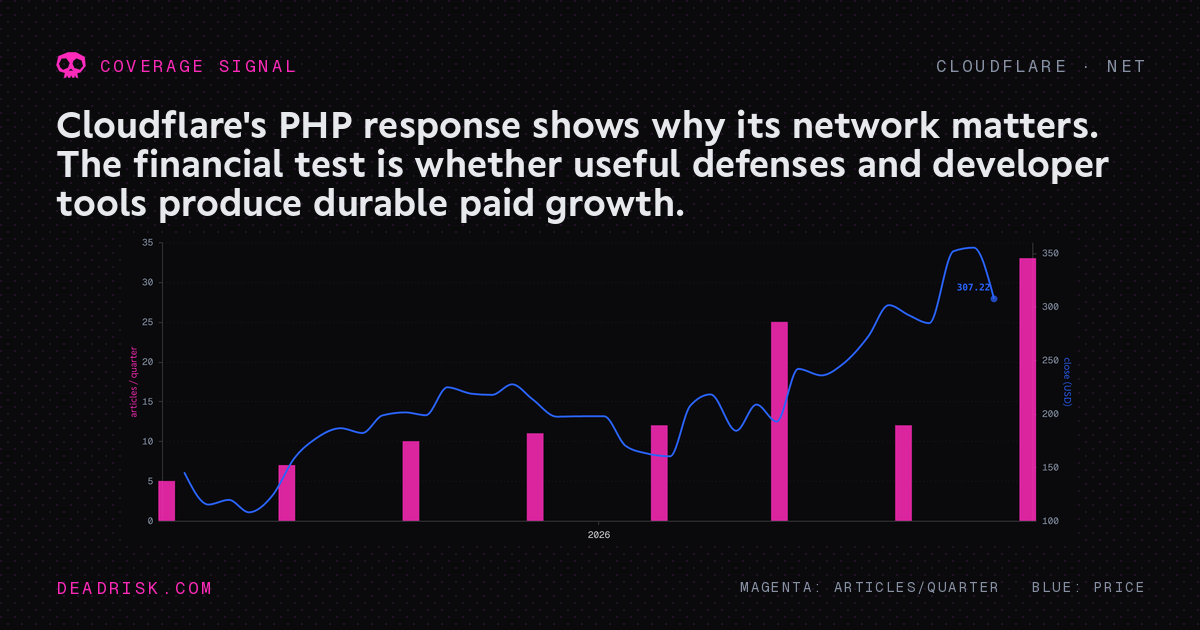
The tape · quarterly coverage amplitude · live quarter blinking
Cloudflare sits between the public internet and the applications that use it. That position gives it a direct role in the cyber resilience story and a separate role in the inference layer. The useful question is how those roles reinforce each other. The company can help customers inspect traffic and run software. It still has to turn that work into paid revenue at a cost that leaves a return.
The October PHP emergency provides a dated test of capability. Cloudflare says it deployed WAF protections for customers on free and paid plans before public disclosure. The product response matters: a company already handling web traffic can deploy a rule without waiting for every application owner to complete a server upgrade. The payment question is separate. Protection on a free plan does not establish incremental revenue, and the announcement does not quantify paid conversions from the incident.
The PHP project’s own advisory describes flaws that can allow unauthenticated code execution on affected servers. This explains why ordinary application login checks may not stop the attack. It does not establish that every authentication system failed, every database suffered a breach, or all users faced a common 20-minute interval. Those broader claims would require evidence beyond the advisory.

The October 22 TEXXR query returned 434 Cloudflare edges across 234 distinct first-seen dates, against 291 total CoreWeave edges, including one undated, across 103 distinct first-seen dates, using the same endpoint and a 500-edge limit. Neither result reached the cap. Cloudflare has a broad record in this sample, but its extracted edge count is not a count of product releases or independent reports. The distinction matters most when coverage moves quickly.
The PHP response appears in two adjacent records, dated October 21 and October 22, that share the same original post. The cached record also contains two entries for the Clairic extraction-model announcement. A raw count would give each pair more weight than one event deserves. Our starting point is a set of dated developments with their repeated pickups kept together.
Those developments describe a wider business than a security-only screen captures. The record links web protection with developer software, extraction tools and the control of automated traffic. That breadth can create more ways to serve a customer. It also makes it harder to infer which product drives total growth. A release cadence can prove engineering activity while leaving the revenue contribution of each release unknown.
The financial evidence comes from a different window. Cloudflare’s August 6 results report second-quarter revenue growth of 36% and current remaining performance obligation growth of 35%. The latter concerns contracted business expected to turn into revenue within a year. Its close growth rate supports the demand picture, but it is not revenue already earned, cash already collected, or a guarantee that a later security event will improve the outlook.
The same release reports a GAAP operating loss of 29.6% of revenue and free cash flow equal to 8% of revenue. Those figures put limits around the growth story. Cash generation and accounting profit answer different questions. A company can collect cash before recognizing all associated costs or revenue. It can also exclude costs from its preferred earnings measure. The task is to follow the reconciliation, rather than select whichever figure supports the strongest narrative.

The spectrogram
Signal decomposition · what the record is made of, by quarter · brightness = share of edges · drift = how far the story moved in meaning
In 2024Q1 the record was 38% financial; by 2026Q1 it is 46% financial. A price chart shows what a name did; the spectrogram shows what its story is made of.
The brains
Panel not seated
Fewer than the full panel of lenses have read this name. The gauge shows n/3 until it fills.
The machine
The PHP example makes the product mechanism unusually clear. Cloudflare’s technical account describes combining request and response signals within a transaction. The value lies in using both sides of the exchange to help distinguish an exploit from legitimate traffic. This is evidence of an implemented defense, with the vendor as the source. It is not an independent measurement of detection accuracy or a claim that every possible exploit path has closed.
The network position creates a plausible advantage: the company can apply new controls where customer traffic already flows. Helmer’s framework asks what keeps that advantage from competitors and who retains its value. Scale can improve deployment economics. A common platform can reduce integration work. Yet free distribution can pass the immediate benefit to users, and competitors may offer similar controls. A technical advantage needs a commercial test.
That test should allow the developer business and security business to interact without pretending they are the same. More application activity can create a need for protection. More security customers can provide an opening for other services. Each claim remains a hypothesis until paid adoption, expansion or retention gives it support. The current release does not disclose how much of the quarter’s revenue came from PHP protection, nor could a June quarter measure an October event.
Compare Tenable, which helps identify exposure, and Rubrik, which addresses recovery. Cloudflare’s role in this incident concerns traffic that passes through its controls. Finding a vulnerable server, blocking a known attempt and restoring a damaged system are distinct jobs. A complete security budget may fund all three, but one vendor’s technical response does not prove another vendor’s sales.
The money

Currency: USD. Revenue/net income/capex/FCF cross-checked against filed XBRL.

The record
- In the next report, compare revenue and current contracted-revenue growth. The June quarter’s 36% and 35% rates provide a dated starting point. Track their definitions as well as their direction.
- Look for paid adoption after new releases. Free protection demonstrates distribution. New paying customers, expansion and product-level revenue would supply stronger commercial evidence.
- Track the cost of serving growth. The June quarter’s 8% free-cash-flow margin and GAAP loss require attention alongside revenue. Read restructuring and stock compensation separately when reconciling results.
- Match cash and convertible debt dates. The June 30 filing describes $1.294 billion of notes due August 15 and an election to pay principal in cash, with shares for the excess conversion value. Removing that debt while keeping all June cash would overstate net cash. Exact post-settlement shares need later disclosure; the old balance sheet does not establish them.
- Follow the PHP response through updated rules and vendor patches. Cloudflare describes its controls as protection alongside updating PHP. A traffic filter and a fixed runtime serve different purposes.
- Keep repeated articles attached to one event. The two PHP records and two Clairic records already show why edge volume alone cannot measure product velocity.
| Quarter | Articles | QoQ | Q-end price | QoQ | The record reads |
|---|---|---|---|---|---|
| 2025Q1 | 5 | — | 112.69 USD | — | first quarter on record |
| 2025Q2 | 7 | +40% | 195.83 USD | +73.8% | attention and price rose together |
| 2025Q3 | 10 | +43% | 214.59 USD | +9.6% | attention and price rose together |
| 2025Q4 | 11 | +10% | 197.15 USD | -8.1% | attention rose as price fell |
| 2026Q1 | 12 | +9% | 206.34 USD | +4.7% | attention and price rose together |
| 2026Q2 | 25 | +108% | 245.28 USD | +18.9% | attention and price rose together |
| 2026Q3 | 12 | -52% | 347.28 USD | +41.6% | attention cooled as price rose |
| 2026Q4 open | 33 | +175% | 307.22 USD | -11.5% | attention rose as price fell (quarter in progress) |
Sources
- Cloudflare, PHP vulnerability protections, October 21, 2026; first TEXXR record and second record. One original post, two indexed entries.
- PHP project, critical security advisory, October 21, 2026. Primary source for the scope of the runtime flaws.
- Cloudflare, Q2 2026 financial results, August 6, 2026. Primary source for results and NYSE listing.
- Cloudflare, June 30 Form 10-Q, filed August 6, 2026. Primary source for the August note maturity and settlement election.
- Cloudflare, Clairic extraction model; TEXXR October 19 record and October 20 record. Used to audit repeated coverage, not to claim general availability or paid adoption.
- TEXXR entity/profile and hyperedge queries, October 22, 2026: Cloudflare 314 indexed articles, 434 edges, 234 distinct first-seen dates; CoreWeave 132 articles, 291 total edges including one undated, 103 distinct first-seen dates. Same endpoint and 500-edge limit; neither capped. Counts include repeated extraction and are not unique-report totals.
- Hamilton Helmer, 7 Powers.