The argument
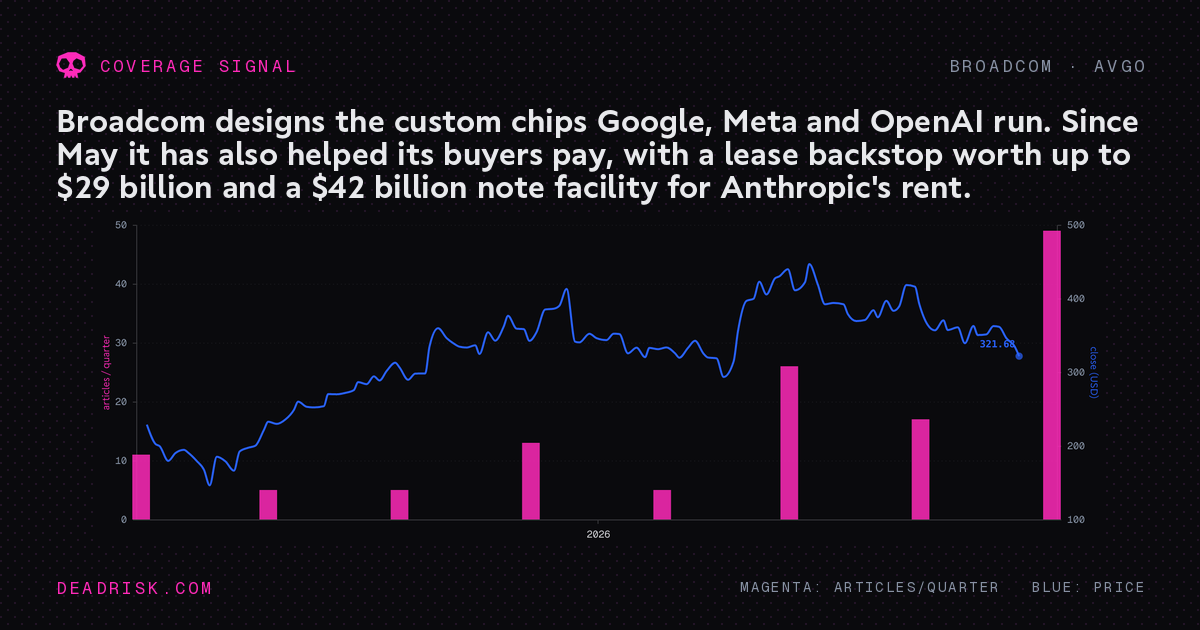
The tape · quarterly coverage amplitude · live quarter blinking
Broadcom now helps pay for the chips it sells. Its 10-Q for the quarter ended 2 August 2026, filed 10 September, describes the “AI XPV platform”. Financial partners buy racks built on Broadcom’s custom accelerators and lease them to “the leading frontier AI labs”. The plan covers more than 20 gigawatts through 2028. In Broadcom’s words, it “bridges the gap between the current cash flows of the leading frontier AI labs and significant upfront investments required for their businesses.”
The first tranche, in June, was $35 billion led by one financial partner, for more than a gigawatt for one customer. Broadcom backstops that customer’s lease payments for five years. If the customer defaults, Broadcom owes the gap between 85% of what is owed and what the racks fetch when sold. Its maximum exposure, once every rack is deployed, is about $29 billion undiscounted. The same customer may also issue Broadcom up to $42 billion of convertible notes, to be spent only on the lease.
The 10-Q names neither the customer nor the partner. Anthropic’s S-1 names Broadcom, though not the partner, and its terms match. It shows five-year equipment leases with Broadcom, with rent of about $161.2 billion excluding interest. The 2026 lease is about $125.2 billion of that, the figure Reuters reported on 2 October. It also shows a $42 billion note facility with nothing drawn. Notes would pay 9% a year in kind and convert into Anthropic stock at 90% of the trailing 30-day average price. Notes issued while a revenue condition is unmet would pay 13% and convert at 85%. Anthropic says Broadcom “simultaneously serves as a supplier and lessor”, and that Broadcom assigned part of one lease to a third party in the second quarter. See the ANT dossier for the other side of the contract.
DeadRisk refused Broadcom on 31 July. It was the closest miss in Situational Awareness LP’s book: the fund’s 13F for the quarter ended 31 March 2026, filed 18 May, listed puts on 3,251,100 Broadcom shares, valued at $1.01 billion. That is the value of the shares the puts referenced, not a premium or capital at risk. Its filing for the quarter ended 30 June, filed 14 August, lists no Broadcom line, and a 13F cannot say why. The record then held custom-silicon supply, a story the Nvidia and Marvell pages already tell. The financing is a different argument, and it is why the name is here now.

The year began as a chip story. On 4 March Broadcom reported fiscal first-quarter revenue of $19.31 billion, up 29%, with AI revenue up 106% to $8.4 billion, and authorised $10 billion of buybacks. In April a filing showed it would make future Google TPUs and give Anthropic about 3.5 gigawatts of capacity.
Money entered the record in May. The Information’s sources said Broadcom and OpenAI were discussing Broadcom financing about $18 billion of initial chip production, if Microsoft bought about 40% of the chips. A day later Bloomberg’s sources had Apollo and Blackstone in talks with Broadcom over about $35 billion. By early June, Bloomberg’s sources said, the package was done: $35 billion to buy TPUs for Anthropic to lease, with Broadcom backstopping the largest senior portions. Bloomberg’s sources said the Broadcom-backed slice might yield about 5.75%, against 8% to 9% for the riskier slice. On that reading, lenders charged less for the part Broadcom stood behind.
The same week, fiscal second-quarter revenue of $22.19 billion missed the estimate and AI guidance came in light. The stock fell, and the chip sector with it.
The financing grew through the summer. In August the FT’s sources described a $200 billion programme Google had assembled for Anthropic, more than $150 billion of it tied to TPUs, with Broadcom, Blackstone and Apollo involved. Bloomberg’s sources had Broadcom raising more than $60 billion of debt for chip financing, and in October a $60 billion syndicate forming. The fiscal third quarter, reported 2 September, brought revenue of $29.59 billion, up 86%, and AI chip revenue of $16.7 billion, up 221%. On 7 October the WSJ’s sources said Broadcom was arranging more than $50 billion for OpenAI’s chip.
Then, on 12 October in Singapore, Hock Tan likened many AI investors to casino gamblers. Bloomberg reported that he also questioned the long-term economics of AI labs. With Intel’s Lip-Bu Tan he warned that access to capital could become AI’s main bottleneck. The FT reported a chip sell-off that followed, led by the memory makers. A month earlier Broadcom’s 10-Q had called its guarantees unlikely to be paid, “supported by the strong profitability trajectory of the leading frontier AI labs”. The record holds both.

The spectrogram
Signal decomposition · what the record is made of, by quarter · brightness = share of edges · drift = how far the story moved in meaning
In 2024Q1 the record was 33% financial; by 2026Q1 it is 33% launch. A price chart shows what a name did; the spectrogram shows what its story is made of.
The brains
Panel not seated
Fewer than the full panel of lenses have read this name. The gauge shows n/3 until it fills.
The machine
For a decade the record was a deals story. Of TEXXR’s 323 Broadcom edges, 67 are acquisitions, about half from 2017 to 2019 and most of the rest the long VMware purchase. Its most-linked names are Qualcomm, Apple and VMware. In 2026 the record holds 80 edges: 51 financial, 25 partnership, and no acquisitions.
The partnerships are the custom chip business: Google’s TPUs; Meta’s MTIA, for which Meta paid Broadcom $2.3 billion in 2025; OpenAI’s Jalapeño; and Apple, which signed a $30 billion-plus US manufacturing deal in July. Upstream, Samsung announced a $200 billion-plus contract to make Broadcom chips through 2030.
The financial edges are where the shape changed. Before May they were results, buybacks and share moves. Since May they include lenders: Apollo and Blackstone, a backstop, a note, and in September an FT account of residual value guarantees that let Nvidia and Broadcom support customer purchases. On 26 October the FT reported that Meta’s planned $35 billion equity raise has Nvidia, AMD and Broadcom as cornerstone investors. Broadcom now sells to, lends to, guarantees and invests in the same few buyers. That is the loop the capital sink and the credit wall track.
The 10-Q shows how few buyers that is. One distributor took 50% of net revenue in the quarter, against 32% a year earlier. The top five end customers took about 55%, against about 40%. Remaining performance obligations, firm orders not yet booked, rose from $45.0 billion on 1 February to $164.6 billion on 3 May and $179.2 billion on 2 August. The filing says that includes a long-term custom accelerator contract signed in the quarter to 3 May, and about a quarter of the total should become revenue within a year. It does not name the buyer. Anthropic’s S-1 dates its Broadcom lease 31 March, inside that quarter.
The money

Currency: USD. Revenue/net income/capex/FCF cross-checked against filed XBRL.

Positioning: how much of AVGO is sold short, on the record brokers file twice a month. It lags by design — read it as where the crowd stood, not where it stands.
The record
Signals in the filings and the coverage record, not trade ideas:
- The backstop figure in the annual report. The $29 billion maximum applies once every rack is deployed; the live amount grows with each delivery and shrinks as rent is paid. The 10-K should say how far deployment has got, and whether a second XPV tranche carries its own guarantee.
- The first draw on the $42 billion note. Anthropic does not expect to issue notes before its listing; it can draw for five years once the equipment is in service. A draw means Anthropic chose to pay rent in paper. A note at the 13% rate means a revenue condition was unmet when it was issued.
- Assignment. The S-1 says Broadcom has already assigned part of one lease, and may assign the note facility to a financial partner. Each assignment moves risk off Broadcom; a backstop keeps some of it on.
- Whether OpenAI’s financing closes, and on whose credit. The WSJ’s $50 billion-plus figure is a source report. A filing that shows a second backstop would make OpenAI the second lab Broadcom backstops.
- Concentration. Half of revenue through one distributor, and over half from five end customers, is the figure to track each quarter. The 10-Q warns that backstops could affect Broadcom’s credit ratings.
- What Hock Tan says next about AI labs. His October remarks and his company’s September filing point different ways. The fiscal fourth-quarter call is the next place he can square them.
| Quarter | Articles | QoQ | Q-end price | QoQ | The record reads |
|---|---|---|---|---|---|
| 2025Q1 | 11 | — | 167.43 USD | — | first quarter on record |
| 2025Q2 | 5 | -55% | 275.65 USD | +64.6% | attention cooled as price rose |
| 2025Q3 | 5 | +0% | 329.91 USD | +19.7% | price rose, attention steady |
| 2025Q4 | 13 | +160% | 346.10 USD | +4.9% | attention and price rose together |
| 2026Q1 | 5 | -62% | 309.51 USD | -10.6% | attention and price fell together |
| 2026Q2 | 26 | +420% | 377.75 USD | +22.0% | attention and price rose together |
| 2026Q3 | 17 | -35% | 351.19 USD | -7.0% | attention and price fell together |
| 2026Q4 open | 49 | +188% | 321.68 USD | -8.4% | attention rose as price fell (quarter in progress) |
The peers
Broadcom lives or dies by the same constraint as these names — small equal-weighted groups, one constraint each. Not investment products: see all categories.
Sources
Disclosure: this page was drafted with Claude, a model made by Anthropic, which is Broadcom’s customer and potential borrower and is named in this page.